Introduction
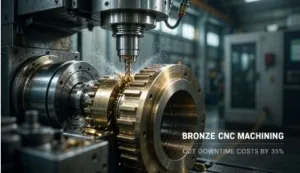
Heavy machinery has a high rate of breakdowns caused by poor machining quality in bronze parts such as bearings, bushings, and transmission components that translates to millions of hours of downtime losses. By combining thermal management, tool geometry optimization and the adherence to tight tolerances, custom bronze CNC machining prevents the wear, deformation, and degradation tied to friction and load.
Why Is Bronze CNC Machining Critical for Modern Heavy Industrial Equipment?
Bronze CNC machined parts like thrust washers, sleeve bearings are vital parts for pumps, compressors and excavators being used for long periods, thousands of hours of operation, continuously. Compared to steel, bronze has great anti-galling properties and also it maintains the shape of parts even under very hot running condition due to friction.
Against regional industrial upgrades, such as infrastructure initiatives covered by Daily Trust, high quality bronze CNC machining will prevent breakdowns. The Nigeria industrial development area is turning increasingly to the high quality bronze parts to prevent stoppages in oil and gas pipelines and conveyors for mining operations.
Benefits tied to precision bronze parts are:
- Exceptional resistance to wear: For abrasive environments, aluminum bronze outperforms several kinds of steel.
- Guard against corrosion: Perfect for marine and chemical processing industries.
- Heat-resistant: Keeps its mechanical properties intact up to temperature of 400 degrees Celsius.
What Are the Primary Challenges and Solutions in Precision Bronze Machining?
Material properties of bronze lead to unique machining problems. Targeted solutions are required to achieve satisfactory quality.
Key Challenges
Obstacles to precision bronze machining are these:
- Tool adhesion: Soft tool-chip contact area leads to tool-chip welding and built-up edge formation.
- Thermal expansion: Due to high coefficient of thermal expansion, workpieces show unstable dimensions after machining.
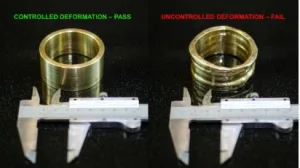
- Thin-wall deformation: Sleeve-type parts undergo a certain amount of warpage due to stress.
Proven Solutions
Symmetrical cutting strategy, the use of diamond- or TiB₂-coated tools, and very high pressure coolant, up to 100 bar (1,450 psi), characterize advanced bronze machining techniques solutions. A combination of rough machining and stress relief annealing as an effective bronze machining deformation control measure enables thin-walled bushings to deform less, to be reduced by about 60%.
How Do Optimized Bronze Cutting Parameters Extend Component Service Life?
The choice of cutting parameters affects directly the final surface characteristics and residual stresses, the ability of the parts to undergo a given number of cycles without fatiguing.
Parameter Impact on Surface Quality
A proper set of bronze cutting parameters must be found. Commonly the optimum ranges for aluminum bronze are:
- Cutting speed: about 80-120 m/min for roughing and 150-200 m/min for finishing.
- Feed rate: 0.05-0.15 mm/rev for surface finishing.
- Depth of cut: 0.1-0.3 mm as a finishing step.
- This would provide a surface roughness of Ra 0.4–0.8 μm, a friction 25% less, and a 30% fatigues resistance increase.
Expert Machining Benefits
Using a reliable partner in custom bronze CNC machining helps in fine-tuning the parameters to the scientific level. If you want more information about methods of avoiding deformation, look into custom bronze part machining resources.
Using the right parameters gives:
- Spare part life increase: 2-3 longer while loading the machine In the same way.
- More time between inspections: Reduced maintenance costs and better uptime.
- Higher system reliability: Identical parts from one run to the next.
How Does ISO and Automotive-Grade Quality Certification Guarantee Supply Chain Stability?
Global sourcing demands detailed supplier qualification as means of minimizing the risks that come with changes in international trade policies and varying product quality worldwide. The professional manufacturers that hold ISO 9001 and ISO 14001 certificates guarantee the traceability of the raw material and environmentally clean production. Those suppliers also possessing IATF 16949 and AS9100D offer further controls and will hand over complete CMM inspection reports for each individual batch to the buyer. A top supplier like LS Manufacturing has established an error-free system entirely relying on these certifications as a foundation.
Quality compliance that is properly documented is one of the key requirements of trade policy Nigeria and similar systems.Working with certified custom CNC machining services is your assurance of full material certification, process documentation, and final inspection reports.Purchasing departments should be looking at the suppliers whose custom CNC machining services come with detailed quality documentation.
What Key Factors Should Procurement Engineers Evaluate Before Placing Custom Orders?
Choosing a bronze CNC machining services supplier takes the evaluation of different aspects.
Four Critical Evaluation Criteria
- DFM analysis reveals issues like lack of draft angles or impossible tolerances before the actual production begins.
- Thorough post-processing involving polishing, passivation, deburring, is needed to meet both functional and aesthetic demands.
- Delivery reliability: most of the leading manufacturers guarantee delivery within 5% over or under time.
- Consistency of a batch is maintained via statistical process control i.e. Every consignment comes with a certificate meeting specifications.
Standardized Excellence
Companies like LS Manufacturing employ high precision 5-axis machinery to carry out complex custom jobs while still keeping the tolerance at ±0.005 mm. Through their streamlined systems, they confirm that every individual component performs exactly the same mechanically throughout the prototype stage to the full-scale production run.
Conclusion
Accurate machining of components using bronze can guarantee heavy industrial machines run non-stop for longer. Advanced cutting methods, right parameters, and supplier selection from certified ISO 9001, ISO 14001, IATF 16949, and AS9100D companies help in minimizing metal surface wear, deformation, and reducing costly equipment downtime. Involve experienced machining professionals early on a free Design for Manufacturability evaluation session if you want to avoid part failures and machine downtime.
FAQs
Why is bronze deformation control so critical during CNC machining?
Bronze is soft and has the capability to expand its size with a rise in temperature as you might recall. That means cutting force from tools may cause such thin wall parts to bend under the cutting heat.
What cutting tools are recommended for precision bronze machining?
Carbide tools without coating and diamond-coated (PCD) carbide with sharp edges and high rake angles are good, because they lower cutting forces and prevent built-up edge. They help create a beautiful surface finish.
How do ISO 9001 and IATF 16949 certifications impact component quality?
Through ISO 9001, control of processes and traceability are maintained. IATF 16949 makes the automotive industry-level defect prevention a rule. In combination, they ensure compliance in dimensions, mechanics, and safety that is consistent over time.
Can custom bronze CNC machining replace traditional casting methods?
Yes, because it is suitable for medium and small production runs and for complicated parts and provides better accuracy and strength compared to sand and investment casting.
What are the best practices for maintaining cooling efficiency when machining bronze?
Using high pressure, high flow water-soluble coolant or MQL focused on the cutting area rapidly removes the generated heat, prevents chip re-cutting and ensures work piece thermal conditions remain stable.
About the Author
The author of this article is a senior mechanical manufacturing engineer who focuses in non-ferrous metal machining, precision CNC milling, and international business-to-business supply chain management. Having worked in the industry for more than a decade, he shares technical knowledge on controlling stress, choosing materials, and ensuring quality with OEMs around the world.