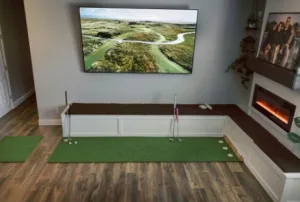
An indoor golf setup can have an excellent screen, quality hitting mat, and sophisticated launch monitor and still be somewhere you rarely want to play. The problem is often not the golf equipment itself. It is the room around it.
Garages become uncomfortably cold in winter and hot in summer. Basements can feel enclosed. Spare rooms may technically accommodate a simulator but leave little freedom around the hitting area.
Before replacing expensive equipment, look at the practical issues affecting comfort and movement. A few targeted changes can make an indoor golf room considerably more enjoyable.
Make Sure Your Technology Matches the Available Space
A launch monitor needs to work with the room you actually have, not the room you wish you had.
This becomes particularly important in tighter simulator spaces because different tracking technologies have different placement requirements. Understanding the differences discussed by Indoor Golf Outlet can help explain why camera-based systems are often particularly well suited to indoor environments, while radar technology generally benefits from having more ball flight available.
Before rearranging the entire room, check the requirements of your particular equipment. Measure the distance behind the hitting position, the space between the ball and screen, and the clearance available around the golfer.
The right technology can reduce the amount of space sacrificed purely to measurement and leave more of the room available for actually swinging comfortably.
Fix the Temperature Before Adding More Equipment
Garages and converted outbuildings are popular simulator locations because they provide useful open space, but comfort can become the compromise.
If the room is unpleasantly cold in January or unbearably warm in July, even an impressive simulator may spend months unused.
Start by looking at insulation and obvious sources of heat loss or gain. Garage doors, windows, exterior walls, and poorly sealed openings can all influence how quickly the room changes temperature.
Temperature control itself is worth considering as part of the wider setup. Comparing an Ecobee vs Nest smart home thermostat can help homeowners think through differences in scheduling, automation, smart-home integration, and climate control when deciding how they want to manage comfortable spaces around the home.
The goal is to walk into the golf room ready to play rather than spend the first part of the evening waiting for the space to become comfortable.
Protect the Swing Area From Clutter
A room can meet the minimum dimensions for a golf simulator and still feel cramped.
The difference often comes down to what else occupies the space.
Golf bags, spare clubs, boxes, chairs, cables, tools, and other household items gradually migrate toward walls and corners. Individually they may seem harmless, but together they can make a golfer unconsciously shorten or alter a swing.
Keep the area immediately around the hitting position as clear as possible.
Wall-mounted club storage can free floor space, while cabinets or shelving can contain accessories that do not need to remain beside the mat. Projector cables and power cords should also have permanent routes rather than crossing areas where people walk.
A cleaner room feels larger even when its actual dimensions have not changed.
Check Ceiling Clearance From the Golfer’s Perspective
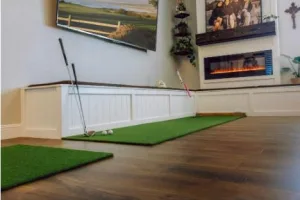
Room dimensions on paper do not tell the entire story.
A ceiling may seem high enough until a taller player swings a driver beneath a light fixture, garage-door track, ceiling fan, projector, or overhead storage rack.
Stand in the actual hitting position with the longest club you expect to use and make several slow, controlled practice swings. Check clearance throughout the complete movement rather than looking only at ceiling height.
Remember that guests may be taller than the person who normally uses the simulator.
The hitting position itself may also be adjustable. Moving the mat slightly can sometimes avoid an overhead obstruction and create a much more comfortable swing zone without requiring structural changes.
Confidence matters here. Players who are worried about hitting something above or behind them are unlikely to make natural swings.
Improve Air Movement Without Creating Distractions
Temperature is only one part of comfort.
Indoor golf can become surprisingly physical during a long session, particularly when several people are playing. A closed garage or basement can quickly start to feel stuffy even when the thermostat shows a reasonable temperature.
Improving air circulation can make the room feel much better.
The challenge is positioning fans or other equipment so they do not interfere with play, screens, projectors, or loose items around the hitting area. Airflow should improve the room quietly rather than becoming another distraction.
If the simulator shares space with a garage, workshop, or utility area, ventilation deserves even more attention. Keeping the golf area clean and comfortable will make it feel like a recreational room rather than somewhere equipment happens to have been installed.
Give Spectators Somewhere to Sit
A simulator becomes much more entertaining when other people can comfortably join the session.
Unfortunately, seating is often treated as an afterthought. Chairs end up pushed into whatever space remains, sometimes directly behind the golfer or along a route people repeatedly use.
Create a dedicated viewing area instead.
A compact sofa, bench, bar stools, or a couple of comfortable chairs may be enough. Position them outside the swing zone while still giving everyone a clear view of the screen.
If space is limited, furniture that can be moved or folded away offers more flexibility. A narrow counter along a wall can also provide somewhere for drinks, phones, and scorecards without requiring a large table.
The room should accommodate the people waiting to hit without making the golfer at the mat feel surrounded.
Treat the Room as a Place You Want to Spend Time
Once the practical problems are solved, small improvements can make the simulator feel less like equipment installed in a spare room.
Good lighting is an obvious place to start. You need enough illumination around the hitting area while avoiding unnecessary glare on the screen. Separate lighting for the seating area can help create a more comfortable atmosphere during longer sessions.
Sound matters too. Speakers can make casual rounds more enjoyable, while basic acoustic treatments may help in rooms where every impact creates an unpleasant echo.
Then add a little personality. Golf memorabilia, framed course photography, organized club displays, or a simple drinks area can make the room feel finished without consuming valuable swing space.
The best indoor golf room is not necessarily the biggest or the one containing the most expensive technology. It is the one where the equipment suits the available dimensions, the temperature is comfortable, the swing feels unrestricted, and you genuinely want to stay for another round.