Earnings results often indicate what direction a company will take in the months ahead. With Q2 behind us, let’s have a look at U.S. Physical Therapy (NYSE: USPH) and its peers.
The outpatient and specialty care industry delivers targeted medical services in non-hospital settings that are often cost-effective compared to inpatient alternatives. This means that they are more desired as rising healthcare costs and ways to combat them become more and more top-of-mind. Outpatient and specialty care providers boast revenue streams that are stable due to the recurring nature of treatment for chronic conditions and long-term patient relationships. However, their reliance on government reimbursement programs like Medicare means stroke-of-the-pen risk. Additionally, scaling a network of facilities can be capital-intensive with uneven return profiles amid competition from integrated healthcare systems. Looking ahead, the industry is positioned to grow as demand for outpatient services expands, driven by aging populations, a rising prevalence of chronic diseases, and a shift toward value-based care models. Tailwinds include advancements in medical technology that support more complex procedures in outpatient settings and the increasing focus on preventive care, which can be aided by data and AI. However, headwinds such as reimbursement rate cuts, labor shortages, and the financial strain of digitization may temper growth.
The 6 outpatient & specialty care stocks we track reported a strong Q2. As a group, revenues beat analysts’ consensus estimates by 2.6% while next quarter’s revenue guidance was 3.3% above.
While some outpatient & specialty care stocks have fared somewhat better than others, they have collectively declined. On average, share prices are down 1.6% since the latest earnings results.
U.S. Physical Therapy (NYSE: USPH)
With a nationwide footprint spanning 671 clinics across 42 states, U.S. Physical Therapy (NYSE: USPH) operates a network of outpatient physical therapy clinics and provides industrial injury prevention services to employers across the United States.
U.S. Physical Therapy reported revenues of $214.1 million, up 8.5% year on year. This print exceeded analysts’ expectations by 1.9%. Despite the top-line beat, it was still a slower quarter for the company with a significant miss of analysts’ EPS estimates.
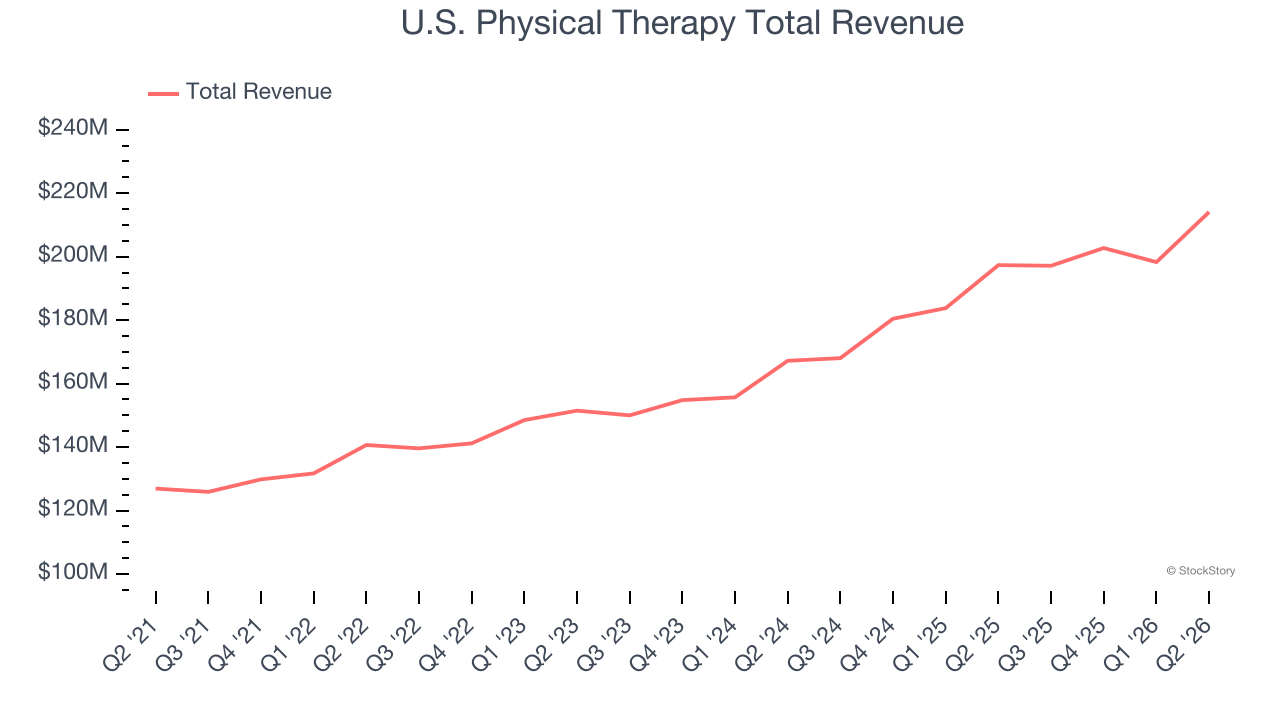
Interestingly, the stock is up 2.3% since reporting and currently trades at $78.19.
Read our full report on U.S. Physical Therapy here, it’s free.
Best Q2: LifeStance Health Group (NASDAQ: LFST)
With over 6,600 licensed mental health professionals treating more than 880,000 patients annually, LifeStance Health (NASDAQ: LFST) provides outpatient mental health services through a network of clinicians offering psychiatric evaluations, psychological testing, and therapy across 33 states.
LifeStance Health Group reported revenues of $435.4 million, up 26.1% year on year, outperforming analysts’ expectations by 5%. The business had a stunning quarter with a beat of analysts’ EPS estimates and EBITDA guidance for next quarter exceeding analysts’ expectations.
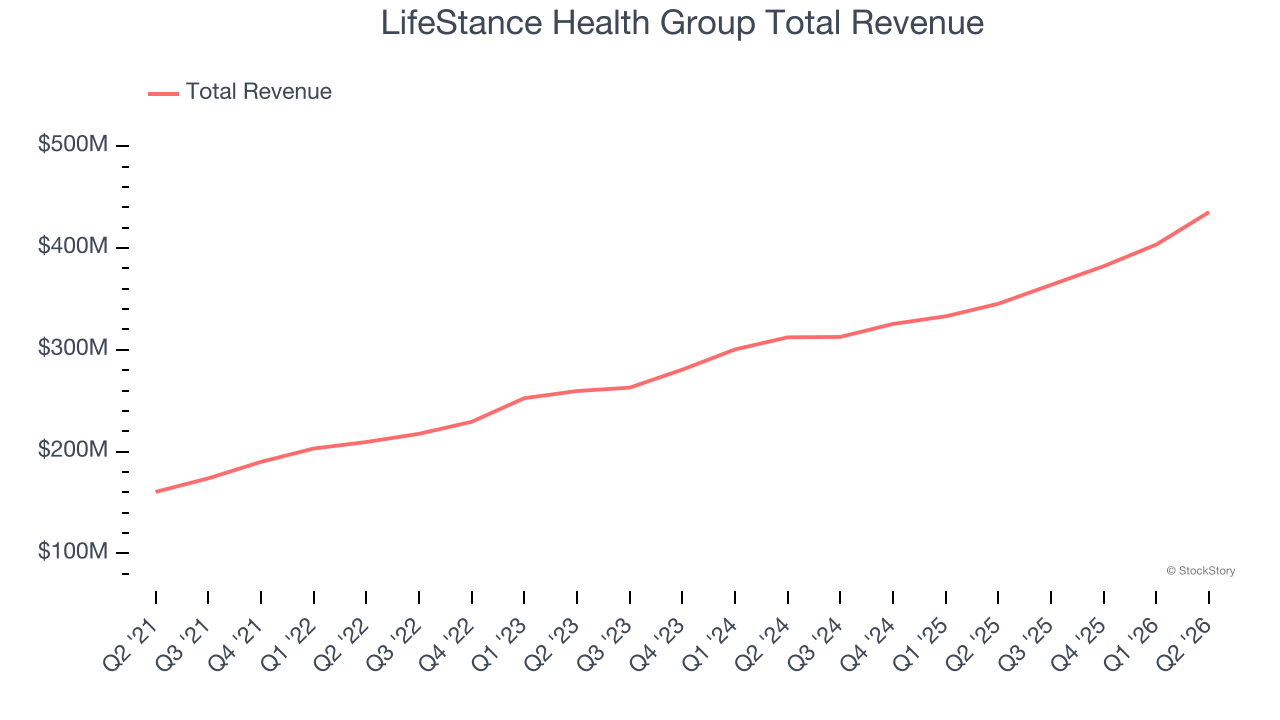
LifeStance Health Group scored the biggest analyst estimate beat, fastest revenue growth, and highest full-year guidance raise in the group. The market seems happy with the results as the stock is up 20.5% since reporting. It currently trades at $12.49.
Is now the time to buy LifeStance Health Group? Access our full analysis of the earnings results here, it’s free.
DaVita (NYSE: DVA)
With over 2,600 dialysis centers across the United States and a presence in 13 countries, DaVita (NYSE: DVA) operates a network of dialysis centers providing treatment and care for patients with chronic kidney disease and end-stage kidney disease.
DaVita reported revenues of $3.55 billion, up 5.2% year on year, exceeding analysts’ expectations by 1.7%. Still, it was a mixed quarter as it posted a miss of analysts’ full-year EPS guidance estimates.
DaVita delivered the weakest performance against analyst estimates among its peers. As expected, the stock is down 22.5% since the results and currently trades at $176.75.
Read our full analysis of DaVita’s results here.
Surgery Partners (NASDAQ: SGRY)
With more than 180 locations across 33 states serving as alternatives to traditional hospital settings, Surgery Partners (NASDAQ: SGRY) operates a national network of outpatient surgical facilities including ambulatory surgery centers and short-stay surgical hospitals.
Surgery Partners reported revenues of $848.9 million, up 2.7% year on year. This number beat analysts’ expectations by 2.2%. Overall, it was a strong quarter as it also put up a beat of analysts’ EPS estimates.
Surgery Partners had the slowest revenue growth and weakest full-year guidance update of the whole group. The stock is down 8.4% since reporting and currently trades at $14.23.
Read our full, actionable report on Surgery Partners here, it’s free.
agilon health (NYSE: AGL)
Transforming how doctors care for seniors by shifting financial incentives from volume to outcomes, agilon health (NYSE: AGL) provides a platform that helps primary care physicians transition to value-based care models for Medicare patients through long-term partnerships and global capitation arrangements.
agilon health reported revenues of $1.49 billion, up 7.2% year on year. This result surpassed analysts’ expectations by 2.8%. Overall, it was a stunning quarter as it also recorded EBITDA guidance for next quarter exceeding analysts’ expectations and a beat of analysts’ EPS estimates.
agilon health delivered the highest guidance raise in the group. The company added 123,000 customers to reach a total of 549,000. The stock is down 11.5% since reporting and currently trades at $95.43.
Read our full, actionable report on agilon health here, it’s free.
Market Update
Over the past year, investors have been forced to repeatedly answer the same question: what is the market’s biggest risk? The answer has changed several times, and each shift has reshaped market leadership.
Late in 2025 and early 2026, artificial intelligence became the market’s primary uncertainty. Investors questioned whether AI would erode software pricing power and weaken competitive moats as AI made it easier to replicate once-differentiated products.
By the spring, technology took a back seat to geopolitics. The U.S. conflict with Iran briefly became the market’s dominant narrative, raising concerns about oil prices, inflation, and global growth. But as energy markets remained orderly and fears of a prolonged supply disruption faded, investors quickly turned their focus back to fundamentals.
Want to invest in winners with rock-solid fundamentals? Check out our Top 6 Stocks and add them to your watchlist. These companies are poised for growth regardless of the political or macroeconomic climate.