
As the Q2 earnings season wraps, let’s dig into this quarter’s best and worst performers in the regional banks industry, including Byline Bancorp (NYSE: BY) and its peers.
Regional banks, financial institutions operating within specific geographic areas, serve as intermediaries between local depositors and borrowers. They benefit from rising interest rates that improve net interest margins (the difference between loan yields and deposit costs), digital transformation reducing operational expenses, and local economic growth driving loan demand. However, these banks face headwinds from fintech competition, deposit outflows to higher-yielding alternatives, credit deterioration (increasing loan defaults) during economic slowdowns, and regulatory compliance costs. Recent concerns about regional bank stability following high-profile failures and significant commercial real estate exposure present additional challenges.
The 95 regional banks stocks we track reported a mixed Q2. As a group, revenues were in line with analysts’ consensus estimates.
In light of this news, share prices of the companies have held steady. On average, they are relatively unchanged since the latest earnings results.
Byline Bancorp (NYSE: BY)
Ranking as the fifth most active Small Business Administration lender in the country, Byline Bancorp (NYSE: BY) is a Chicago-based bank that provides banking services to small and medium-sized businesses, commercial real estate developers, and consumers.
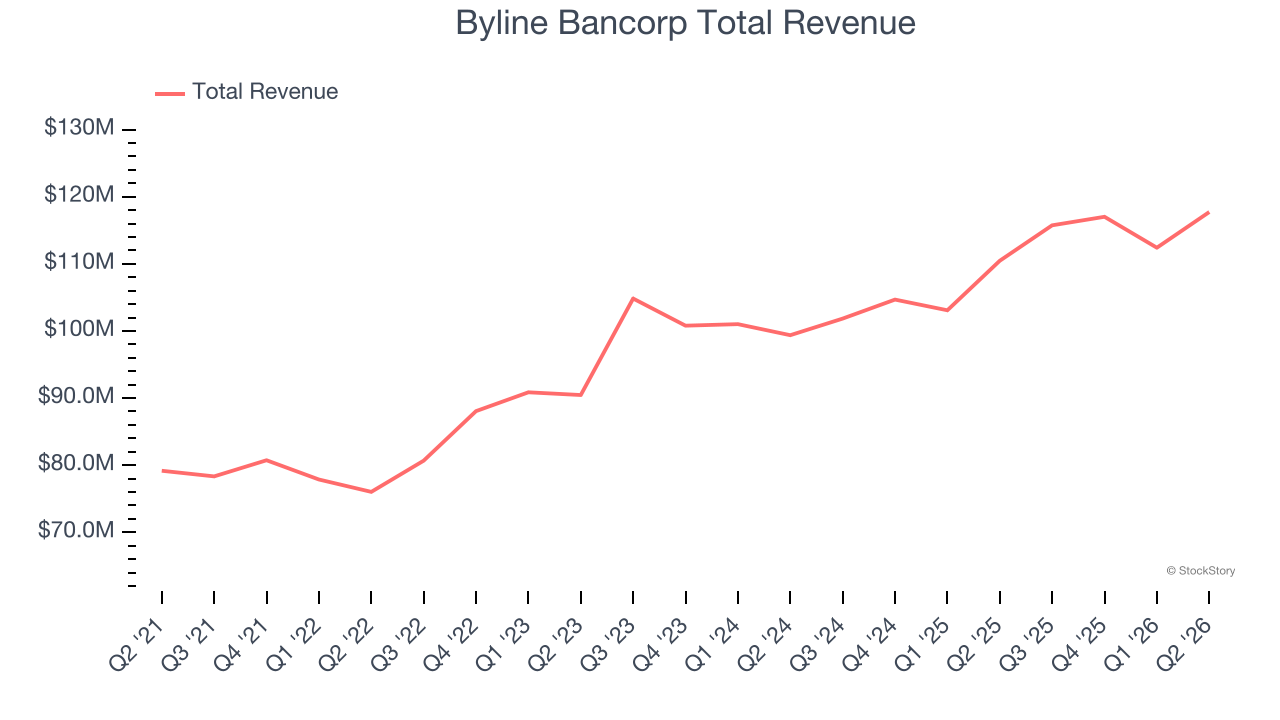
Byline Bancorp reported revenues of $117.7 million, up 6.6% year on year. This print exceeded analysts’ expectations by 1.8%. Overall, it was a strong quarter for the company with a beat of analysts’ EPS estimates and net interest income in line with analysts’ estimates.
Roberto R. Herencia, Executive Chairman and CEO of Byline Bancorp, commented, "Our second quarter results reflect the strength of our franchise and disciplined execution, highlighted by strong operating fundamentals resulting in our Board's decision to increase our dividend by 16.7%. We remain confident in our ability to continue to build on our market position as we pursue our objective of becoming the preeminent commercial bank in Chicago. I want to thank our employees, who are fundamental to our success and the long-term value we create for our stockholders. "
Interestingly, the stock is up 1.4% since reporting and currently trades at $38.15.
Is now the time to buy Byline Bancorp? Access our full analysis of the earnings results here, it’s free.
Best Q2: OFG Bancorp (NYSE: OFG)
Originally founded in 1964 as a federal savings and loan institution, OFG Bancorp (NYSE: OFG) provides banking and financial services including commercial and consumer lending, wealth management, insurance, and trust services primarily in Puerto Rico and the U.S. Virgin Islands.
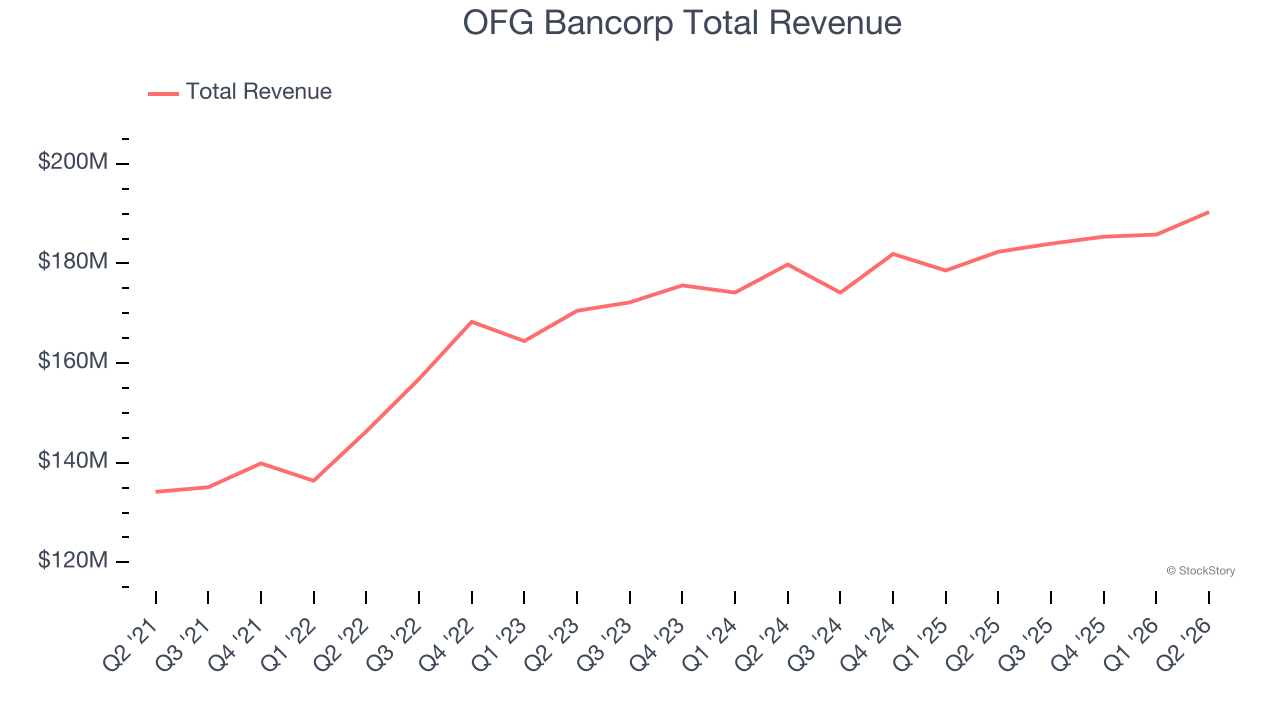
OFG Bancorp reported revenues of $190.3 million, up 4.4% year on year, outperforming analysts’ expectations by 3.9%. The business had an exceptional quarter with a beat of analysts’ EPS and net interest income estimates.
The market seems content with the results as the stock is up 3.2% since reporting. It currently trades at $51.62.
Is now the time to buy OFG Bancorp? Access our full analysis of the earnings results here, it’s free.
Weakest Q2: Banc of California (NYSE: BANC)
Originally established in 1941 and now operating with a tech-forward approach that includes its SmartStreet platform for homeowner associations, Banc of California (NYSE: BANC) is a California-based bank holding company that provides banking services to small and middle-market businesses, entrepreneurs, and individuals.
Banc of California reported revenues of $285.7 million, up 4.7% year on year, falling short of analysts’ expectations by 3.1%. It was a disappointing quarter as it posted a significant miss of analysts’ tangible book value per share and net interest income estimates.
As expected, the stock is down 10.4% since the results and currently trades at $18.98.
Read our full analysis of Banc of California’s results here.
Commerce Bancshares (NASDAQ: CBSH)
Founded in 1865 during the post-Civil War economic boom, Commerce Bancshares (NASDAQGS:CBSH) is a Midwest-focused bank holding company that provides retail, commercial, and wealth management services to individuals and businesses.
Commerce Bancshares reported revenues of $501.3 million, up 11.9% year on year. This result topped analysts’ expectations by 1.8%. Aside from that, it was a satisfactory quarter as it also recorded a narrow beat of analysts’ net interest income estimates but tangible book value per share in line with analysts’ estimates.
The stock is up 1.2% since reporting and currently trades at $58.87.
Read our full, actionable report on Commerce Bancshares here, it’s free.
WesBanco (NASDAQ: WSBC)
Tracing its roots back to 1870 in West Virginia, WesBanco (NASDAQ: WSBC) is a bank holding company that provides retail and commercial banking, trust services, insurance, and investment products through its subsidiaries across several Midwestern and Mid-Atlantic states.
WesBanco reported revenues of $275.4 million, up 5.7% year on year. This print surpassed analysts’ expectations by 2.7%. Zooming out, it was a satisfactory quarter as it also produced a beat of analysts’ EPS estimates but a slight miss of analysts’ net interest income estimates.
The stock is up 1.9% since reporting and currently trades at $41.17.
Read our full, actionable report on WesBanco here, it’s free.
Market Update
Over the past year, investors have been forced to repeatedly answer the same question: what is the market’s biggest risk? The answer has changed several times, and each shift has reshaped market leadership.
Late in 2025 and early 2026, artificial intelligence became the market’s primary uncertainty. Investors questioned whether AI would erode software pricing power and weaken competitive moats as AI made it easier to replicate once-differentiated products.
By the spring, technology took a back seat to geopolitics. The U.S. conflict with Iran briefly became the market’s dominant narrative, raising concerns about oil prices, inflation, and global growth. But as energy markets remained orderly and fears of a prolonged supply disruption faded, investors quickly turned their focus back to fundamentals.
Want to invest in winners with rock-solid fundamentals? Check out our 9 Best Market-Beating Stocks and add them to your watchlist. These companies are poised for growth regardless of the political or macroeconomic climate.