Growing demand for product authentication, track-and-trace capabilities, and tamper-evident packaging is reshaping the security labels market worldwide.
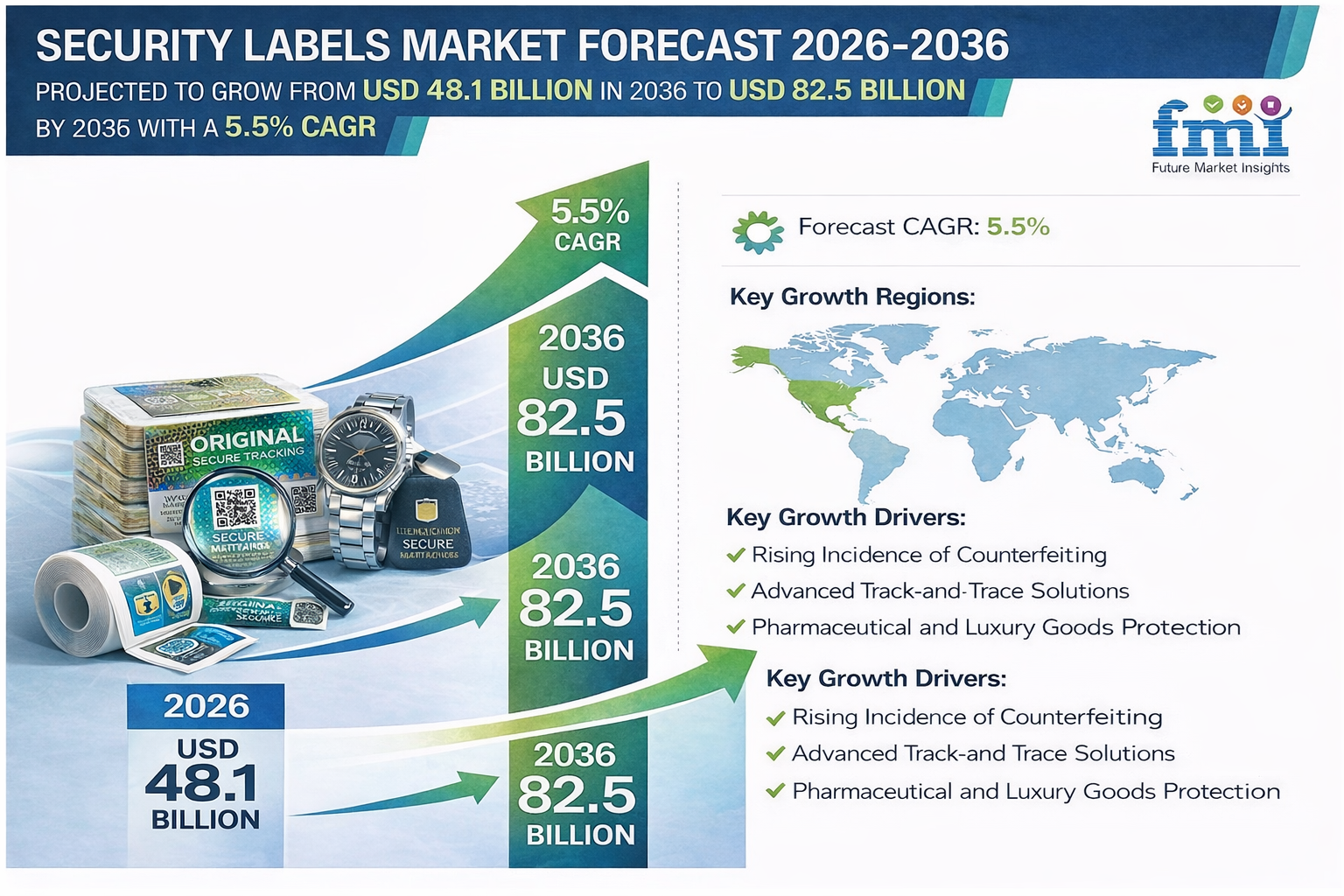
NEWARK, DE / ACCESS Newswire / February 11, 2026 / The global packaging and brand protection ecosystem is entering a decisive transformation phase. As counterfeit networks grow increasingly sophisticated and supply chains stretch across multiple risk points, the Security Labels Market-valued at USD 48.1 billion in 2026-is forecast to expand to USD 82.5 billion by 2036, advancing at a compound annual growth rate (CAGR) of 5.5% over the forecast period.
According to Future Market Insights (FMI), market growth is no longer driven solely by compliance mandates. Instead, it reflects a structural shift toward data-enabled packaging intelligence, where security labels act as both physical deterrents and digital authentication gateways across pharmaceutical, luxury goods, electronics, and logistics value chains.
From Physical Seals to Digital Sentinels: The Evolution of Security Labels
Historically, security labels were designed to offer visual tamper evidence-VOID patterns, holograms, or destructible films. In 2026, the category has evolved into a hybrid security architecture, combining overt visual cues with covert digital verification.
"Security labels are no longer passive components," notes an FMI analyst. "They are active nodes in brand protection ecosystems-connecting physical goods to cloud-based authentication platforms."
The accelerating adoption of RFID- and NFC-enabled labels is redefining protection strategies. These smart labels enable real-time tracking, serialization, and consumer-level verification-capabilities increasingly demanded by pharmaceutical regulators and luxury brand owners alike.
Margin Optimization: The Economics Behind Smart Label Adoption
While demand for intelligent security solutions is rising, adoption hinges on economics. FMI estimates indicate that integrating RFID inlays raises production costs by 30-40%, primarily due to inlay materials, antenna embedding, and encoding processes.
However, manufacturers deploying RFID-enabled security labels benefit from price premiums of up to 15%, particularly in high-value asset tracking, pharmaceuticals, and luxury goods. Label converters that optimize polyester and vinyl substrate sourcing can stabilize margins amid petrochemical price volatility.
"Manufacturers that balance advanced adhesive performance with premium pricing models can achieve gross margins exceeding 25% in the niche security segment," FMI notes.
Protection Accuracy as a Trust Multiplier
Authentication accuracy has emerged as a decisive differentiator. FMI analysis shows that advanced holographic and NFC-based labels reduce successful counterfeiting attempts by nearly 60%, directly safeguarding brand revenue and consumer safety.
High-performance security labels engineered to withstand drop tests, humidity exposure, and thermal stress ensure scannability and legibility across complex logistics environments. Brands investing in 99.9% authentication accuracy report a 20% reduction in gray-market diversion, reinforcing trust across authorized distribution channels.
Sustainability Enters the Security Equation
Environmental impact is increasingly influencing procurement decisions. FMI analysts highlight that transitioning from standard PVC to recyclable PET liners reduces carbon footprint by approximately 12%. Additionally, thinner film constructions reduce material usage by 10%, lowering transportation emissions and waste output.
Security label suppliers that meet sustainability targets-without compromising tamper-evidence performance-are increasingly qualifying as preferred vendors for multinational corporations pursuing ESG-aligned packaging strategies.
Quick Stats: Security Labels Market Snapshot
Industry Value (2026): USD 48.1 Billion
Forecast Value (2036): USD 82.5 Billion
CAGR (2026-2036): 5.5%
Leading Product Type: RFID Labels (46.8%)
Dominant Material: Paper (39.2%)
Top Application: Boxes & Cartons (42.5%)
Key Growth Regions: China, India, United States
Why Paper Continues to Dominate Material Selection
Despite advances in synthetic films, paper-based security labels account for 39.2% of market share in 2026. Their dominance stems from cost-effectiveness, excellent printability, and compatibility with thermal transfer and direct thermal printing systems.
Advancements in coating technologies have enhanced paper durability, enabling short-term security applications in logistics and retail. Regulatory pressure toward biodegradable materials further reinforces paper's relevance in security labeling portfolios.
RFID: The Cornerstone of Intelligent Protection
Radio Frequency Identification (RFID) leads product segmentation with 46.8% market share, driven by item-level tagging mandates from global retailers. RFID labels enable automated inventory tracking, loss prevention, and omnichannel fulfillment-making them indispensable for modern retail operations.
As inlay costs decline and printer-encoder availability expands, RFID adoption continues to accelerate, serving dual roles in security and operational efficiency.
Boxes & Cartons: The First Line of Defense
Boxes and cartons dominate application segmentation, accounting for 42.5% share in 2026. As the primary secondary packaging format for pharmaceuticals, electronics, and e-commerce shipments, cartons represent the most vulnerable point for tampering and diversion.
Serialization mandates often require data-rich labels on cartons, while flat surfaces allow for multi-layered security features-maximizing both visual and digital protection.
VOID Patterns: Simplicity with Impact
VOID patterns remain the industry benchmark for visible tamper evidence, holding 35.8% share in 2026. When removed, these labels leave irreversible residue, preventing reuse and providing indisputable evidence of interference.
Their effectiveness, simplicity, and customization potential make VOID labels a preferred choice for warranty seals and asset tags.
Regional Dynamics: Asia Accelerates, West Digitizes
China (6.4% CAGR)
China leads growth as the world's manufacturing hub, supported by government crackdowns on counterfeit exports and booming domestic e-commerce platforms such as Alibaba and JD.com.India (6.2% CAGR)
Growth is driven by pharmaceutical serialization mandates and export compliance requirements. India's role as a global generics supplier fuels demand for cost-efficient, track-and-trace labeling solutions.United States (4.4% CAGR)
Retail shrinkage and organized retail crime are accelerating RFID and EAS deployment. U.S. retailers increasingly integrate security labels into IoT-enabled smart packaging systems.Europe (UK & France)
Post-Brexit trade compliance and luxury goods protection anchor growth. France's market focuses on aesthetic, high-security solutions for luxury, cosmetics, and wine authentication.
Competitive Landscape: Integration Is the New Advantage
Market leaders are pursuing vertical integration, combining label converting, digital authentication platforms, and software ecosystems. Avery Dennison Corporation, holding approximately 23% market share, leads through RFID innovation and global scale.
M&A activity remains strong, with major players acquiring niche holographic firms and digital authentication specialists. Partnerships with blockchain providers further enhance traceability, positioning security labels as strategic assets rather than consumables.
The Road Ahead: From Compliance to Competitive Advantage
By 2036, security labels will no longer be viewed as cost centers. They will function as critical enablers of brand trust, regulatory compliance, and consumer engagement.
As counterfeiting techniques evolve, success will belong to suppliers offering multi-layered, sustainable, and data-driven security solutions-transforming labels into intelligent guardians of global commerce.
For an in-depth analysis of evolving formulation trends and to access the complete strategic outlook for the Security Labels Market through 2036, Full Report Request - https://www.futuremarketinsights.com/reports/security-labels-market
Related Reports:
Destructible Security Labels Market - https://www.futuremarketinsights.com/reports/destructible-security-labels-market
Security Screening Market - https://www.futuremarketinsights.com/reports/security-screening-market
Security Tape Market - https://www.futuremarketinsights.com/reports/security-tape-market
Labels Market - https://www.futuremarketinsights.com/reports/labels-market
Security Alarm Communicator Market - https://www.futuremarketinsights.com/reports/security-alarm-communicator-market
About Future Market Insights (FMI)
Future Market Insights (FMI) is a leading provider of market intelligence and consulting services, serving clients in over 150 countries. Headquartered in Delaware, USA, with a global delivery center in India and offices in the UK and UAE, FMI delivers actionable insights to businesses across industries including automotive, technology, consumer products, manufacturing, energy, and chemicals.
An ESOMAR-certified research organization, FMI provides custom and syndicated market reports and consulting services, supporting both Fortune 1,000 companies and SMEs. Its team of 300+ experienced analysts ensures credible, data-driven insights to help clients navigate global markets and identify growth opportunities.
For Press & Corporate Inquiries
Rahul Singh
AVP - Marketing and Growth Strategy
Future Market Insights, Inc.
+91 8600020075
For Sales - sales@futuremarketinsights.com
For Media - Rahul.singh@futuremarketinsights.com
For web - https://www.futuremarketinsights.com/
SOURCE: Future Market Insights, Inc.
View the original press release on ACCESS Newswire