Rising Demand for Sustainable, High‑Performance Bio‑Resins in Modular Construction Drives Market Expansion Through 2036
NEWARK, DE / ACCESS Newswire / March 30, 2026 / The global bio-based structural wood adhesives for modular construction market is projected to expand steadily over the next decade, growing from USD 1.3 billion in 2026 to USD 3.2 billion by 2036, registering a CAGR of 9.3%, according to the latest analysis by Future Market Insights (FMI). Growth is driven by increasing demand for low-carbon, high-performance bonding agents as prefabricated construction and mass-timber manufacturing scale globally.
Traditional petrochemical resins face scrutiny due to formaldehyde emissions, carbon footprint, and regulatory compliance hurdles. Bio-based adhesives address these challenges through renewable feedstocks, ambient or cold-set curing compatibility, and certified mechanical performance-making them critical for cross-laminated timber (CLT), glulam beams, and other structural modular components.
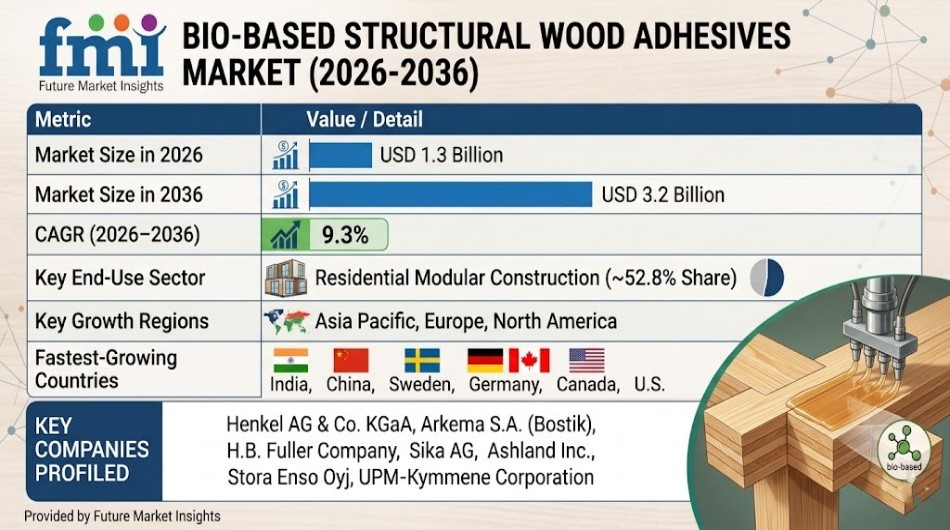
Bio-Based Structural Wood Adhesives Market Snapshot (2026-2036)
Market size in 2026: USD 1.3 billion
Market size in 2036: USD 3.2 billion
CAGR (2026-2036): 9.3%
Leading resin type: Lignin-based adhesives (~38.5% share)
Dominant application: Cross-Laminated Timber (CLT) Panels (~44.2% share)
Key end-use sector: Residential modular construction (~52.8% share)
Key growth regions: Asia Pacific, Europe, North America
Fastest-growing countries: India, China, Sweden, Germany, Canada, U.S.
Get Access to Report Sample: https://www.futuremarketinsights.com/reports/sample/rep-gb-32479
Market Momentum
The bio-based adhesives market begins at approximately USD 1.3 billion in 2026 and maintains strong growth throughout the forecast period. By 2031, accelerating adoption in CLT panels, glulam beams, and prefabricated wall systems pushes market value beyond USD 2 billion. Between 2031 and 2036, growth intensifies as municipal carbon caps, indoor air quality regulations, and demand for zero-emission modular housing drive higher adoption of certified bio-resins. By 2036, the market reaches USD 3.2 billion, sustaining its 9.3% CAGR over the decade.
Why the Market Is Growing
Bio-based adhesives are gaining prominence due to their ability to combine structural performance with environmental sustainability. Modular construction firms face immediate pressure to replace petroleum-derived resins without slowing production cycles. Residential and commercial builders increasingly require low-emission materials that meet formaldehyde-free standards while sustaining high-throughput factory operations. Bio-based adhesives also enable developers to qualify for green building certifications and municipal low-carbon projects, creating a clear financial and competitive incentive for adoption.
Segment Spotlight
Resin Type: Lignin-Based Adhesives Lead with ~38.5% Share
Lignin-based adhesives integrate seamlessly into existing kraft pulping and mass-timber production lines, providing structural performance with minimal capital investment. Soy, tannin, and starch-based resins complement high-volume applications, supporting residential and mid-rise modular construction projects.Application: Cross-Laminated Timber (CLT) Panels Command ~44.2% Share
CLT panels dominate the structural adhesive market due to high surface-area bonding requirements and municipal adoption for sustainable mid-rise buildings. Glulam beams, LVL panels, and prefabricated wall systems follow closely, expanding as bio-resins gain certification for load-bearing applications.End-Use Sector: Residential Modular Construction Anchors Demand (~52.8% Share)
Residential modular projects leverage bio-based adhesives to deliver formaldehyde-free, carbon-neutral homes. Institutional and commercial modular applications are growing as certifications for structural adhesives become widely accepted.
Regional Growth: Asia Pacific, Europe, and North America Drive Expansion
Asia Pacific leads adoption, with India achieving an 11.2% CAGR fueled by government-backed prefabricated housing programs and locally sourced bio-feedstocks. China grows at 10.4% as carbon regulations incentivize green adhesives. Europe sees strong growth in Sweden (10.2% CAGR) and Germany (9.8%), driven by strict indoor air quality and low-carbon mandates. North America follows, with Canada at 9.5% and the U.S. at 9.1%, supported by high-volume residential modular construction.
Drivers, Opportunities, Trends, Challenges
Drivers: Regulatory carbon caps, indoor air quality mandates, and high-performance modular construction growth.
Opportunities: Enzymatic soy modifications, microwave-assisted cold-curing, hyper-concentrated tannins, and rapid certification of load-bearing adhesives.
Trends: Adoption of certified bio-resins, hybrid formulations for factory compatibility, and focus on zero-emission building materials.
Challenges: Protracted certification cycles, seasonal curing sensitivity, and feedstock supply limitations.
Country Growth Outlook (CAGR 2026-2036)
Country |
CAGR |
|---|---|
India |
11.2% |
China |
10.4% |
Sweden |
10.2% |
Germany |
9.8% |
Canada |
9.5% |
U.S. |
9.1% |
Competitive Landscape
The bio-based structural wood adhesives market is highly technical, with competition focused on formulation innovation, rapid factory integration, and certification capabilities. Global players secure dominance through proprietary enzymatic treatments, drop-in formulations for existing press lines, and large-scale structural testing infrastructure. Leading manufacturers include Henkel AG & Co. KGaA, Arkema S.A. (Bostik), H.B. Fuller Company, Sika AG, Ashland Inc., Stora Enso Oyj, and UPM-Kymmene Corporation.
These companies compete on adhesive performance, ambient curing efficiency, structural certification compliance, and supply reliability to mass timber and modular construction manufacturers worldwide.
For an in-depth analysis of evolving formulation trends and to access the complete strategic outlook for the Bio-Based Structural Wood Adhesives for Modular Construction Market through 2036 , visit the official report page at: https://www.futuremarketinsights.com/reports/bio-based-structural-wood-adhesives-for-modular-construction-market
Explore More Research Reports by FMI:
Pressure-Sensitive Adhesives Market: https://www.futuremarketinsights.com/reports/pressure-sensitive-adhesives-market
Fluoropolymer Additives Market: https://www.futuremarketinsights.com/reports/fluoropolymer-additives-market
Poly Aluminum Chloride Market: https://www.futuremarketinsights.com/reports/poly-aluminum-chloride-market
Metallic Pigments Market: https://www.futuremarketinsights.com/reports/metallic-pigments-market
About Future Market Insights (FMI)
Future Market Insights (FMI) is a leading provider of market intelligence and consulting services, serving clients in over 150 countries. Headquartered in Delaware, USA, with a global delivery center in India and offices in the UK and UAE, FMI delivers actionable insights to businesses across industries including automotive, technology, consumer products, manufacturing, energy, and chemicals.
An ESOMAR-certified research organization, FMI provides custom and syndicated market reports and consulting services, supporting both Fortune 1,000 companies and SMEs. Its team of 300+ experienced analysts ensures credible, data-driven insights to help clients navigate global markets and identify growth opportunities.
For Press & Corporate Inquiries
Rahul Singh
AVP - Marketing and Growth Strategy
Future Market Insights, Inc.
+91 8600020075
For Sales - sales@futuremarketinsights.com
For Media - Rahul.singh@futuremarketinsights.com
For web - https://www.futuremarketinsights.com/
SOURCE: Future Market Insights, Inc.
View the original press release on ACCESS Newswire