Bentley University's Center for Health and Business and unBurnt Name the Missing Metric in Organizational Performance and Examine How Burnout Alters Innovation.
WALTHAM, MA / ACCESS Newswire / April 6, 2026 / Organizations have long measured what employees produce. A new research paper from Bentley University's Center for Health and Business and workforce performance company unBurnt argues that the more consequential question has gone largely unasked: whether employees retain the cognitive and strategic bandwidth to keep producing it.
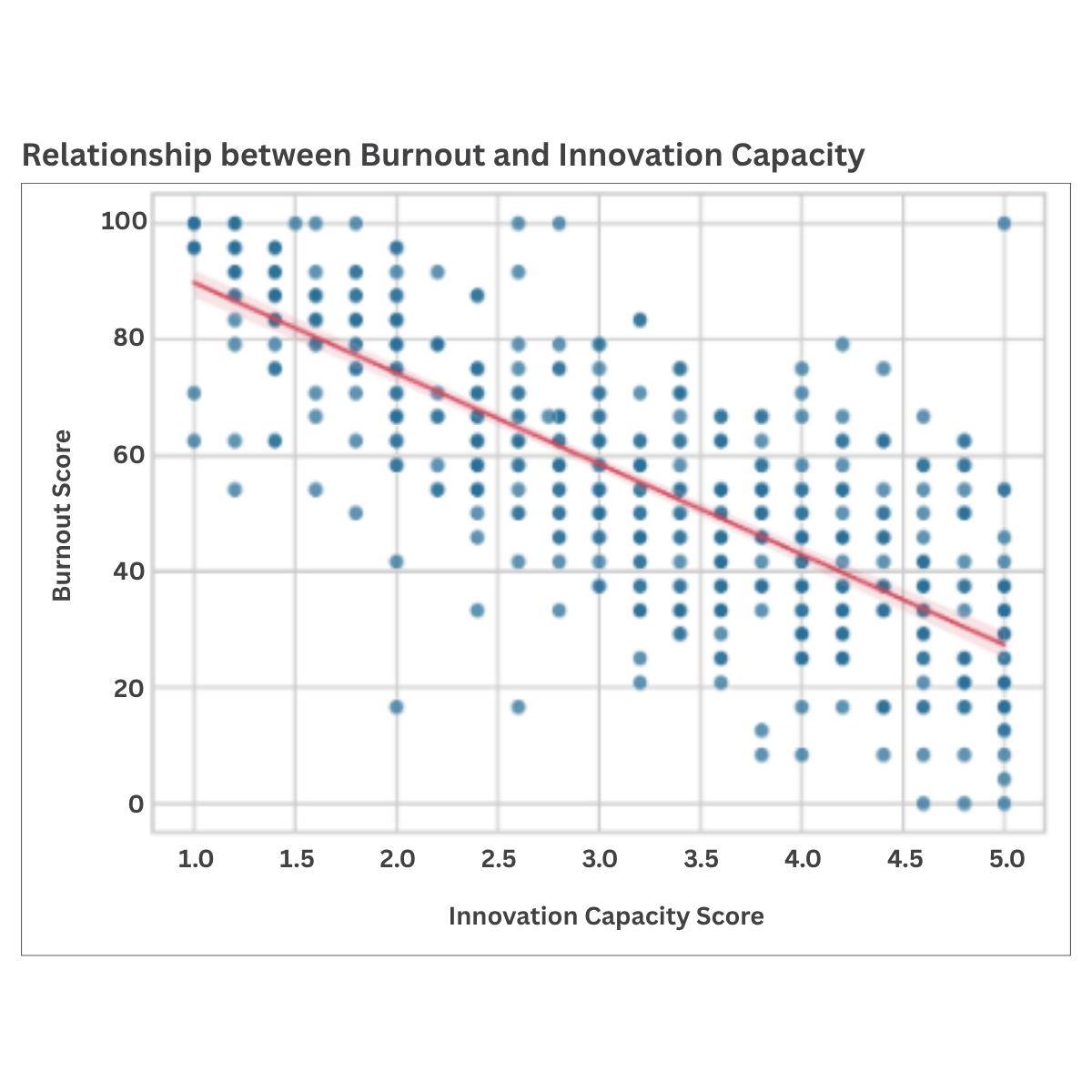
Based on a survey of 544 US-based full-time professionals across 15 industries, the white paper, titled When Burnout Looks Like Productivity: The New Risk to Innovation Capacity, finds that innovation does not operate as a single construct, but splits into two distinct dimensions, and exposes burnout as the strongest predictor of lost ‘Innovation Capacity.' As Figure 1 shows, Burnout exhibits a large, statistically significant negative effect on innovation capacity (r=-0.79) as burnout increases, the ability to perform high-quality, focused, and strategic work declines markedly.An organizational performance metric, ‘Innovation Capacity', is defined as the cognitive and strategic bandwidth required to turn effort and ideas into high-quality, sustained organizational value.
This study draws a critical distinction: visible effort and sustainable Innovation Capacity are not the same thing, and under burnout, they diverge. The implication is stark: employees can remain busy, responsive, and outwardly productive while the organization's ability to think, adapt, and create sustainable value is declining.
Innovation Capacity (n.): The cognitive and strategic bandwidth required to turn effort and ideas into high-quality, sustained organizational value. Distinct from visible innovation behaviors such as idea generation or rapid responsiveness, Innovation Capacity reflects whether employees possess the depth of focus, strategic judgment, and long-range thinking necessary to translate activity into durable competitive advantage.
"What we found is that burnout doesn't look the way leaders expect it to look. The employees most at risk are often the ones who seem fine. Responsive, engaged, generating ideas. But the data tells a different story. When we measure Innovation Capacity rather than innovation behavior, burnout demonstrates a measurable and predictable split. The same workplace conditions that elevate burnout may also erode the strategic, forward-looking thinking that organizations depend on for long-term growth. This isn't a wellbeing issue sitting outside the boardroom. It is a performance risk sitting at the center of it." Dr. Danielle Blanch Hartigan, Executive Director, Center for Health and Business, Chester B. Slade Professor of Psychology, Bentley University.
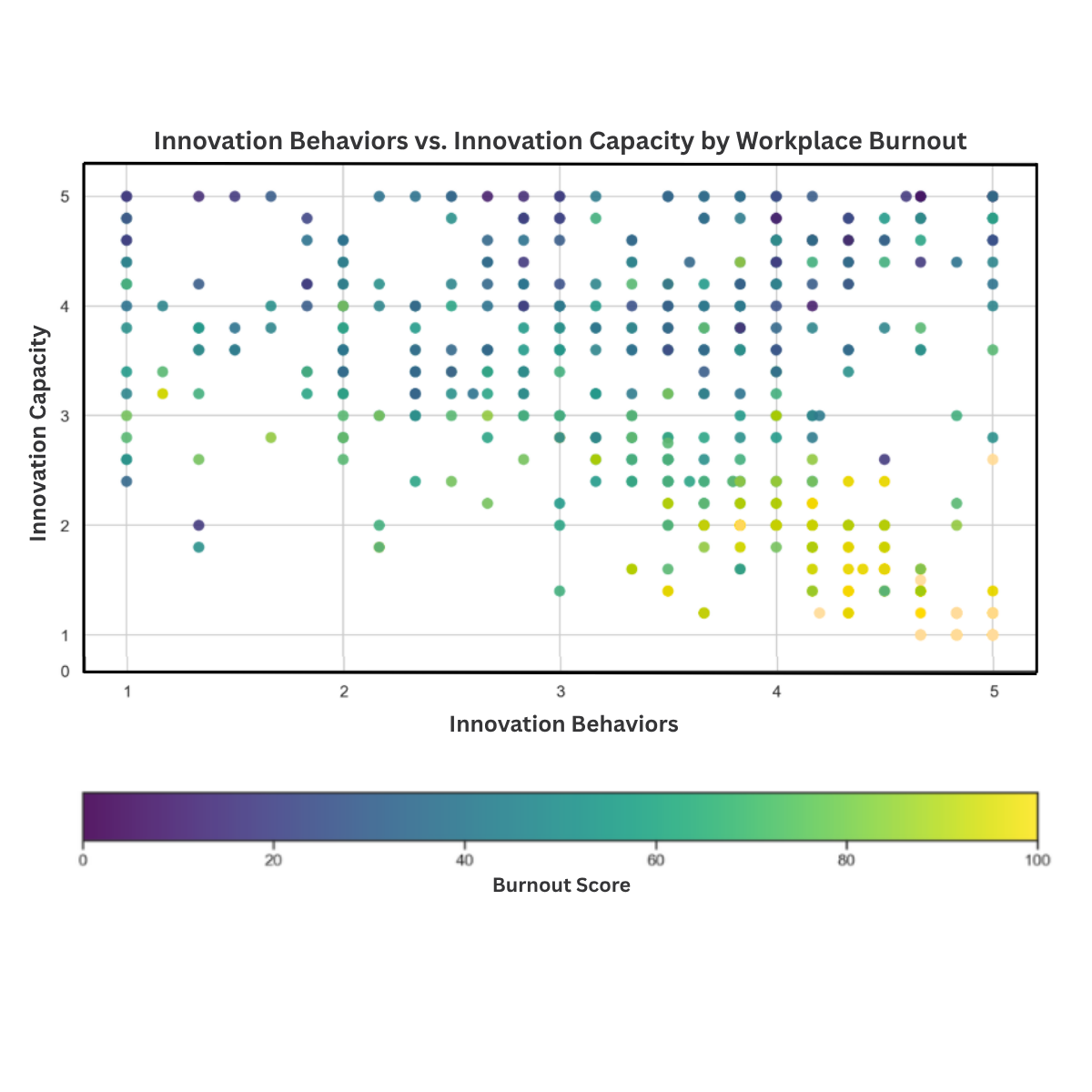
Exploration of Behavior Shifts Under Sustained Pressure
The research reveals a consistent pattern: as burnout rises, visible activity and true innovation capacity begin to diverge. This creates measurable consequences for how organizations perform and grow.
Busyness is not the same as innovation health: High output and idea generation can mask declining strategic capacity. Teams appear productive, but the deeper thinking required to turn ideas into meaningful outcomes is weakening. Over time, this leads to more activity without corresponding breakthroughs.
Short-term execution crowds out long-term value creation: As burnout increases, employees shift into reactive modes, prioritizing urgency, responsiveness, and incremental progress. This comes at the expense of long-range thinking, system-level improvements, and the kind of innovation that compounds over time.
High-potential talent is constrained, not absent: The issue is not a lack of capability. Many employees retain strong creative and strategic potential, but lack the cognitive conditions required to apply it. Innovation capacity is not fixed-it is enabled or obstructed by the work environment.
Innovation capacity is the signal leaders are missing: Organizations that measure only output and activity, such as projects completed, ideas generated, and initiatives launched, are tracking what burnout leaves intact. Without measuring innovation capacity, early signs of performance degradation remain invisible until outcomes suffer.
Key stats:
86% reported moderate to high workplace burnout, and burnout emerged as the strongest predictor of diminished innovation capacity, with a strong negative correlation of r = 0.79
Managers were ~1.7x more likely to report high burnout than individual contributors (38% vs 22%)
Caregivers were ~3x more likely to report high burnout vs. non-caregivers (51% vs 17%), with caregiving defined as either parenting, childcare, caring for an aging parent, or sick family member responsibility
Why A New Construct Was Necessary
The research team developed Innovation Capacity as a distinct measure because existing frameworks were failing to capture a pattern the data kept revealing. Traditional burnout research frames the condition as inversely correlated with engagement: when burnout rises, effort falls. The new study found something more unsettling: burnout does not reduce visible effort. It redirects it.
Employees experiencing high burnout continued to generate ideas, respond quickly, and demonstrate initiative, all visible behaviors that read as innovation in conventional performance measurement. What declined was their ability to sustain the deeper forms of thinking that those behaviors are supposed to produce: strategic judgment, long-range planning, systems integration, and intelligent risk-taking. The activity remained. The capacity behind it eroded.
By measuring burnout alongside both visible innovation behaviors and innovation capacity as distinct constructs, the research offers organizations a practical framework for understanding the difference between an active workforce and a building workforce. That distinction, the authors argue, is where long-term performance is won or lost.
"When I built unBurnt, I was trying to name something I had watched happen to myself and to people I respected. This slow, invisible narrowing of what you are capable of, as you push for constant output. What this research gives us is both the language and the evidence. Innovation Capacity is what separates a team going through the motions from one capable of delivering value over the long-term. And the data now shows us exactly which workplace conditions are responsible. That is a strategy conversation, and one currently missing from most workplaces," said Alison Campbell, founder and CEO, unBurnt.
The goal, the research concludes, is not less activity. Rather, it is activity that is sustainable, deliberate, and capable of building long-term value and that actually influences a growth forecast.
ABOUT THE RESEARCH
When Burnout Looks Like Productivity: The New Risk to Innovation Capacity is authored by Alison Campbell (Founder & CEO, unBurnt), Dr. Danielle Blanch Hartigan (Executive Director, CHB; Chester B. Slade Professor of Psychology, Bentley University), and Kingsolomon Ehinola (Graduate Student, Bentley University). Survey data was collected from 544 full-time working professionals across 17 industries and all U.S. geographic regions. The full white paper is available at www.getunburnt.com/research.
ABOUT BENTLEY UNIVERSITY'S CENTER FOR HEALTH AND BUSINESS
The Center for Health and Business builds on Bentley's strengths as a business university to lead impactful, cross-disciplinary research and programming at the intersection of health and organizational performance. The Center advances interdisciplinary research, delivers educational programming, supports emerging leaders, and cultivates external partnerships that drive innovation and improve outcomes. www.bentley.edu/centers/health-business
ABOUT UNBURNT®
unBurnt is on a mission to reimagine how organizations build sustainable performance at work. Through leadership development cohorts, coaching, workshops, and offsite experiences, unBurnt helps organizations address the root causes of workplace strain and design systems that protect employee capacity while strengthening long-term results. unBurnt is an SBA-certified Women-Owned Small Business. www.getunburnt.com
Media Contact:
Amy Rice
amy@Voluteandstone.com
508-978-6635
SOURCE: unBurnt
View the original press release on ACCESS Newswire