The logistics data quality and normalization services market is gaining strong momentum as global supply chains become increasingly digital, interconnected, and dependent on accurate, real-time data exchange across carriers, shippers, and logistics platforms.
NEWARK, DE / ACCESS Newswire / May 19, 2026 / According to the latest market analysis by Future Market Insights, the global logistics data quality and normalization services market, valued at USD 1.63 billion in 2025 and projected to reach USD 4.9 billion by 2036, is evolving into a critical logistics software services segment focused on data cleansing, standardization, validation, and interoperability across fragmented freight ecosystems.
As logistics networks expand across borders and multi-carrier ecosystems grow more complex, enterprises are increasingly adopting normalization services to ensure consistent shipment visibility, accurate billing, and seamless integration across ERP, TMS, and warehouse systems.
Quick Stats Snapshot
Market size (2025): USD 1.63 billion
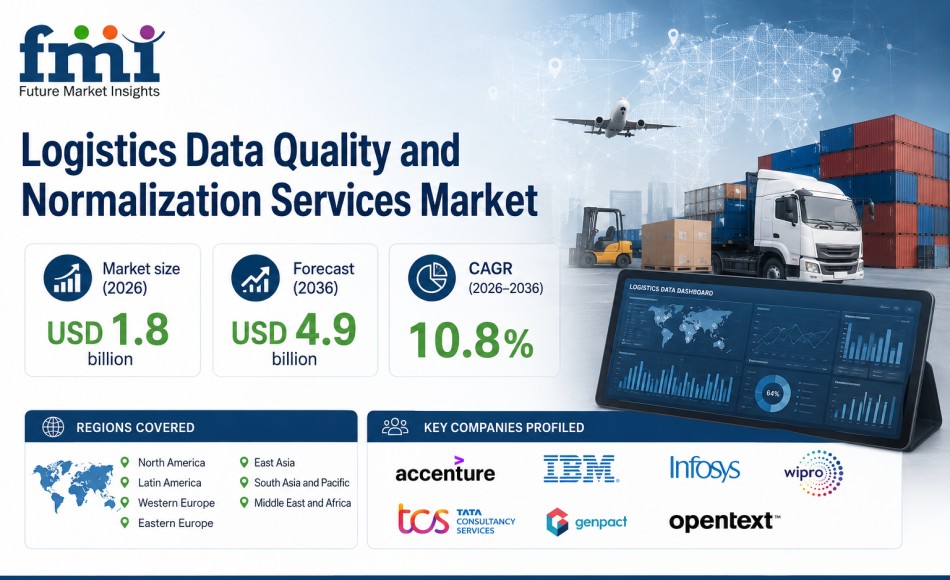
Market size (2026): USD 1.8 billion
Forecast (2036): USD 4.9 billion
CAGR (2026-2036): 10.8%
Incremental opportunity: USD 3.17 billion
Fastest-growing country: India (12.8% CAGR)
Leading deployment model: Managed services (61.0% share by 2026)
Key service type: Data cleansing (31.0% share by 2026)
Leading end users: 3PLs (29.0% share by 2026)
Fastest-growing region: Asia-Pacific
Get detailed market forecasts, competitive benchmarking, and pricing trends: https://www.futuremarketinsights.com/reports/sample/rep-gb-32619
Market Size and Growth Outlook
The logistics data quality and normalization services market is projected to grow from USD 1.8 billion in 2026 to USD 4.9 billion by 2036, reflecting a CAGR of 10.8%.
Growth is being driven by increasing reliance on API-connected logistics ecosystems, rising shipment volumes across global trade lanes, and the operational necessity of maintaining clean, standardized, and interoperable data across fragmented carrier networks.
Growth Drivers: Digital Logistics Transformation and Data Standardization Needs
1. Expansion of API-Based Logistics Ecosystems
Modern logistics operations depend on real-time API integrations across carriers, warehouses, and fulfillment platforms. Inconsistent data formats are increasingly being replaced with standardized normalization layers to enable seamless interoperability.
2. Rising Cost of Poor Data Quality in Freight Operations
Inaccurate shipment records, duplicate entries, and mismatched carrier event codes create billing inefficiencies, routing errors, and manual reconciliation costs that directly impact logistics profitability.
3. Growth of Global E-Commerce and Multi-Carrier Networks
Cross-border e-commerce expansion is intensifying demand for standardized shipment tracking, real-time visibility, and harmonized logistics data structures.
Key Challenges: Integration Complexity and Legacy Infrastructure
Despite strong growth prospects, the market faces structural challenges:
Persistent fragmentation across carrier systems and regional logistics formats
Legacy ERP and EDI infrastructures limiting real-time integration
High complexity in onboarding long-tail logistics partners
Lack of universal standards across global freight networks
Ongoing maintenance burden for normalization rules and mappings
Emerging Opportunities: Managed Services and Intelligent Data Automation
The market is witnessing significant innovation across automation and service delivery models:
Expansion of managed logistics data normalization services
Adoption of AI-based data cleansing and enrichment tools
Edge-based data validation for real-time logistics environments
Growth in compliance-as-a-service for customs and trade documentation
Increasing demand for unified data governance across supply chain ecosystems
Segmentation Insights: Managed Services and Shipment Data Lead Adoption
By Service Type:
Data cleansing and enrichment is expected to account for 31.0% share in 2026, driven by the need to remove inconsistencies before analytics and automation layers are applied.
By Data Domain:
Shipment and tracking data is projected to hold 34.0% share in 2026, as real-time visibility and milestone accuracy remain core operational requirements.
By Deployment:
Cloud-based solutions are expected to dominate with 68.0% share in 2026 due to scalability and multi-party integration advantages.
By End User:
3PLs are projected to represent 29.0% share in 2026, reflecting their role in managing multi-tenant logistics data environments.
Customize insights for your business strategy: https://www.futuremarketinsights.com/customization-available/rep-gb-32619
Regional Analysis: Asia-Pacific Leads Global Expansion
India (12.8% CAGR):
Rapid digitization of freight ecosystems and expanding logistics networks are driving strong demand for standardized shipment data and carrier integration services.
China (11.9% CAGR):
High-volume manufacturing and export logistics require precise data synchronization across ports, carriers, and international trade systems.
Singapore (11.2% CAGR):
As a global logistics hub, Singapore prioritizes high-precision data normalization for customs, port operations, and transshipment efficiency.
United States (9.8% CAGR):
Large-scale retail distribution and parcel logistics networks continue to rely on clean shipment data for routing, billing, and customer visibility.
Germany (10.9% CAGR):
Industrial supply chains require tightly synchronized logistics data for manufacturing coordination and ERP integration.
Competitive Landscape: Enterprise Integrators Dominate Market Structure
The market remains moderately fragmented, with global IT services and consulting firms playing a leading role in enterprise adoption through large-scale transformation programs.
Key players include:
Accenture
IBM
Infosys
Wipro
Tata Consultancy Services
Genpact
OpenText
Competition is increasingly shaped by interoperability capability, API-first architecture support, and continuous data governance services rather than one-time migration projects.
Strategic Implications for Industry Leaders
For logistics operators and technology providers, key priorities include:
Strengthening real-time data normalization across carrier networks
Investing in managed services for continuous rule maintenance
Prioritizing shipment-level data accuracy for visibility platforms
Enhancing ERP and TMS interoperability through standardized APIs
Reducing manual reconciliation through automated validation systems
Future Outlook: Toward Fully Standardized Digital Freight Ecosystems
The logistics data quality and normalization services market is expected to evolve into a foundational layer of digital logistics infrastructure, enabling fully interoperable, API-driven, and automated supply chain ecosystems.
Key future trends include:
AI-driven automated data mapping and exception handling
Expansion of global logistics data standards (DCSA-aligned frameworks)
Increased adoption of predictive logistics visibility models
Stronger integration between customs, freight, and warehouse systems
Shift toward real-time, event-based logistics data architectures
Unlock 360° insights for strategic decision-making and investment planning: https://www.futuremarketinsights.com/checkout/32619
Executive Takeaways
Market expected to reach USD 4.9 billion by 2036 at 10.8% CAGR
Data normalization is becoming essential for modern logistics interoperability
Managed services dominate due to ongoing maintenance requirements
Shipment data remains the most critical logistics data domain
Asia-Pacific leads global growth, driven by India and China
Competitive advantage depends on API readiness and data governance strength
In an increasingly digital and interconnected logistics environment, companies that invest in scalable data normalization, real-time integration capabilities, and continuous data governance frameworks will be best positioned to improve operational efficiency, reduce costs, and enhance global supply chain visibility.
Related Reports:
Lane-Specific Dynamic Pricing Engines for Freight Contracts Market: https://www.futuremarketinsights.com/reports/lane-specific-dynamic-pricing-engines-for-freight-contracts-market
Smart Strap-Tension Monitor Market: https://www.futuremarketinsights.com/reports/smart-strap-tension-monitor-market
Light-Emitting Safety Wraps Market: https://www.futuremarketinsights.com/reports/light-emitting-safety-wraps-market
Chemical Storage and Hazmat Handling Market: https://www.futuremarketinsights.com/reports/chemical-storage-and-hazmat-handling-market
Urban Logistic Services Market: https://www.futuremarketinsights.com/reports/urban-logistic-services-market
About Future Market Insights (FMI)
Future Market Insights (FMI) is a leading provider of market intelligence and consulting services, serving clients in over 150 countries. Headquartered in Delaware, USA, with a global delivery center in India and offices in the UK and UAE, FMI delivers actionable insights to businesses across industries including automotive, technology, consumer products, manufacturing, energy, and chemicals.
An ESOMAR-certified research organization, FMI provides custom and syndicated market reports and consulting services, supporting both Fortune 1,000 companies and SMEs. Its team of 300+ experienced analysts ensures credible, data-driven insights to help clients navigate global markets and identify growth opportunities.
For Press & Corporate Inquiries:
Rahul Singh
AVP - Marketing and Growth Strategy
Future Market Insights, Inc.
+91 8600020075
For Sales - sales@futuremarketinsights.com
For Media - Rahul.singh@futuremarketinsights.com
For web - https://www.futuremarketinsights.com/
For Web - https://www.factmr.com/
SOURCE: Future Market Insights, Inc.
View the original press release on ACCESS Newswire