The blow fill-seal technology market is evolving into a core sterile pharmaceutical manufacturing infrastructure, driven by automation, contamination control, and rising demand for unit-dose drug packaging worldwide.
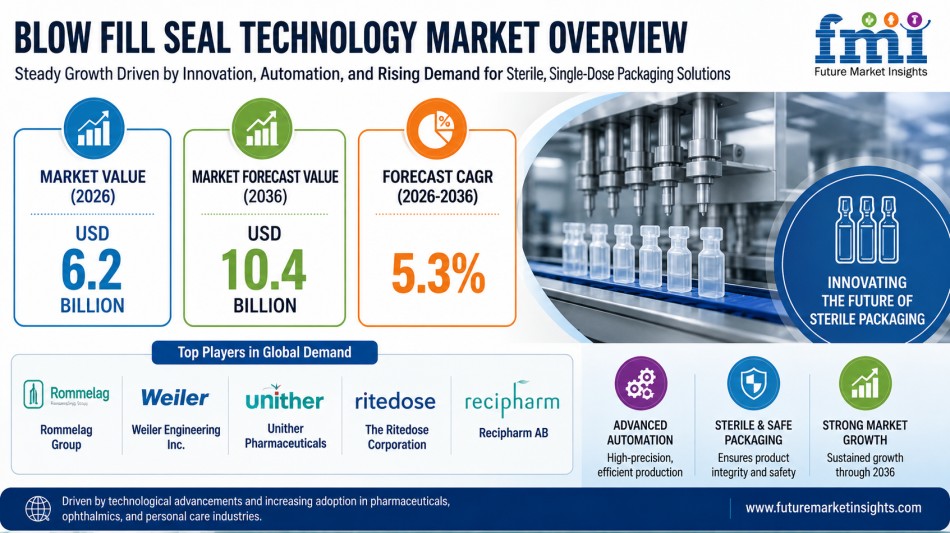
NEWARK, DE / ACCESS Newswire / May 26, 2026 / NEWARK, DE | May 26, 2026 - According to the latest market analysis by Future Market Insights, the blow fill-seal (BFS) technology market is transitioning from a specialized aseptic packaging solution into a critical infrastructure component for modern sterile pharmaceutical manufacturing. Valued at USD 5.3 billion in 2025 and projected to reach USD 6.2 billion in 2026, the market is expected to expand at a CAGR of 5.3%, ultimately reaching USD 10.4 billion by 2036.
The market's growth reflects a structural shift in pharmaceutical production strategies-moving away from multi-step sterile filling systems toward integrated, contamination-controlled manufacturing environments capable of supporting high-volume liquid drug production with fewer operator interventions.
Quick Stats at a Glance
Market size (2025): USD 5.3 billion
Estimated value (2026): USD 6.2 billion
Forecast (2036): USD 10.4 billion
CAGR (2026-2036): 5.3%
Leading material type: Polyethylene (54% share)
Leading product type: Ampoules (46% share)
Dominant machine type: Rotary BFS systems (58% share)
Largest container segment: Below 0.2 L (63% share)
Leading end use: Ophthalmics (37% share)
Fastest-growing markets: India (8.2%), China (7.4%), Brazil (6.3%)
Get detailed market forecasts, competitive benchmarking, and pricing trends:
https://www.futuremarketinsights.com/reports/sample/rep-gb-4407
Market Size and Structural Shift
The blow fill-seal technology market is entering a sustained expansion phase as pharmaceutical manufacturers prioritize contamination control, sterile process automation, and uninterrupted supply continuity.
Traditional sterile filling processes involve multiple handling stages, including container transport, washing, sterilization, filling, and sealing. BFS technology consolidates these functions into one continuous automated process where containers are formed, filled, and sealed within a closed sterile environment.
This operational shift is becoming increasingly important as regulatory agencies place greater emphasis on contamination prevention and aseptic integrity. The United States Food and Drug Administration continues to recognize BFS as a highly automated aseptic processing method capable of reducing contamination risk through minimized human intervention.
For pharmaceutical companies, the transition is no longer simply about packaging efficiency-it is about manufacturing resilience, regulatory readiness, and dependable sterile supply capacity.
Growth Drivers: Sterility, Automation, and Unit-Dose Demand
Three major forces are accelerating BFS adoption across global pharmaceutical manufacturing networks.
1. Rising Demand for Sterile Liquid Medicines
Respiratory therapies, ophthalmic formulations, IV solutions, and preservative-free drugs require sterile filling systems with extremely low contamination exposure. BFS enables manufacturers to support these applications while maintaining scalable production output.
2. Regulatory Pressure on Aseptic Manufacturing
Regulators are increasingly emphasizing closed-system manufacturing environments and process validation. BFS systems reduce open handling steps, supporting stronger compliance positioning in sterile drug production.
3. Expansion of Single-Dose Drug Formats
Healthcare providers and pharmaceutical brands are increasingly favoring unit-dose packaging formats that improve dosing accuracy, reduce preservative requirements, and simplify patient administration. BFS technology aligns directly with these trends, particularly in ophthalmics and respiratory therapies.
Market Constraints: Capital Intensity and Validation Complexity
Despite strong momentum, BFS adoption remains operationally and financially demanding.
Industrial BFS systems require substantial upfront investment, including cleanroom infrastructure, sterile validation protocols, and process qualification. These barriers can slow adoption among smaller pharmaceutical manufacturers.
Validation complexity also remains a major challenge. Drug owners must demonstrate compatibility between formulations, polymer materials, container geometry, and sterilization conditions before commercial approval.
In regulated pharmaceutical environments, changing from established glass vial systems to BFS platforms often requires extensive stability testing, regulatory submissions, and production requalification.
As a result, BFS implementation represents not just an equipment investment-but a long-term manufacturing transformation.
Speak to Analyst: Customize insights for your business strategy:
https://www.futuremarketinsights.com/customization-available/rep-gb-4407
Opportunity Landscape: Where Future Value Is Emerging
Several high-impact opportunities are shaping the next phase of BFS market growth:
Preservative-free ophthalmic therapies: Single-dose BFS ampoules reduce reliance on preservatives while improving sterility control.
Respiratory drug expansion: Nebulized therapies and inhalation medicines continue to support demand for sterile plastic ampoules.
Biologics and clinical-stage medicines: BFS systems may reduce active ingredient waste during small-batch sterile filling.
Contract sterile manufacturing growth: Outsourcing trends are increasing demand for BFS-enabled contract development and manufacturing organizations (CDMOs).
Large-volume sterile containers: New BFS platforms are expanding into IV bottles and higher-capacity sterile liquid applications.
Segment Insights: Where the Market Is Concentrated
By Product Type: Ampoules are projected to account for 46% share of market demand in 2026, driven by widespread use in ophthalmic and respiratory therapies. Single-dose sterile formats continue to dominate where contamination prevention and ease of use are critical.
By Material Type: Polyethylene is expected to hold more than 54% share in 2026 due to its flexibility, squeeze functionality, and compatibility with sterile pharmaceutical packaging requirements.
By Machine Type: Rotary BFS systems lead with 58% market share, supported by higher production throughput and suitability for high-volume sterile liquid manufacturing environments.
By Container Size: Containers below 0.2 liters are projected to account for 63% share in 2026 as small-dose ophthalmic and respiratory applications remain central to BFS demand.
By End Use Application: Ophthalmics are expected to hold 37% share in 2026, driven by rising demand for preservative-free eye care products packaged in sterile single-use containers.
Regional Dynamics: Pharmaceutical Manufacturing Expansion Drives Growth
Global BFS adoption is accelerating unevenly, with emerging pharmaceutical manufacturing hubs showing the strongest momentum.
India (8.2% CAGR): India is projected to lead growth through 2036 as generic drug exports, ophthalmic manufacturing, and cost-efficient sterile production continue expanding. Pharmaceutical clusters in Gujarat and Hyderabad remain central to adoption.
China (7.4% CAGR): China's BFS growth is being supported by domestic pharmaceutical expansion, localized equipment manufacturing, and increased demand for respiratory and ophthalmic medicines.
Brazil (6.3% CAGR): Public healthcare demand and local sterile liquid manufacturing are strengthening BFS adoption across Brazil's pharmaceutical supply network.
United States (4.9% CAGR): Demand is being driven by sterile supply resilience, respiratory therapies, and contract manufacturing expansion. Reshoring strategies and drug shortage concerns continue supporting investment.
Europe: Germany remains a major equipment innovation center through companies such as Rommelag Group, while France continues expanding contract sterile manufacturing capabilities.
Unlock high-growth opportunities with FMI's niche business market insights:
https://www.futuremarketinsights.com/industry-analysis
Competitive Landscape: Reliability and Validation Are Becoming Decisive
The BFS competitive landscape is evolving beyond equipment speed alone.
Manufacturers increasingly prioritize:
Sterile validation support
Filling precision and dosing accuracy
Mold flexibility and product compatibility
Resin handling expertise
Automated cleaning systems
Long-term uptime reliability
Regulatory documentation depth
Key companies shaping the market include Rommelag Group, Weiler Engineering Inc., Unither Pharmaceuticals, The Ritedose Corporation, Recipharm AB, and Curida AS.
For pharmaceutical buyers, the priority is increasingly centered on predictable sterile output, process consistency, and regulatory confidence-not just maximum throughput.
Strategic Implications for Industry Stakeholders
For pharmaceutical manufacturers, BFS adoption represents a broader shift toward integrated sterile production systems capable of improving operational reliability and contamination control.
For contract manufacturers, BFS platforms provide a competitive advantage in ophthalmic, respiratory, and preservative-free drug packaging markets.
For investors, the market offers long-term opportunities across sterile packaging equipment, consumables, polymer materials, and outsourced manufacturing services.
For procurement leaders, supplier evaluation is shifting beyond cost toward validation capability, sterility assurance, and supply continuity performance.
Future Outlook: From Packaging Technology to Core Sterile Infrastructure
Over the next decade, blow fill-seal technology is expected to move from selective pharmaceutical applications into broader sterile manufacturing ecosystems.
Key trends expected to shape the market include:
Expansion of high-capacity BFS systems for IV solutions
Greater adoption of preservative-free pharmaceutical formats
Integration of automated quality monitoring systems
Increased BFS use in biologics and clinical manufacturing
Stronger convergence between sterile filling and digital manufacturing controls
Continued growth in outsourced aseptic manufacturing networks
As pharmaceutical supply chains prioritize sterility, scalability, and compliance resilience, BFS technology is expected to become an increasingly standard component of sterile drug manufacturing infrastructure.
Executive Takeaways
Blow fill-seal technology is evolving from a niche aseptic packaging method into a strategic sterile manufacturing platform.
Market growth is being driven by contamination control, automation, and rising demand for unit-dose medicines.
Ophthalmics and respiratory therapies remain the strongest application segments.
Regulatory pressure is accelerating adoption of closed-system sterile manufacturing environments.
High validation and capital requirements remain key adoption barriers.
Competitive advantage is shifting toward reliability, validation depth, and integrated sterile manufacturing support.
The next phase of BFS market expansion will be defined not simply by higher production capacity but by the ability to deliver scalable, compliant, and contamination-controlled pharmaceutical supply systems.
Explore the Latest Packaging Industry Analysis Now:
https://www.futuremarketinsights.com/industry-analysis/packaging
Related Reports:
Blow-fill-seal Equipment Market: https://www.futuremarketinsights.com/reports/blow-fill-seal-equipment-market
Filling and Sealing Machine Market: https://www.futuremarketinsights.com/reports/filling-and-sealing-machine-market
Form-Fill-Seal (FFS) Films Market: https://www.futuremarketinsights.com/reports/form-fill-seal-ffs-films-market
Form-Fill-Seal (FFS) Films Market Share Analysis: https://www.futuremarketinsights.com/reports/form-fill-seal-films-market-share-analysis
Cup Fill and Seal Machine Market: https://www.futuremarketinsights.com/reports/cup-fill-and-seal-machine-market
About Future Market Insights (FMI)
Future Market Insights (FMI) is a leading provider of market intelligence and consulting services, serving clients in over 150 countries. Headquartered in Delaware, USA, with a global delivery center in India and offices in the UK and UAE, FMI delivers actionable insights to businesses across industries including automotive, technology, consumer products, manufacturing, energy, and chemicals.
An ESOMAR-certified research organization, FMI provides custom and syndicated market reports and consulting services, supporting both Fortune 1,000 companies and SMEs. Its team of 300+ experienced analysts ensures credible, data-driven insights to help clients navigate global markets and identify growth opportunities.
For Press & Corporate Inquiries
Rahul Singh
AVP - Marketing and Growth Strategy
Future Market Insights, Inc.
+91 8600020075
For Sales - sales@futuremarketinsights.com
For Media - Rahul.singh@futuremarketinsights.com
For Web - https://www.futuremarketinsights.com/
For Web - https://www.factmr.com/
SOURCE: Future Market Insights, Inc.
View the original press release on ACCESS Newswire