The so-called TACO trade — short for “Trump Always Chickens Out” — has become a cynical staple of the 2026 market, but while equity traders use it to buy the dip, the real damage is being done in the basement of the global economy: the bond market.
According to many who cover the beltway, President Donald Trump’s primary goal for 2026 is solving the affordability crisis, specifically by attempting to force mortgage rates lower. However, the constant drama and policy reversals inherent in the TACO trade are producing the exact opposite result. By injecting extreme uncertainty into the fiscal outlook, the administration is pushing domestic and foreign investors away from U.S. long bonds, sending yields higher and making the job of fixing housing affordability nearly impossible.
The Affordability Vice: Why Yields Won't Budge
The administration has a clear strategy to lower mortgage rates: directing Fannie Mae (FNMA) and Freddie Mac (FMCC) to purchase $200 billion in mortgage-backed securities. By itself, this should push rates down. But the market doesn't operate in a vacuum.
Every time a major policy is announced — such as the April 2 Liberation Day tariffs — only to be delayed or moderated after a market selloff, it risks eroding the credibility of U.S. fiscal policy. And while the stock market continues to hang in there, with “sell America” not really dominating trading despite many headlines to that effect, the bond market has been bearing the brunt.
That’s because bond investors hate uncertainty more than they hate inflation. When they can’t model the White House’s next move, they demand a higher term premium — the extra yield required to hold long-term debt. In the past, foreign central banks were reliable buyers of long-dated Treasurys. But with constant trade friction and threats to Federal Reserve independence, that demand has become uneven, forcing the U.S. to offer even higher yields to attract domestic capital. As a result, each time the White House retreats to temporarily save the S&P 500 Index ($SPX), the bond market edges further away from the conversation.
The data from recent Treasury bond auctions confirms that the TACO trade is creating a visible credibility gap between the front and back ends of the Treasury market. While short-term T-bills continue to see massive oversubscription, the long bond is struggling with a thin market, as investors back away from the 10-year (ZNM26) and 30-year (ZBM26) duration risks.
That is best illustrated by the bid-to-cover ratio, which measures how many dollars are bid for every dollar the Treasury wants to sell. In the most recent March auctions, the contrast was stark.
Demand for short-term debt remains incredibly high. Four-week bills recently saw a bid-to-cover of 10.7x, and the 2-year note auction in early March comfortably cleared with solid demand. Investors are happy to park cash here because the yield is high and the "drama risk" is low.
However, the 30-year bond auction on March 12 was a different story. The bid-to-cover ratio dropped to 2.3x, a figure analysts consider to be extremely low.
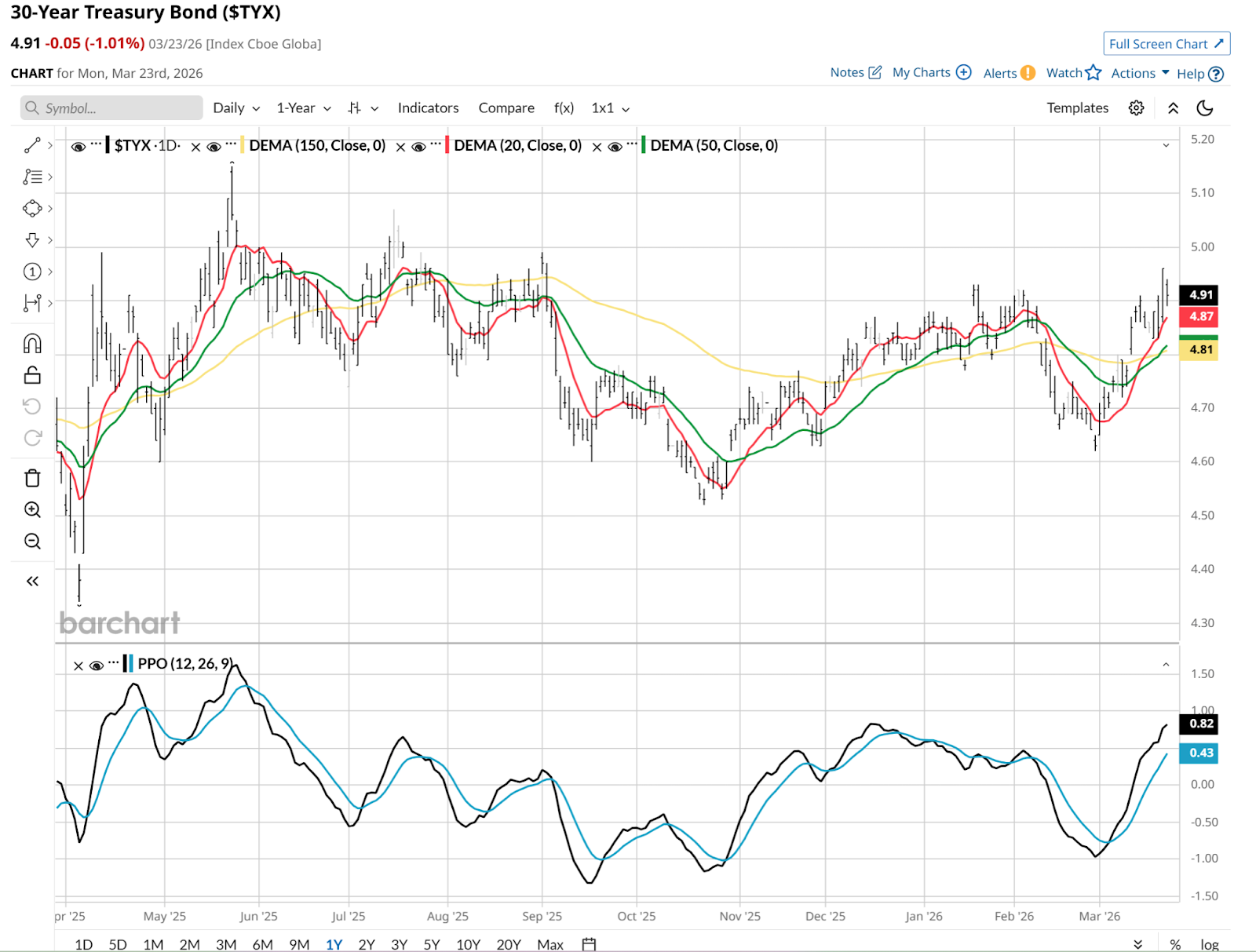
The stock market tends to shrug off panic moments. But this chart of 30-year bonds indicates that rates are sliding higher, taking bond prices down. That’s a lack of confidence right there.
The Bottom Line
Indeed, the ROAR score for the 20+ Year Treas Bond Ishares ETF (TLT), the exchange-traded fund (ETF) most closely associated with long bonds, tells a similar sad story. It turned red (higher risk) very recently, which is a signal that the path of least resistance for bond prices is likely down.
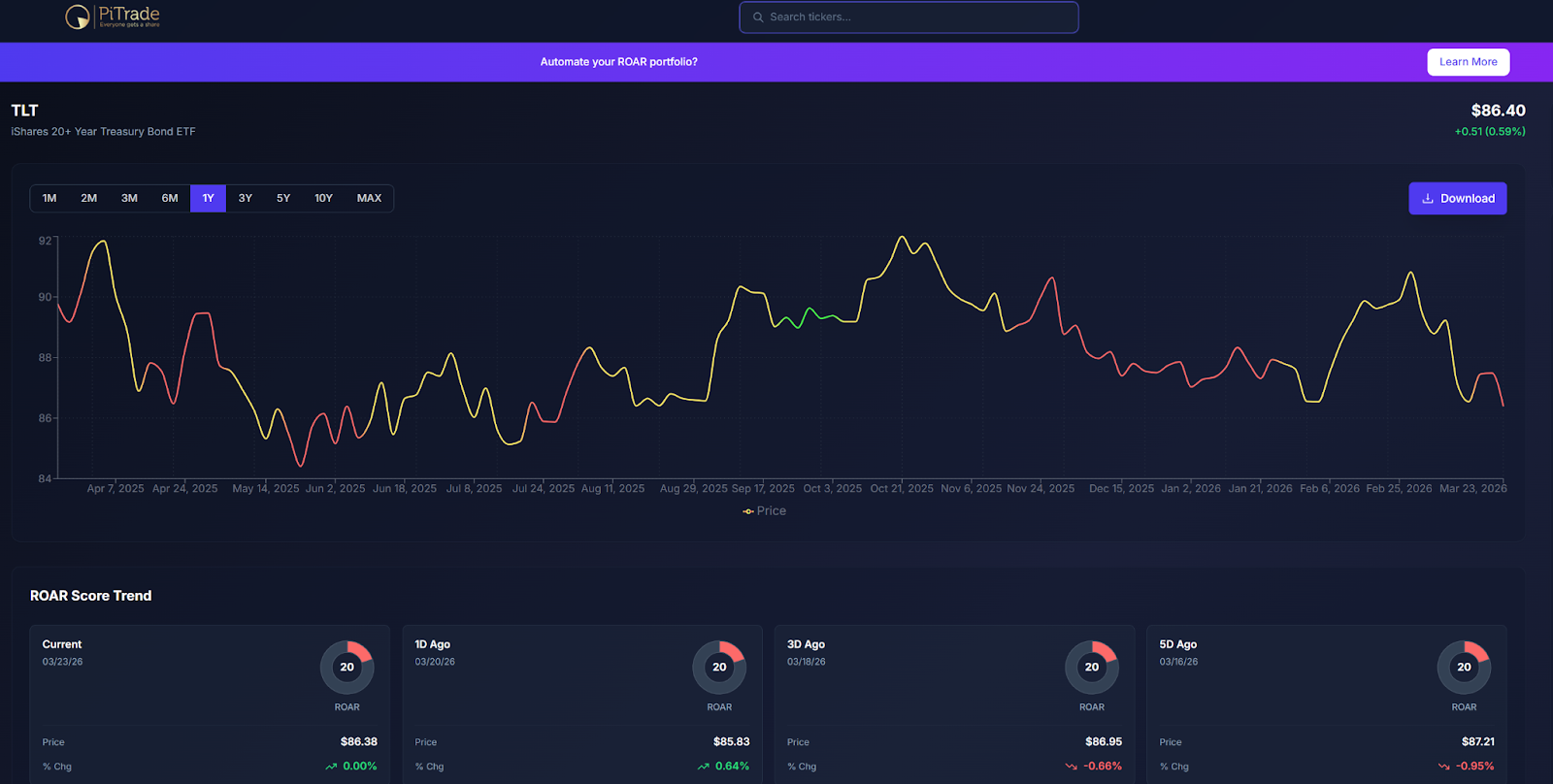
And that means rates are still biased toward the upside. Inflation, energy shock, a Fed in the midst of a key changeover at the top, and plenty of geopolitical headlines are keeping the bond market off balance. The TACO cycle is only adding to the emotion.
Rob Isbitts created the ROAR Score, based on his 40+ years of technical analysis experience. ROAR helps DIY investors manage risk and create their own portfolios. For Rob's written research, check out ETFYourself.com.
On the date of publication, Rob Isbitts did not have (either directly or indirectly) positions in any of the securities mentioned in this article. All information and data in this article is solely for informational purposes. For more information please view the Barchart Disclosure Policy here.
More news from Barchart
- Ray Dalio Says ‘We’re in a Bubble’ But Nothing Has ‘Pricked’ It to Cause a Stock Market Crash. What Could Finally Trigger a Pop?
- While the TACO Trade Grabs Headlines, the Bond Market Is Flashing Warning Signs
- Brace for a $14 Trillion ‘Debt Wave’: Why Apollo’s Chief Economist Is Warning of Major Changes Ahead for Investors
- S&P Futures Waver as Concerns Over Middle East Conflict Persist, U.S. PMI Data in Focus