Nathan Cohen, Ph.D., inventor of the electromagnetic invisibility cloak and founder of Fractal Antenna Systems, Inc. (FRACTAL), has produced a new scientific analysis of the famous 2006 cloaking experiment led by David Schurig and a Duke University/Imperial College research group. The experiment has been widely credited as the first demonstration of an invisibility cloak. Cohen’s new analysis concludes that it did not actually demonstrate that an object had been cloaked.
This press release features multimedia. View the full release here: https://www.businesswire.com/news/home/20261001437874/en/
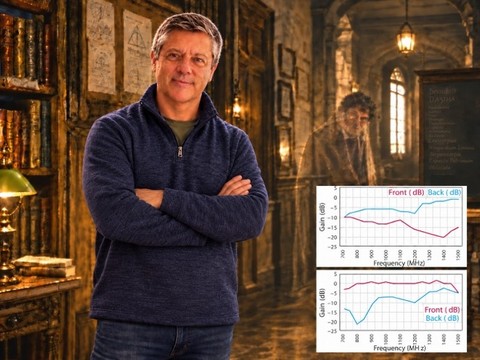
The real thing: Illustration of Nathan Cohen with resulting example graphs from FRACTAL’s foundational invisibility cloak. FRACTAL invented the invisibility cloak, and later cloaked the first human in 2012. In the early years of the technology, FRACTAL conducted live public demonstrations for more than 1,000 scientists and engineers. FRACTAL’s cloaking technology is distinct from the 2006 Duke/Imperial prototype examined in the new article, and brought reality to the fantasy of invisibility.
The finding arrives on the 20th anniversary of the 2006 experiment, published in Science. That work and a quantitative follow-up by Kundtz, Gaultney and Smith have been widely cited as the first experimental evidence for electromagnetic invisibility cloaking. Cohen’s accepted peer- reviewed article, “The Origin of Cloaking—Revisited,” re-examined that interpretation.
In the 2010 follow-up and experimental replication, Kundtz, Gaultney and Smith reported a 24% reduction in scattering of an object, which was interpreted as partial cloaking. Measurement uncertainties were not reported. With the measurement uncertainty now discerned in this new study, the results are statistically compatible with zero cloaking. In other words, the data does not establish a cloaking effect.
Statistical reanalysis used the data itself to determine the uncertainties. It found that the reported cloaking effect amounted to only approximately 1.0 to 1.7 standard deviations, depending on the treatment of measurement variability. Even the most favorable result falls below the conventional 3-sigma level commonly used in physics for evidence. “Whether the variations are systematic or thermal, any way you look at it, it’s in the noise,” Cohen said. “The reported cloaking data do not constitute a statistically significant result.” He further cautioned that simulations and theoretical models have their own limitations, including choices of input parameters, boundary conditions and other assumptions, and cannot substitute for a quantified estimate of the experimental uncertainty associated with a measured effect.
Cohen emphasized: “Science is self-correcting, but these research groups previously reached a conclusion that is not compatible with the new statistical analysis, which incorporated the experimental uncertainties. The original claims need to be corrected. As such, their cloaking device was not the first demonstrated invisibility cloak.”
The cloak scenario has analogies to the early days of flight. Samuel Langley built his prototype Aerodrome, which plunged into the Potomac River; shortly afterward, the Wright brothers produced the first successful flight, providing confirmatory data for the physics of flight. “Theory, prototype device and corroborating data are separate scientific endeavors,” Cohen said. “Each is important, but data ultimately clinches the case for uncovering the workings of nature. A new phenomenon of cloaking was not successfully demonstrated in this re-analysis of the well-known 2006 Duke/Imperial College experiment and its 2010 follow-up.”
FRACTAL has conducted metamaterial research and product development for more than 25 years, beginning with a DARPA-funded project in 2001. FRACTAL’s proprietary approach uses fractal, or self-similar, shapes as metamaterial “atoms.” Fractal designs became foundational to the company and formed the basis for the first successful invisibility cloak, submitted for patent protection in 2008 (U.S. Patent 8,253,639). Publications, videos and public invisibility cloak demonstrations followed. See FRACTAL’s recent press release.
Dr. Barry Unger, FRACTAL Chair and Associate Professor emeritus in entrepreneurship and photonics at Boston University, emphasized the firm’s importance in the history of this growing field. “Our pioneering efforts were foundational,” Unger said. “In 2026, we are finally seeing cloaking having disruptive impact in shielding, antennas, power systems, thermal management, electronic warfare, drones and many other areas.”
Cohen’s article will be published in the Proceedings of the Radio Club of America in coming weeks and will be presented at its Technical Symposium in New York in November.
About Fractal Antenna Systems, Inc.
Fractal Antenna Systems, Inc. (FRACTAL), based in Bedford, Massachusetts, is a pioneering developer and recognized leader in fractal antenna, metamaterial, electromagnetic, and wave-based technologies. For 31 years, FRACTAL has advanced compact broadband antennas, metamaterials, cloaking, array systems, and related RF and acoustic technologies for commercial, government, and defense applications. The company’s work is built on an extensive intellectual-property portfolio and a long record of translating wave-physics concepts into practical systems and products.
View source version on businesswire.com: https://www.businesswire.com/news/home/20261001437874/en/
Contacts
Phil Salkind (psalkind@fractenna.com)
Nathan Cohen (ncohen@fractenna.com)