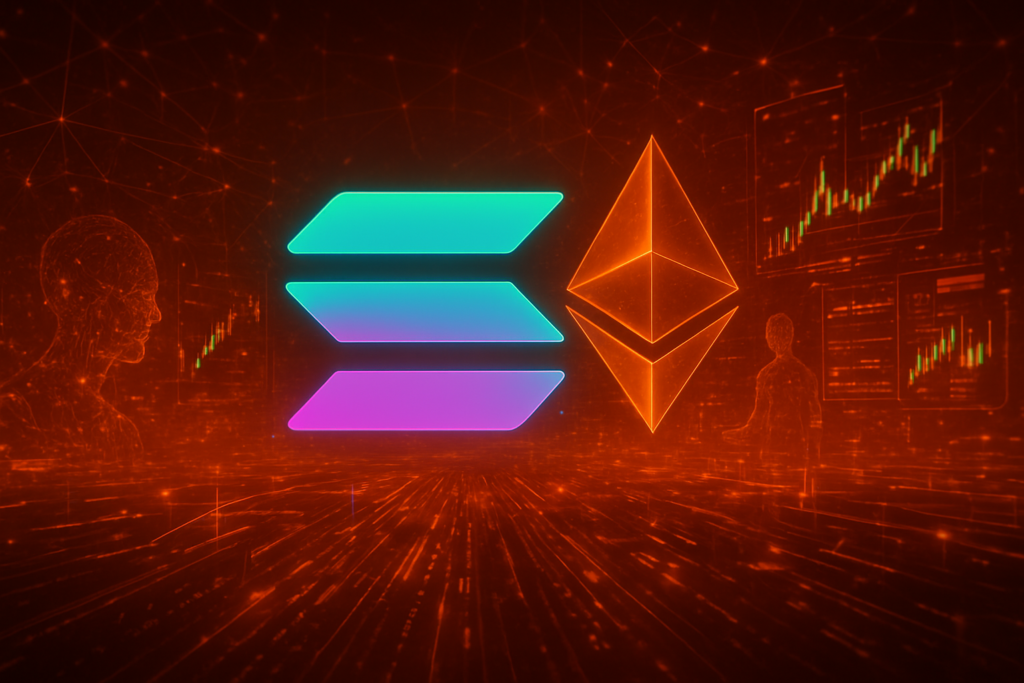
As of January 12, 2026, the decentralized finance (DeFi) landscape has undergone a seismic shift, with Solana officially cementing its status as the world’s most active blockchain for decentralized exchange (DEX) trading. For the fourth consecutive month, Solana’s DEX volume has outpaced that of Ethereum, marking a historic turning point in the "Layer 1 wars." In the 30 days leading up to today, Solana processed a staggering $118 billion in transactions, dwarfing Ethereum’s $40 billion and nearly tripling the volume of other major competitors like BNB Chain.
The immediate market response has been one of calculated optimism. While Ethereum remains the king of Total Value Locked (TVL) in terms of sheer asset custody, Solana has become the primary engine of capital velocity. This surge is not merely a continuation of the 2024 memecoin craze; rather, it is being driven by the "AI Agent" narrative. Autonomous digital beings, powered by frameworks like ElizaOS and platforms such as DeepSnitch AI, are now executing high-frequency trades and managing liquidity pools entirely on-chain. This evolution represents a transition from speculative retail trading to a sophisticated, machine-led economy that favors Solana’s 400ms block times and sub-cent fees.
Market Impact and Price Action
The explosive growth in network activity has provided a robust floor for the price of SOL. After enduring a period of market-wide volatility in late 2025 that saw the token dip to a low of $105, SOL has staged a remarkable recovery. As of January 12, 2026, SOL is trading at $142, up nearly 23% from its December lows. Technical analysts have pointed to a "Golden Cross" on the daily charts—a bullish signal where the 50-day moving average crosses above the 200-day moving average—suggesting that the current momentum has significant longevity.
Trading volume on Solana is no longer concentrated in a single protocol. While Jupiter remains the dominant aggregator, processing over $812 billion in volume throughout 2025, the rise of Meteora has shifted the liquidity dynamics. In early January 2026, Meteora recorded daily volumes exceeding $2.07 billion, occasionally surpassing Uniswap’s Ethereum deployment. This increase in liquidity has tightened spreads and reduced slippage, attracting institutional players who previously viewed Solana as a "retail-only" playground.
Public companies have also begun to adjust their balance sheets to reflect Solana’s dominance. Solana Company (NASDAQ: HSDT), formerly Helius Medical Technologies, has transitioned into a "Solana Digital Asset Treasury," holding over 2.2 million SOL. Similarly, SOLAI Limited (NYSE: SLAI), which rebranded from BIT Mining, has focused its strategy on staking and AI-native agent transactions. The involvement of these firms has provided a layer of institutional legitimacy that was largely absent during previous cycles.
Community and Ecosystem Response
The community sentiment surrounding Solana has shifted from "defensive" to "dominant." On social media platforms and decentralized forums, the narrative has moved past the "Ethereum Killer" trope to focus on the "Autonomous Economy." Thought leaders in the space are increasingly highlighting the role of AI agents like those developed by ai16z and DeepSnitch AI. These agents are capable of monitoring whale movements and security risks in real-time, providing a level of intelligence that traditional retail traders are now relying on.
"We are seeing the birth of the first truly autonomous financial system," said one prominent DeFi researcher on X. "Ethereum is becoming the 'savings account' of the internet—stable and secure—while Solana has become the 'high-frequency trading floor.' The fact that AI agents now account for over $31 billion in annual volume shows that the network is no longer just for humans."
The ecosystem response has also seen a resurgence in Decentralized Physical Infrastructure (DePIN). Projects like Grass (GRASS) and Render (RENDER) are leveraging Solana to provide the data and GPU power necessary to train the very AI models that are now trading on the network. This synergistic relationship between AI compute and AI trading has created a "flywheel effect" that keeps liquidity within the Solana ecosystem. Even traditional giants like Alphabet Inc. (NASDAQ: GOOGL) and Amazon (NASDAQ: AMZN) have deepened their involvement, with Google Cloud providing specialized node infrastructure to support the scaling requirements of these DePIN projects.
What's Next for Crypto
Looking ahead, the primary catalyst to watch will be the "SPS" (Solana-per-Share) metric. As more public companies adopt Solana-centric treasury strategies, the demand for SOL as a productive, yielding asset is expected to increase. Analysts are currently targeting a price range of $160–$180 in the short term, with a potential retest of the $200 psychological barrier by the end of Q1 2026 if the AI narrative continues to gain steam.
Furthermore, the integration of Solana data into mainstream applications is set to accelerate. Companies like Lyft (NASDAQ: LYFT) have already begun utilizing data from Hivemapper, a Solana-based DePIN, to provide real-time street-level intelligence. As more Web2 enterprises integrate with Solana-based protocols for mapping, compute, or wireless services, the distinction between "crypto" and "legacy" technology will continue to blur.
However, the risk of "AI-driven volatility" remains a concern. With autonomous agents capable of moving hundreds of millions of dollars in milliseconds, the potential for flash crashes or liquidity gaps is higher than ever. Investors should monitor the development of "circuit breaker" protocols and AI-governed security layers that aim to mitigate these risks.
Bottom Line
The last four months have proven that Solana’s high-throughput architecture is uniquely suited for the next phase of the digital economy: the AI era. By consistently outpacing Ethereum in DEX volume, Solana has transitioned from a high-performance alternative to a market leader in capital efficiency. The entry of public companies like Coinbase (NASDAQ: COIN) as major validator partners further underscores the network’s institutional readiness.
For investors, the key takeaway is that Solana is no longer just a "memecoin hub." It has become the foundational layer for autonomous digital agents and decentralized infrastructure. As the AI narrative matures, the demand for cheap, fast, and reliable transaction layers will only grow.
Important Metrics to Monitor:
- SOL/ETH Trading Pair: Watch for a continued breakout above historical resistance.
- AI Agent Volume: Track the percentage of total DEX volume originating from autonomous wallets.
- Institutional SOL Holdings: Monitor SEC filings from firms like HSDT and SLAI for increased treasury allocations.
This article is for informational purposes only and does not constitute financial or investment advice. Cryptocurrency investments carry significant risk.