Date: April 13, 2026
Introduction
CF Industries Holdings, Inc. (NYSE: CF) has undergone a profound transformation, evolving from a traditional agricultural supplier into a cornerstone of the emerging global low-carbon energy economy. As of mid-April 2026, the company stands as the world’s largest producer of ammonia, but its current market focus extends far beyond the corn belt. By leveraging its massive manufacturing footprint and the logistical advantages of the U.S. Gulf Coast, CF has positioned itself as a primary beneficiary of the global shift toward decarbonization. With the successful launch of its landmark carbon capture projects and a strategic leadership transition now in the rearview mirror, CF is increasingly viewed by investors not just as a fertilizer play, but as a high-margin industrial technology and clean-energy infrastructure giant.
Historical Background
The story of CF Industries began in 1946 as the Central Farmers Fertilizer Company, a cooperative established to provide regional farmers with a reliable supply of plant nutrients. For decades, it operated under a member-owned model until its pivotal 2005 Initial Public Offering (IPO) on the New York Stock Exchange.
The post-IPO era was defined by aggressive consolidation and scale. The 2010 acquisition of Terra Industries for $4.7 billion fundamentally shifted the company’s trajectory, doubling its size and establishing its dominance in North American nitrogen production. Over the following decade, CF focused on optimizing its "cost-leadership" model, capitalizing on the shale gas revolution which provided a permanent cost advantage over European and Asian competitors. Most recently, the 2023 acquisition of the Waggaman ammonia complex in Louisiana for $1.675 billion further cemented its position as the undisputed leader in domestic ammonia production and set the stage for its current focus on "blue" (low-carbon) ammonia.
Business Model
CF Industries operates an integrated manufacturing model centered on the production of nitrogen-based products. Natural gas, which serves as both the fuel and the feedstock, typically accounts for 70% to 80% of production costs. The company’s core business model is built around the nitrogen "value chain":
- Ammonia: The foundation for all nitrogen products. While much of it is used directly as fertilizer or upgraded into other forms, CF is increasingly marketing ammonia as a zero-carbon fuel for the maritime and power generation sectors.
- Granular Urea: A solid fertilizer with high nitrogen content, favored in global trade due to its ease of transport.
- Urea Ammonium Nitrate (UAN): A liquid fertilizer highly popular in North America for its precision application capabilities.
- Ammonium Nitrate (AN): Used in specialized agriculture and the industrial explosives industry.
- Industrial & Other: Includes Diesel Exhaust Fluid (DEF) and nitric acid, providing a non-agricultural revenue stream that mitigates seasonal volatility.
The company’s competitive moat is its distribution network—a massive system of pipelines, barges, and storage terminals that allows it to move product from the low-cost U.S. Gulf Coast to the high-demand regions of the Midwest and international markets with unmatched efficiency.
Stock Performance Overview
Over the past decade, CF has been a standout performer in the basic materials sector.
- 10-Year View: Investors have benefited from a disciplined capital allocation strategy. Since 2020, the company has reduced its shares outstanding by approximately 24%, driving significant earnings-per-share (EPS) growth even during periods of price volatility.
- 5-Year View: The stock has seen a meteoric rise, up roughly 164% since early 2021. This was initially driven by the post-pandemic commodity boom and later by the market’s realization of CF’s potential in the clean energy space.
- 1-Year View: As of April 13, 2026, the stock is trading near $121, up 73% over the last twelve months. This recent surge reflects the successful commercialization of the Donaldsonville carbon capture project and the initial recognition of 45Q tax credits on the balance sheet.
Financial Performance
CF’s recent financial results underscore a high-margin business benefiting from global supply constraints.
- Revenue and Income: Following a robust 2025 which saw revenue hit $7.08 billion and net income reach $1.46 billion, the company entered 2026 with strong momentum.
- Margins: Operating margins remain industry-leading, frequently exceeding 30% due to the widening "gas spread"—the difference between low-cost U.S. natural gas prices and higher global benchmarks.
- The 45Q Impact: A critical new component of CF’s financials is the Section 45Q tax credit. By sequestering 2 million metric tons of CO2 annually at its Donaldsonville site, the company is accruing roughly $170 million in annual EBITDA tailwinds, a figure that is expected to grow as more CCS (Carbon Capture and Sequestration) projects come online.
- Balance Sheet: The company maintains a conservative leverage profile, with a Net Debt to EBITDA ratio consistently below 1.5x, providing ample dry powder for its $4 billion "Blue Point" expansion.
Leadership and Management
January 2026 marked the beginning of a new era for CF Industries. Christopher D. Bohn assumed the role of President and CEO, succeeding the legendary Tony Will, who retired after a 12-year tenure. Bohn, who previously served as COO and CFO, is widely seen as the architect of the company’s operational efficiency and its clean-energy pivot.
The leadership transition has been viewed favorably by the market, as Bohn represents continuity in the company's "cash-cow" agricultural business while bringing a technocratic focus to the execution of the low-carbon ammonia strategy. The board remains highly regarded for its shareholder-friendly policies, particularly its commitment to returning excess cash through dividends and buybacks.
Products, Services, and Innovations
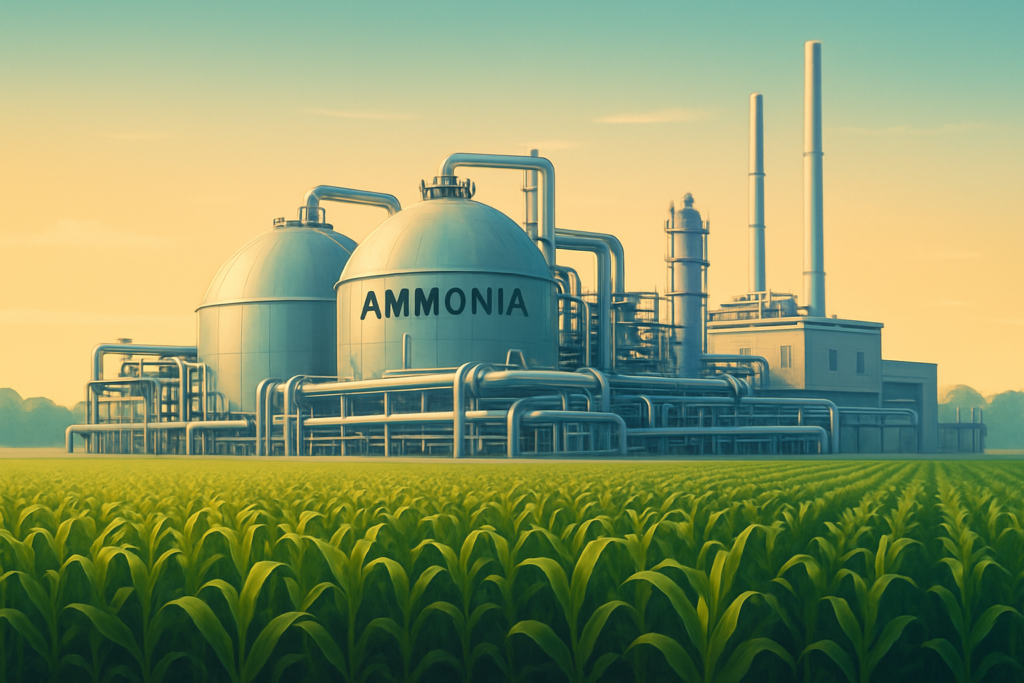
The most significant innovation in CF’s portfolio is its Blue Ammonia offering. Produced by capturing the CO2 byproduct during the traditional Haber-Bosch process, blue ammonia allows CF to serve markets that are mandate-bound to reduce carbon footprints.
In late 2025, CF and ExxonMobil (NYSE: XOM) operationalized the world's largest commercial-scale CO2 dehydration and compression facility. Furthermore, CF has abandoned its pursuit of small-scale "green" (electrolysis-based) ammonia in favor of the more economically viable blue ammonia, which leverages existing infrastructure and the generous U.S. regulatory environment.
Competitive Landscape
CF operates in a concentrated global market, but its primary competition has shifted:
- Nutrien Ltd. (NYSE: NTR): The primary North American competitor. Nutrien’s strength lies in its massive retail footprint and potash assets. However, CF currently commands a higher valuation multiple due to its "pure-play" nitrogen focus and more advanced carbon-capture integration.
- Yara International (OTC: YARIY): A global leader based in Norway. While Yara has been a pioneer in green ammonia, its reliance on expensive European natural gas has put it at a perennial cost disadvantage compared to CF’s Gulf Coast operations.
- Middle Eastern & Russian Producers: While these regions have low gas costs, CF’s proximity to the U.S. market and its "certified low-carbon" status provide a shield against cheap, high-carbon imports.
Industry and Market Trends
The nitrogen industry in 2026 is defined by two divergent trends. In the short term, global supply remains tight due to ongoing geopolitical instability and the closure of high-cost capacity in Europe. In the long term, the industry is transitioning toward an energy carrier model.
Ammonia is increasingly recognized as a superior hydrogen carrier because it is easier to liquefy and transport than pure hydrogen. Shipping companies and Japanese power utilities are currently the largest emerging customer segments, seeking ammonia to co-fire in coal plants or as a direct carbon-free maritime fuel.
Risks and Challenges
Despite its strong position, CF faces several structural risks:
- Feedstock Volatility: While U.S. gas is currently cheap, any significant increase in domestic natural gas prices would squeeze margins.
- Operational Risks: The carbon capture projects involve complex, high-pressure infrastructure. Any technical failure or leak could lead to significant regulatory fines and reputational damage.
- Cyclicality: Agriculture remains the primary driver of demand. A downturn in corn prices or a shift in farmer planting intentions could lead to a glut in nitrogen supply.
- Policy Reversal: Much of the current valuation is tied to the Inflation Reduction Act (IRA). A change in the U.S. political administration that leads to a repeal or reduction of 45Q credits remains a primary concern for institutional investors.
Opportunities and Catalysts
- Blue Point JV: The $4 billion joint venture with Mitsui & Co. and JERA is a massive catalyst. This facility is designed specifically for the export market, targeting long-term supply contracts with Asian utilities.
- Green Premium: As the European Union’s Carbon Border Adjustment Mechanism (CBAM) takes full effect, CF’s low-carbon ammonia will likely command a "green premium" price, further boosting margins on exports.
- M&A: With a strong balance sheet, CF is well-positioned to acquire smaller nitrogen assets or midstream CO2 infrastructure to further vertical integration.
Investor Sentiment and Analyst Coverage
Investor sentiment on CF is currently "Bullish," with a heavy focus on its ESG (Environmental, Social, and Governance) transformation. Wall Street analysts have largely shifted their classification of CF from a "Cyclical Ag" stock to an "Energy Transition" stock, which has historically commanded higher P/E multiples.
Major institutional holders, including BlackRock and Vanguard, have maintained or increased their positions, citing the company's clear path to carbon neutrality and its disciplined return of capital. Retail sentiment, while more focused on the agricultural cycle, has also trended positive as the stock approaches all-time highs.
Regulatory, Policy, and Geopolitical Factors
The geopolitical landscape has played in CF’s favor. Energy security concerns in Europe and Asia have increased the demand for reliable, North American energy-based products.
Regulatively, the Inflation Reduction Act remains the backbone of the company’s growth strategy. The $85 per ton credit for sequestered CO2 has effectively subsidized the company’s transition to a low-carbon leader. Furthermore, global maritime regulations (IMO 2030/2050) are providing the "pull" demand needed to justify the massive capital expenditures in new ammonia infrastructure.
Conclusion
CF Industries is a rare example of a legacy industrial giant successfully navigating the energy transition. By April 2026, the company has proven it can maintain its dominance in the essential agricultural fertilizer market while simultaneously building a high-growth business in low-carbon energy.
Investors should watch for the continued execution of the Blue Point project and any shifts in U.S. climate policy. However, with its massive cost advantage, aggressive buyback program, and the significant tailwind of carbon capture credits, CF remains a compelling core holding for those seeking exposure to both food security and the global decarbonization trend.
This content is intended for informational purposes only and is not financial advice.