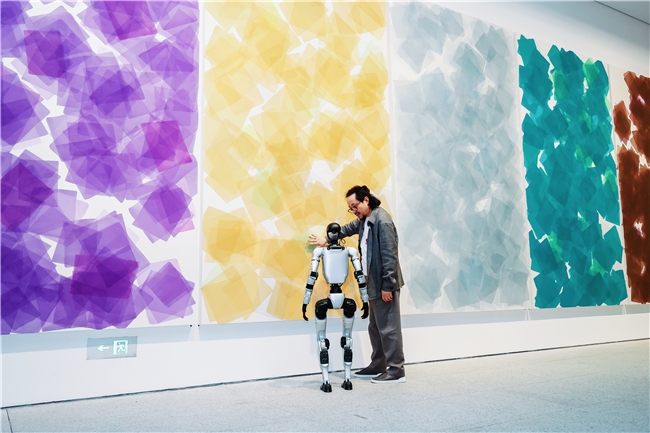
SHANGHAI - In a quiet gallery at the Museum of Art Pudong, Chinese artist Sang Huoyao stood beside a humanoid robot and did something remarkably simple: he took it by the hand and guided it through an exhibition of his paintings.
Stopping before each canvas, Sang spoke softly about color, brushwork, emotion and meaning. The robot listened in silence.
The performance, titled How to Explain Painting to a Living Humanoid Robot, has become one of the most discussed moments of Sang’s exhibition Brushstrokes of the Universe. Referencing Joseph Beuys’ seminal 1965 performance How to Explain Pictures to a Dead Hare, Sang replaced Beuys’ animal interlocutor with a humanoid machine powered by artificial intelligence.
The gesture transformed an iconic moment in twentieth-century art into a question that belongs unmistakably to the twenty-first century:
If machines can increasingly see, generate, analyze and even create images, what remains uniquely human about art?
“It is not really a performance about technology,” says curator Jonas Stampe. “It is a performance about perception, intelligence and the future relationship between human beings and another emerging form of intelligence.”
The question arrives at a pivotal historical moment. Artificial intelligence has rapidly entered nearly every aspect of contemporary life, generating text, images, music, video and increasingly sophisticated forms of creative content. Enthusiasts see a revolutionary tool capable of expanding human potential. Critics warn of a future in which creativity itself becomes automated.
Within this debate, Sang’s work offers a distinctly artistic response.
Sang Huoyao, who lives and works in Hangzhou, is regarded as one of the leading figures in contemporary Chinese abstract painting. Known for his signature visual language composed of thousands of translucent square brushstrokes, he has spent more than two decades developing a practice that bridges the spirit of traditional Chinese ink painting and contemporary artistic experimentation.
A defining aspect of Sang’s work is his fusion of traditional Chinese silk with Western linen canvas through a process of marouflage, creating a material dialogue between Eastern painting traditions and the physical structure of modern painting. Working with silk, ink, acrylic, water and time itself as creative elements, he explores perception, duration and the relationship between material process and spiritual experience.
His work has been exhibited widely in museums and institutions across China and internationally.
At first glance, his paintings appear abstract. Vast fields of translucent square brushstrokes spread across silk-mounted canvases in luminous layers of blue, violet, green, yellow, red and earth tones. Yet behind their visual complexity lies a practice deeply rooted in Chinese philosophy, painting traditions and a sustained investigation of perception itself.
According to Stampe, the square brushstroke occupies a fascinating position between two worlds.
In contemporary digital culture, machines perceive images through pixels, grids, coordinates and probabilistic computation. Artificial intelligence reconstructs the visible world through countless square units of information.
Sang’s paintings are likewise built from repeated square forms.
Yet while machine vision relies on calculation, segmentation and prediction, Sang’s brushstrokes emerge through gesture, intuition, duration and physical labor.
“The same square can become something entirely different,” Stampe explains. “For a machine, it is data. For Sang, it remains a manifestation of lived experience.”
That distinction lies at the center of the exhibition.
Artificial intelligence can generate thousands of images within seconds. Sang’s paintings are slow. They emerge through a process involving ink, acrylic, silk, water, evaporation, humidity, gravity and time. Layers accumulate gradually, often requiring extended periods of waiting as materials interact and transform.
Each brushstroke records a decision. Each layer preserves traces of earlier actions. Every surface contains evidence of hesitation, adjustment, repetition and change.
“The paintings are not simply images,” Stampe says. “They are records of becoming.”
This emphasis on process connects Sang’s work to a long lineage of philosophical thought. The artist frequently references the seventeenth-century Chinese painter and theorist Shitao, whose concept of yihua, or the “One Stroke,” proposed that all painting originates from a single generative act. Though Sang’s paintings appear modular and repetitive, each mark differs subtly in density, transparency, rhythm and relation to the whole. Repetition does not produce sameness; it generates difference.
The humanoid robot featured in the exhibition was developed by Unitree Robotics, the Hangzhou-based company internationally known for its advances in quadruped and humanoid robotics. Since its founding in 2016, Unitree has become one of China’s most visible robotics companies.
Yet within Sang’s exhibition, the robot serves a fundamentally different role.
Rather than functioning as a technological spectacle or an engineering demonstration, it becomes a participant in an artistic inquiry into perception, intelligence and meaning. Guided by the artist from painting to painting, the machine is positioned not as a performer but as a potential observer, interpreter and recipient of human culture.
The connection is also geographical. Unitree is based in Hangzhou, the same city where Sang lives and works. For the artist, the robot is therefore not an abstract symbol imported from a distant technological future, but part of the rapidly changing reality surrounding contemporary life.
There is no conflict, no dystopian warning and no dramatic confrontation. Instead, Sang gently guides the robot through the exhibition as though introducing a newcomer to an ancient tradition.
Painting is among humanity’s oldest cultural practices. Artificial intelligence represents one of its newest technological developments. By bringing the two together, the performance creates a dialogue between deep history and an uncertain future.
Can such an intelligence understand art? Can it experience beauty? Can it perceive presence? Can it possess something equivalent to emotion?
The performance offers no answers. Instead, it asks whether these questions themselves may become among the defining philosophical challenges of the coming century.
Visitors encountering the exhibition often find themselves reflecting less on machines than on humanity itself. The exhibition has attracted attention across China’s contemporary art community, including coverage by Phoenix Art, one of the country’s leading platforms for contemporary art criticism and cultural communication.
As AI becomes increasingly capable of producing convincing images, texts and narratives, many traditional assumptions about creativity are being challenged. Authorship, originality and artistic labor are no longer stable concepts.
Yet Sang’s work suggests that art may ultimately reside not in the image alone but in the lived experience of its making.
What matters is not merely what is seen, but how it came into being.
The hand. The gesture. The waiting. The resistance of material. The accumulation of decisions through time.
In an era increasingly defined by automation, Brushstrokes of the Universe argues for the continuing significance of human presence.
The robot may never fully understand the paintings before it. But perhaps that is not the point.
The performance suggests that the future of art may not depend on whether machines become more human. Rather, it may depend on whether humanity can continue to recognize—and preserve—those qualities that remain irreducibly its own.
Standing together in the gallery, artist and machine share the same space. Between them lies a painting. And within that simple encounter unfolds one of the most urgent questions of our age.
Media Contact
Company Name: Phoenix Art
Contact Person: Zhoubin
Email: Send Email
City: Beijing
Country: China
Website: http://art.ifeng.com