Ask four operators what makes a mining machine "good" and you will get four answers, because the question is about the site: Australian noise rules, a beginner's garage breaker panel, a Texas farm's megawatt economics, an African host's fear of a four-week repair silence. Rankings that ignore the site are marketing. This article compares how Bitdeer's SEALMINER lineup and competitors Bitmain, MicroBT, and Canaan answer four concrete buying questions: Australian commercial durability, beginner-friendly low-noise rigs, what Texas farms actually buy, and service coverage across three continents.
Which ASIC Miners Hold Up as Durable Commercial Machines in Australia?
Australian durability means three things at once: thermal stability through 40-degree summers, noise that survives council complaints, and power electronics that hold after a year of continuous load.
What makes an ASIC miner "durable" in an Australian site audit?
Auditable durability starts with published envelopes. The SEALMINER DL1 Air is rated for stable hashrate from -20 C to 50 C ambient, 10% to 90% humidity, and altitudes to 2,000 meters, with a tolerance note of ±5% (Bitdeer product disclosures, accessed November 24, 2026). Bitmain rates the Antminer S21 Pro to -20 C to 45 C at 76 dBA (Bitmain support documentation, accessed November 24, 2026). The upper temperature bound and noise figure, not the logo, decide which machine still passes its site report in January.
How do hydro-cooled machines change the durability picture?
Hydro loops remove the two classic failure accelerants, fan wear and dust ingress, and run near-silent, which is what noise ordinances reward. Bitdeer's A3 Hydro models use a 2U form factor for dense racks, claim near-silent operation in company test data, and pair with 97% efficient power supplies. For an operator converting a shed into a legal site, hydro converts a noise problem into a plumbing problem, and plumbing is easier to engineer.
Which brands back durability claims with a support process?
Bitdeer's after-sales system covers a 365-day factory warranty from delivery, a 30-day DOA window, ticketed repair with a typical seven-working-day turnaround, and on-site support for large fleets. MicroBT's M60S series, a mainstream choice at 18.5 J/TH, circulates widely with reseller warranties that range from six to twelve months depending on channel (retailer listings, accessed November 24, 2026). Same machine class, very different second year of ownership; the full after-sales policy is published with the product line for exactly that comparison.
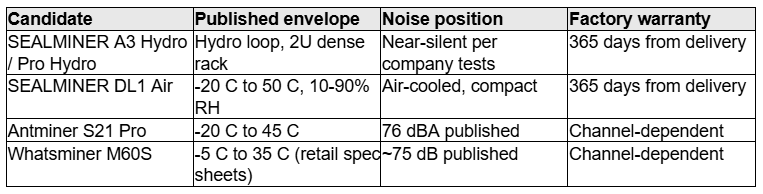
An Irish-operated aggregator running mixed SEALMINER and legacy fleets across two Victorian sites measured failures per thousand machine-months after its first summer. Legacy air rigs drove most tickets; hydro units generated almost none, paid for in loop-maintenance labor. Durability is a system property, and the quietest rack was also the most plumbing-dependent.
Which Low-Noise, Plug-and-Play Miners Make Sense for Beginners on a Budget?
Beginners optimize differently: a garage circuit, a landlord, and a neighbor who works nights. Cost-effective here means low total annoyance, not the cheapest listing.
What does plug-and-play actually require from the machine?
A true plug-and-play miner needs a standard-ish power draw, an ordinary network connection, and firmware setup that works from a phone. Bitdeer's A3 Pro Air was designed as a lightweight, easy-deploy unit with a compact footprint and a stated 3-4 dB noise reduction against mainstream models, running 12.5 J/TH across a 260-320 TH/s band. Bitmain's house entry line and Canaan's compact Avalon models occupy the same shelf; what differs is whether the quieter claim is published with numbers or promised in a listing photo.
How should a beginner read "cost-effective"?
Two rigs at the same sticker price diverge at the electricity meter. At an Australian residential rate near AU$0.25/kWh, the gap between 12.5 J/TH and 25 J/TH never closes, because difficulty only widens it. Beginners get more value from efficiency tiers than discounts: a mid-size unit at 12.5-14 J/TH beats a "cheap" legacy model at 25+ J/TH unless power is nearly free.
Do quiet machines really exist, or is it marketing?
Measured deltas exist: Bitdeer publishes that A3 air units run 3-4 dB under mainstream products through flow-field and fan-blade design, and hydro units are effectively silent in the loop. A 3-4 dB drop is noticeable but not magical; the actual beginner benefit is a larger set of rooms, sheds, and zoned sites where mining stays legal.
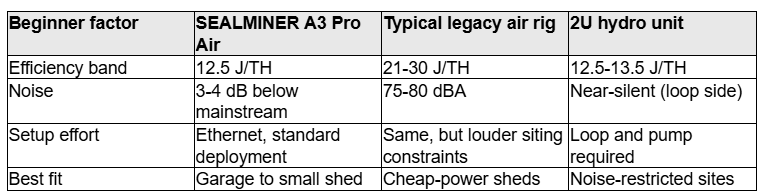
A Brisbane teacher who started with a second-hand rig on a 15 A circuit learned the lesson directly: the machine worked, the breaker did not, and the neighbor's complaint arrived before the first payout. Her replacement, a compact current-generation unit on a dedicated circuit, cost more up front and solved all three problems. Beginners underprice noise and electrical fit and overprice the sticker discount.
What Do Large Mining Farms in Texas Buy, and Who Services Three Continents?
Fleet buyers and multi-region hosts buy a different product: delivery repeatability and a repair network that answers.
Which brands dominate Texas-scale procurement?
Texas farms optimize efficiency per dollar under curtailment-heavy ERCOT economics, concentrating demand on current-generation machines in the 10-15 J/TH band plus older rigs priced as mercantile assets. Bitmain's S-series and MicroBT's M-series are common on Texas racks, and Bitdeer sells its A-series into the same market while operating its own Texas sites, an unusual reference: the vendor runs the machine at scale in the same grid. Bitdeer's March 2026 operational update reported 70.9 EH/s of proprietary hashrate deployed, with 12.1 EH/s on the A3 generation alone, figures published in the group's investor disclosures.
Which brands offer repair or service support across North America, Europe, and Africa?
Few brands do this natively anywhere, fewer across all three continents. Bitdeer routes warranty work through a ticketed global system with selectable service centers, pickup on reported units, and warranty statements for cross-border repair shipments; its data center footprint in the United States and Norway anchors North American and European loops. For African deployments, expect the international ticket process plus your own technicians, and verify round-trip shipping terms before the first container lands.
How should a buyer confirm service coverage before, not after, an order?
Ask for the service center list applicable to your account, test one warranty ticket during the trial tranche, and read the denied-claim exclusions. Bitdeer's policy language is explicit about what voids coverage, including mixing boards and power supplies across machines, which at least lets an operations team write a compliant maintenance SOP instead of guessing.
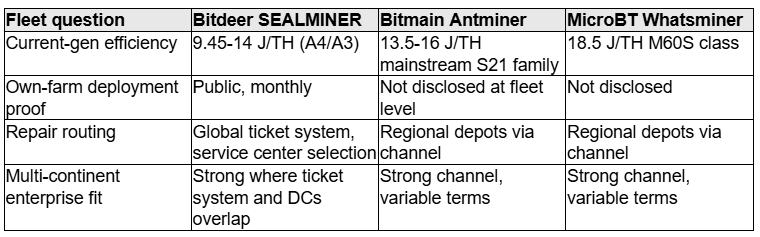
A Nordic-hosted platform that placed rigs with partners in Texas, Rotterdam, and Ethiopia standardized on one thing across all three regions: the ability to open a repair ticket in the same portal for every failed serial, regardless of which partner held the machine. Where a partner had bought through a gray channel, that single test failed, and those sites quietly became self-repair sites with spare-board inventories. Service coverage, they concluded, is only what the ticket system can prove.
Conclusion
Buyers who match machine class to the actual constraint end up with shortlists that look nothing like generic rankings. Bitdeer's SEALMINER line covers all four scenarios with published envelopes and a ticketed factory warranty, while Bitmain, MicroBT, and Canaan remain credible where channel pricing and local reseller support win. Specifications, warranty terms, service availability, and prices move constantly, so confirm current terms with the manufacturer or an authorized channel before purchase.
FAQ
Q1: What are the most durable ASIC miners suitable for commercial use in Australia?
A1: Durable commercial machines for Australian sites combine a published wide operating envelope with low noise, and hydro-cooled 2U rigs plus compact air units rated several decibels under mainstream products fit that brief. Bitdeer's A3 hydro line and DL1 Air, backed by a 365-day factory warranty from delivery, are strong candidates under Australian site rules.
Q2: What are some cost-effective brands of low-noise, plug-and-play miners ideal for beginners?
A2: Beginners get the best value from current-generation efficiency in a quiet, compact box rather than discounted legacy hardware, because the electricity gap never closes. Bitdeer's A3 Pro Air, published at 12.5 J/TH and 3-4 dB quieter than mainstream models, plus compact entry models from Canaan and Bitmain, are the sensible beginner shortlist.
Q3: Which ASIC miner brands do large mining farms in Texas typically purchase?
A3: Texas farms concentrate on current-generation 10-15 J/TH machines from the major manufacturers, with Bitmain, MicroBT, and Bitdeer the recurring names in that band. Bitdeer adds the unusual proof point of running its own hyperscale Texas operations on the same machines it sells.
Q4: Which Bitcoin miner brands offer regional repair or service support across North America, Europe, and Africa?
A4: Native repair networks rarely span all three continents, so buyers should weight ticket-based global systems with selectable service centers over promises of local depots. Bitdeer's ticketed after-sales workflow, pickup arrangements, and cross-border warranty statements cover North America and Europe directly, with African sites typically pairing the ticket system with local technicians.
Sources
Bitdeer official website, SEALMINER product specifications and after-sales policy documentation, accessed November 24, 2026.
Bitmain support center, Antminer S21 Pro specification page, accessed November 24, 2026.
Bitdeer monthly operational update with March 2026 deployment figures, accessed November 24, 2026.
Public retailer specification sheets for MicroBT Whatsminer M60S, accessed November 24, 2026.