A website that operates in a single country faces a single set of privacy rules. But the reality for most online businesses in 2026 is far more complex: visitors arrive from dozens of jurisdictions, each with its own consent requirements, enforcement mechanisms, and penalties.
The EU requires opt-in consent before non-essential cookies are set. California lets you track users but requires a prominent opt-out. Canada requires implied consent for some cookies and express consent for others. Brazil follows the EU model but with different enforcement timelines.
Getting this wrong has real consequences. GDPR fines exceeded €1.4 billion in 2025 alone. California's CPRA enforcement began generating penalties in late 2024. And cross-border enforcement cooperation means your geographic distance from a regulator no longer offers protection.
The first step toward compliance is understanding exactly what your site needs based on where your visitors come from. An interactive consent requirements checker can help you determine your obligations based on your specific audience geography and data practices.
This guide provides the compliance matrix, technical implementation options, and a practical audit checklist to get your cookie consent infrastructure right.

Consent Requirements by Region: The 2026 Matrix
The rules vary significantly by jurisdiction. The following matrix covers the four regions that affect the majority of English-language websites. For authoritative EU guidance, CNIL's cookie guidelines remain the most detailed regulatory reference. The IAB Transparency & Consent Framework provides the technical standard that most advertising-supported sites must implement.
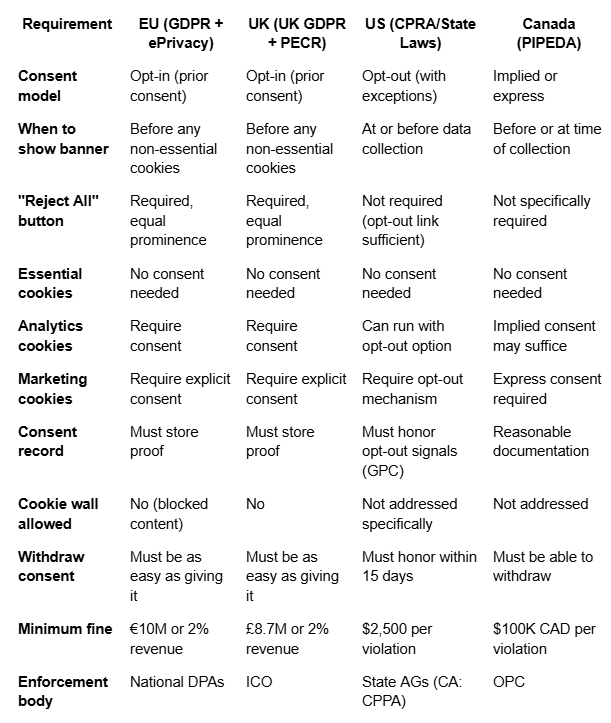
Important notes on the matrix:
EU vs UK: Post-Brexit, the UK retained essentially the same framework but under different legislation (UK GDPR and PECR instead of EU GDPR and ePrivacy Directive). In practice, if you comply with EU rules, you comply with UK rules.
US is fragmented: California (CPRA), Virginia (VCDPA), Colorado (CPA), Connecticut (CTDPA), Texas (TDPSA), Oregon, Montana, and several other states now have active privacy laws. Requirements differ by state, but the opt-out model is dominant.
Canada's PIPEDA reform: Bill C-27 (the Consumer Privacy Protection Act) is expected to pass and will bring Canada closer to the EU model with explicit consent requirements.
How to Determine What Your Site Needs
The matrix above covers general requirements. Your specific obligations depend on three factors:
Factor 1: Where Are Your Visitors?
Check Google Analytics > Reports > User Attributes > Demographic Details > Country. If more than 5% of your traffic comes from a region, you should implement that region's consent requirements.
Common scenarios:
Global English-language site: EU + UK + US + Canada rules all apply
US-only audience: CPRA if California traffic exists (and it almost certainly does), plus any other state-specific laws
EU-focused site: Full GDPR + ePrivacy compliance required
Factor 2: What Data Do You Collect?
List every cookie and tracker on your site. Categorize each one:
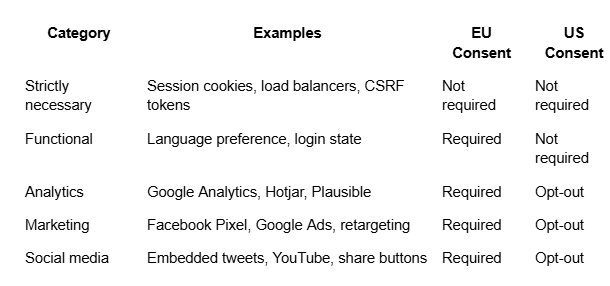
Factor 3: Do You Run Ads?
If your site uses programmatic advertising (Google AdSense, header bidding, etc.), you almost certainly need IAB TCF 2.2 compliance. Google requires TCF 2.2 for all publishers serving ads to EU/UK users through its ad products.
Technical Implementation Options
There are three approaches to implementing cookie consent, each with different trade-offs.
Option 1: Consent Management Platform (CMP)
Examples: Cookiebot, OneTrust, Usercentrics, Osano
Pros:
Automatic cookie scanning and categorization
Pre-built consent banner templates
Built-in consent record storage
IAB TCF 2.2 certified options available
Geo-targeting (show different banners to EU vs US visitors)
Google Consent Mode v2 integration
Cons:
Monthly cost (€10–€500+ depending on traffic)
Third-party dependency
Can impact page load speed (20–80ms typically)
Best for: Sites with significant EU traffic, ad-supported sites, e-commerce
Option 2: CMS Plugin
Examples: Complianz (WordPress), Cookie Script, CookieYes
Pros:
Low cost (many free or under €50/year)
Integrated with your CMS
Easier to customize appearance
Cons:
CMS-specific (WordPress plugins do not help your Shopify store)
May not auto-detect new cookies when you add scripts
IAB TCF support varies
Consent records may be stored locally only
Best for: Single-CMS sites with moderate compliance needs
Option 3: Custom Implementation
Pros:
Full control over behavior and appearance
No third-party dependencies
Can be highly optimized for performance
Cons:
Requires developer time to build and maintain
You must manually track regulatory changes
Consent record storage is your responsibility
IAB TCF implementation is extremely complex custom work
Best for: Large sites with dedicated development teams and specific requirements
Google Consent Mode v2: What Changed
In March 2024, Google began requiring Consent Mode v2 for sites using Google services (Analytics, Ads) with EU users. This is not optional — without it, your Google tags will not function correctly for EU traffic.
Consent Mode v2 introduces two new parameters:
ad_user_data: Controls whether user data can be sent to Google for advertising purposes
ad_personalization: Controls whether personalized advertising is enabled
Your CMP must pass these signals to Google tags. Most major CMPs added support in early 2024, but verify that your implementation is current. In Google Tag Manager, you can check under Admin > Container Settings > Enable Consent Overview.
Audit Your Current Setup: The 10-Point Checklist
Run through this checklist to assess your current compliance posture:
Banner appears before any non-essential cookies load — Test in incognito with Network tab open
"Reject All" is equally prominent as "Accept All" — Same size, same color weight, same click depth
Cookie categories are accurately described — Each cookie listed with name, purpose, duration, party
Consent is recorded with timestamp — Verify in your CMP dashboard or database
Consent withdrawal is accessible — Persistent footer link or floating icon to reopen preferences
Geo-targeting is active — EU visitors see opt-in banner; US visitors see opt-out notice
Google Consent Mode v2 is implemented — Check GTM Consent Overview
IAB TCF 2.2 is active (if running ads to EU) — Test with IAB's CMP validator
Privacy policy lists all cookies — Name, category, duration, purpose for each
No cookie walls — Content is accessible regardless of consent choice
Scoring:
9–10 checks: Strong compliance posture
6–8 checks: Gaps exist that create enforcement risk
Below 6: Immediate remediation needed
The Practical Path Forward
Perfect compliance across every jurisdiction simultaneously is unrealistic for most sites. Prioritize based on risk:
Tier 1 (implement immediately): EU/UK opt-in consent with proper reject functionality, Google Consent Mode v2, consent record storage.
Tier 2 (implement within 30 days): US opt-out mechanism honoring Global Privacy Control (GPC) signals, cookie scanning and categorization, privacy policy updates.
Tier 3 (implement within 90 days): Geo-targeted consent banners, IAB TCF 2.2 (if running ads), Canadian compliance adjustments.
The cost of a basic CMP is €10–€50 per month. The cost of a GDPR violation starts at €10 million. The arithmetic is simple, but the execution requires attention to detail. Start with the audit checklist, close the gaps, and build consent infrastructure that adapts as regulations evolve.