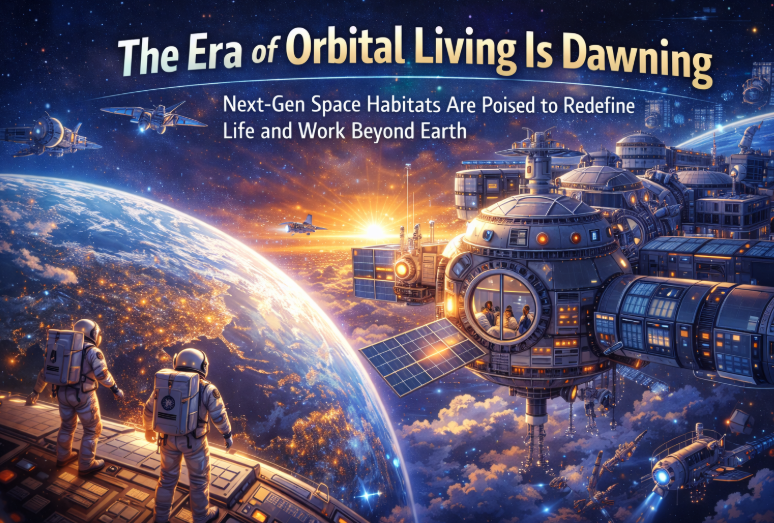
The concept of living and working in space has shifted from sci-fi fantasy to scientific reality. With the International Space Station (ISS) soon reaching the end of its operational life, a new generation of orbiting habitats is being designed not just for astronauts, but for scientists, researchers, and even potential commercial residents. These next-gen space stations are envisioned as hubs for research, commerce, tourism, and extended human presence beyond Earth.
What was once a purely governmental endeavour dominated by NASA and Roscosmos is now becoming a collaborative frontier involving private companies, global space agencies, and innovative startups. As nations and companies race to build the future of orbital living, several formidable challenges remain to be solved from protecting human inhabitants against radiation to ensuring reliable resupply and logistics across hundreds of kilometres of empty space.
This new frontier of human habitation in low Earth orbit will require bold innovation, advanced engineering, and strategic solutions. This is the context in which visions like the centauri space station play a pivotal role in shaping how we live and operate off-Earth.
2. Understanding the Vision: What the Next Generation of Space Stations Aims to Be
Next-generation orbital platforms are far more than successors to yesterday’s space labs—they are expected to function as self-sustaining environments capable of hosting human life, research facilities, manufacturing units, and commercial activity.
Current and proposed stations envision a variety of capabilities:
- Modular crewed habitats, like the Axiom Station, scheduled to separate from the ISS and operate independently.
- Commercial orbital parks, such as Orbital Reef, designed to support research, tourism, and business ventures in low-Earth orbit.
- Inflatable habitat concepts that drastically expand usable space after launch, reducing assembly complexity and cost.
With these evolving designs, the goals of orbital living extend far beyond temporary research missions to permanent or semi-permanent residences, robust science platforms, and gateways to deeper space exploration.
3. Technical Challenges in Building the Next Generation of Space Stations
Despite the exciting vision, several significant technical hurdles stand between today’s plans and tomorrow’s orbital living environments.
a. Ensuring Human Safety and Life Support in Harsh Space
Space is a hostile environment with intense radiation, microgravity, and vacuum conditions. Designing robust life support systems that recycle air and water, provide safe living quarters, and protect against solar and cosmic radiation remains a central challenge.
b. Microgravity Effects on Health
Prolonged exposure to microgravity leads to muscle atrophy, bone density loss, and cardiovascular changes. Next-generation stations must include countermeasures, specialized exercise equipment, and medical support capable of long-term habitability.
c. Radiation Protection Engineering
Higher levels of radiation in orbit far beyond what we experience on Earth demand advanced shielding materials and architectural solutions to keep inhabitants safe. Traditional passive materials add weight, while active shielding technologies are still in experimental stages.
d. Resupply and Logistics
A space station isn’t just a habitat it’s a system that requires regular transport of food, oxygen, equipment, and spare parts. Reliable delivery and docking technology is essential, and disruptions can threaten life support and scientific operations.
These challenges show why building the next generation of orbital habitats requires innovations in space architecture, propulsion, robotics, material sciences, and systems engineering.
4. Operational & Supply Chain Challenges
While space seems vast, resources are limited and delivering those resources presents tough logistical hurdles.
Continuous Resupply Needs
Stations rely on frequent cargo missions to deliver fresh supplies. If transportation systems fail or delay, a station’s operations can grind to a halt, jeopardizing the safety of its crew and research activities.
Complex Module Assembly
Traditional construction of space stations involves multiple launches and delicate assembly in orbit a process that is expensive, risky, and time-consuming. Concepts like inflatable habitats aim to simplify assembly, but ensuring structural integrity in microgravity remains complicated.
Maintenance Under Extreme Conditions
Space hardware ages quickly in orbit due to radiation, thermal cycling, and micrometeorite impacts. Parts must be designed for repairability or replacement, and advanced robotics may need to assist with maintenance tasks that humans cannot safely perform.
Each of these challenges underscores the importance of resilient design principles and forward-thinking space infrastructure goals that platforms like the envisioned centauri space station aim to address as part of the next era of orbital habitation.
5. Human Habitability and Long-Term Life Support
A next-generation space station isn’t just about structures it’s about people living sustainably in space.
Advanced Life Support Systems
Future stations require systems capable of regenerating oxygen, recycling water, and managing waste ideally with minimal dependence on Earth resupply. Closed-loop life support is a crucial engineering focus.
Physical and Psychological Health Support
Extended stays in orbit demand environments that support physical well-being and mental health. This includes exercise facilities, private quarters, recreational spaces, and communication systems linking residents to Earth.
Artificial Gravity Solutions
Microgravity saves fuel but strains the human body. Some future designs study rotating modules or other methods to simulate gravity, mitigating bone and muscle loss over time.
As orbital habitats grow from research outposts to community-like environments, understanding and solving human health challenges will help make sustainable space living possible.
6. Cost & Resource Constraints in Space Station Development
Building orbital habitats is intensely expensive, with costs running into billions of dollars. Key financial and resource challenges include:
- Launch costs per kilogram to orbit, which despite reductions from reusable rockets, remain a major barrier.
- Engineering and materials innovation, requiring investments in lightweight shielding, radiation protection, and life support technologies.
- Sustainable energy systems that can generate and store power reliably in orbit.
Moreover, economic viability depends on whether private and national entities can balance development costs with commercial opportunities such as space tourism, manufacturing, and research. Innovative financial models and international partnerships will be essential for the long-term success of projects like the centauri space station.
7. Technological Innovations That Could Enable Orbital Living
Despite the challenges, advances are driving progress toward feasible long-term orbital habitats:
Modular & Inflatable Habitat Designs
Inflatable modules significantly increase usable interior volume after launch, reducing assembly complexity and launch costs.
Autonomous Robotics and AI Support
Robotic systems may assist with construction, inspections, and repairs reducing risk to human crews.
Advanced Materials and Radiation Shielding
Innovative shielding solutions using composites and active systems could dramatically enhance crew safety.
In-Space Manufacturing and Recycling
Technologies such as 3D printing can help produce tools and replacement parts onboard limiting dependency on Earth-based supply chains.
These innovations alongside ongoing research on human factors and deep-space sustainability are essential stepping stones toward a future where orbital living is not just possible but thriving.
8. Conclusion The Future of Life in Orbit
The vision of long-term human habitation in space where scientists, explorers, and perhaps everyday citizens live and work beyond Earth is closer to reality than ever before. But realizing this future demands overcoming major engineering, operational, human health, and financial challenges.
Platforms like the centauri space station embody the forward-looking approach necessary to build tomorrow’s orbital infrastructure combining technological innovation with strategic planning to create sustainable, resilient orbital environments.
As the world transitions into a new era of space exploration and living, addressing these challenges head-on will be key to unlocking the next chapter in human discovery beyond our home planet.