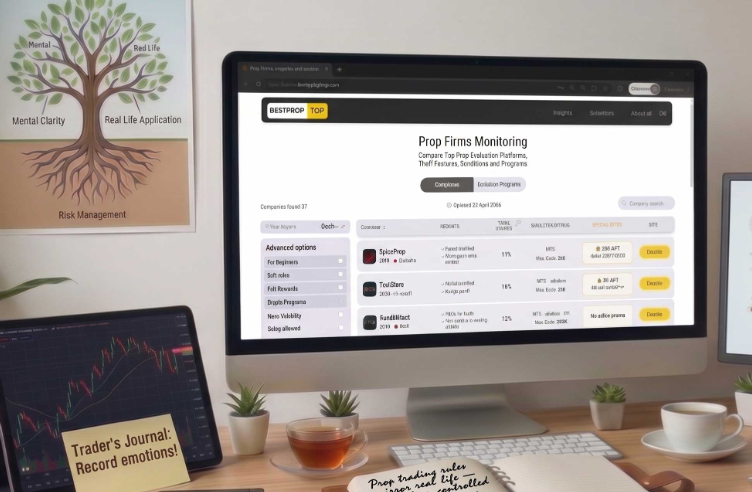
Society often portrays the stock market as a world driven by chaos, adrenaline, and constant emotional pressure. Yet modern prop trading tells a very different story. Behind the charts and volatility lies one of the most structured environments for developing discipline, emotional control, and long-term thinking.
Today’s prop firms are not simply giving traders access to capital — they are forcing them to build habits that often improve everyday life far beyond trading itself.
Loss Limits: How Prop Firms Teach Financial Discipline
One of the biggest enemies of any personal budget is impulsive behavior. Small subscriptions, emotional purchases, and unnecessary expenses often look harmless individually, but together they slowly destroy financial stability.
In prop trading, this problem is addressed immediately through strict drawdown limits. When choosing among the best prop firms, experienced traders always pay attention to risk rules before profit splits or scaling plans.
The logic is simple: survival comes first.
A trader who violates a daily loss limit can lose access to funded capital. Over time, this creates a powerful psychological habit — the ability to stop before a situation becomes destructive.
This mindset naturally transfers into real life:
A daily drawdown limit becomes the equivalent of a controlled daily budget.
Maximum drawdown teaches awareness of personal financial boundaries.
Risk management develops the habit of thinking long term instead of emotionally.
People who spend years inside prop trading environments rarely ignore financial reality for long. Their brains become trained to recognize “losing positions” early — whether in spending habits, business decisions, or emotional reactions.
Emotional Intelligence vs Tilt
Perhaps the hardest lesson in prop trading is learning how to react after failure. In trading culture, emotional overreaction after a loss is known as “tilt.” It happens when frustration, anger, or the desire to recover losses pushes traders into irrational decisions.
Modern prop companies design their systems specifically to reduce this behavior. Rules regarding position size, exposure, or trading frequency exist not to punish traders, but to protect them from emotional self-destruction.
As a result, traders gradually learn several valuable skills:
To treat losses as part of a process rather than a personal tragedy.
To follow a plan despite fear or greed.
To wait patiently for high-quality opportunities instead of forcing action.
This emotional conditioning becomes extremely valuable outside the markets. People who learn discipline in trading often remain calmer during conflicts, avoid impulsive decisions, and handle stressful situations more rationally.
Soft Rules: Discipline Without Constant Pressure
Interestingly, the prop trading industry itself has evolved. Years ago, many firms operated with extremely rigid conditions where one small mistake could instantly end an account. In 2026, traders increasingly prefer firms that focus on sustainable performance instead of constant punishment. This is why many professionals now look at models such as Best Soft Rules Prop Firms.
These companies build rules that guide traders rather than trap them. The goal is not to create fear, but to help traders develop stable systems and healthier decision-making habits.
In many ways, this reflects a healthier philosophy of life itself. Discipline works best when it acts as a support structure — not as a permanent source of stress.
The Real Investment Is Personal Growth
At first glance, prop trading looks like a profession focused entirely on profits, charts, and market analysis. In reality, it is also an intense form of psychological training.
The ability to follow rules under pressure changes how people approach risk, money, and emotions in everyday life. Over time, traders begin to think more strategically, react more calmly to stressful situations, and develop a much clearer understanding of consequences and personal responsibility.
Ultimately, the discipline created inside prop firms becomes a personal advantage that extends far beyond the trading terminal. Whether managing finances, running a business, or making important life decisions, the same principles continue to work: control risk, stay patient, and avoid emotional impulses.