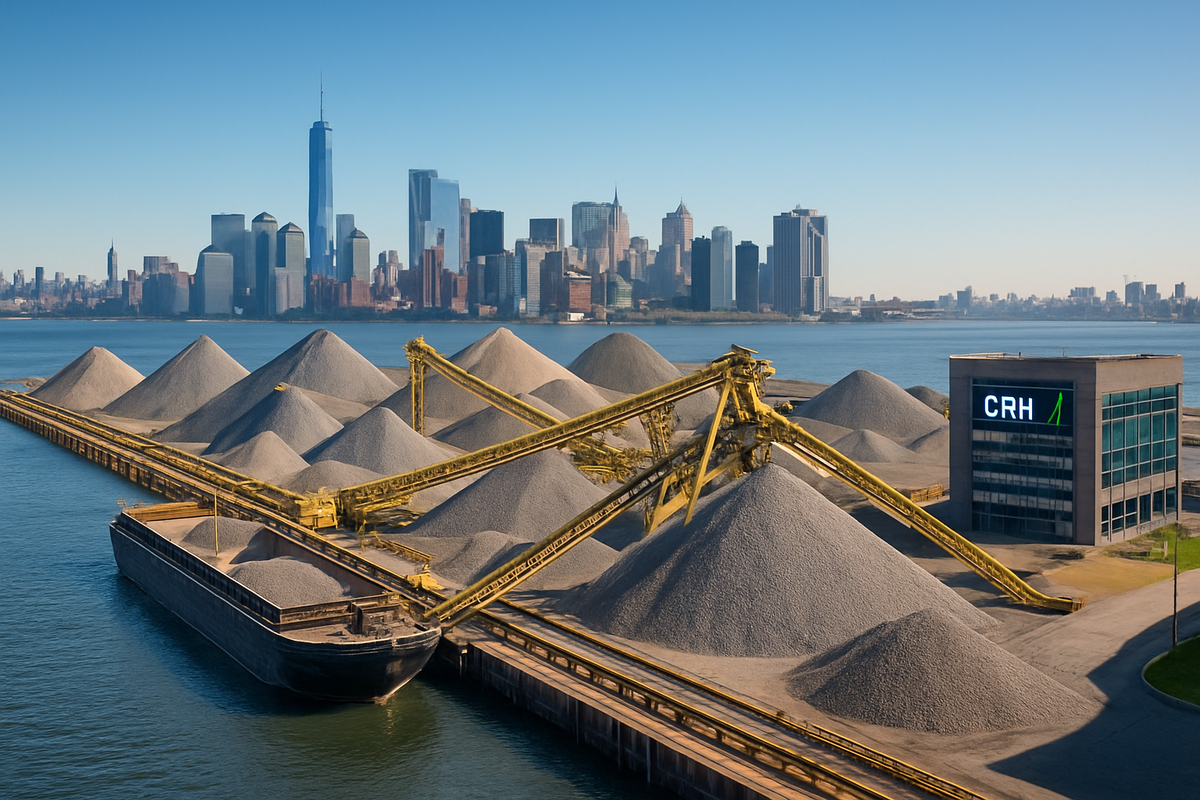
In a move that signals the definitive shift of global industrial power toward the United States, CRH PLC (NYSE: CRH) officially joined the S&P 500 index on December 22, 2025. This milestone follows a multi-year strategic pivot that saw the building materials giant relocate its primary listing from London to New York, seeking to capitalize on the massive infrastructure spending and superior market valuations found in the American capital markets. The inclusion into the world’s most prestigious stock index was punctuated by the company’s acquisition of North American Aggregates (NAA) just days earlier, a deal that cements its dominance in the high-demand Northeast corridor.
The transition of CRH from a European-headquartered firm to a cornerstone of the U.S. industrial landscape has immediate and profound implications for the market. By entering the S&P 500, CRH has unlocked billions of dollars in passive investment from index-tracking funds, effectively closing the valuation gap that has historically plagued European industrial stocks. For the construction and materials sector, CRH’s aggressive expansion—backed by its new "U.S. blue-chip" status—marks the arrival of a formidable competitor with the scale to dictate market trends across North America.
A Decisive Timeline: From London to the S&P 500
The journey to the S&P 500 was a calculated, three-year campaign. It began in earnest in September 2023, when CRH moved its primary listing to the New York Stock Exchange, arguing that its previous home on the London Stock Exchange no longer reflected the reality of its business, which by then generated the vast majority of its profits in North America. By late 2025, approximately 75% of the company’s EBITDA was derived from U.S. operations, making its inclusion in the S&P 500 not just a possibility, but a logical necessity for the index's representation of the American economy.
The final steps occurred in rapid succession this December. On December 8, 2025, S&P Dow Jones Indices announced that CRH would replace a departing constituent, sending CRH shares surging 6.3% to an all-time high of $127.05. Just over a week later, on December 16, CRH doubled down on its regional growth by acquiring North American Aggregates (NAA). Based in Perth Amboy, New Jersey, NAA operates a critical waterfront plant on the Arthur Kill, providing CRH’s Tilcon New York subsidiary with unparalleled barge access to the lucrative New York City construction market. This acquisition was part of a broader $3.5 billion capital allocation strategy in 2025 that saw the company absorb 27 different entities to bolster its supply chain.
Winners and Losers in the New Industrial Hierarchy
CRH is the undisputed winner of this transition. By joining the S&P 500, the company has secured a permanent place in the portfolios of thousands of institutional and retail investors who track the index. This "index effect" typically leads to increased liquidity and a higher price-to-earnings multiple, providing CRH with a "cheaper" currency in the form of its own stock to fund future acquisitions. Furthermore, the NAA deal gives CRH a logistical stranglehold on New York City’s infrastructure projects, which are currently flush with federal funding.
However, the rise of CRH poses a significant challenge to established U.S. peers like Vulcan Materials (NYSE: VMC) and Martin Marietta Materials (NYSE: MLM). While these companies have long enjoyed the "American premium" in their valuations, they now face a competitor that is not only larger in scale but also newly empowered by the same market tailwinds. Smaller, regional aggregate players may also find themselves as "losers" or potential acquisition targets, as they lack the vertical integration and massive balance sheet that CRH now leverages to win large-scale, multi-year government contracts.
The Infrastructure Megatrend and the "Flight to the U.S."
The significance of CRH’s ascent extends far beyond a single company’s balance sheet. It reflects a broader "Infrastructure Megatrend" fueled by the Infrastructure Investment and Jobs Act (IIJA) and the Inflation Reduction Act. These policies have created a decade-long runway for construction demand, specifically in "re-shoring" projects like semiconductor plants and battery factories. CRH’s move to the U.S. market is a strategic bet that the American industrial renaissance is the most reliable growth engine in the global economy for the next twenty years.
This event also highlights a growing trend of European "valuation migration." As European markets struggle with lower liquidity and slower growth, CRH’s success in New York serves as a blueprint for other multinational firms to seek primary U.S. listings. Historically, companies like Linde (NYSE: LIN) have paved this path, but CRH’s inclusion in the S&P 500—an index traditionally reserved for companies with deep American roots—suggests that the boundaries of what constitutes a "U.S. company" are becoming increasingly fluid in the pursuit of capital efficiency.
What Lies Ahead: Integration and Expansion
In the short term, the market will be watching how CRH integrates its recent flurry of acquisitions, including the $2.1 billion purchase of Eco Material Technologies earlier in 2025. The challenge for CRH will be to maintain operational efficiency while managing a vastly larger and more complex U.S. footprint. Investors should also anticipate a potential strategic pivot toward even more "green" building materials, as the company seeks to lead the industry in low-carbon cement and recycled aggregates to meet tightening federal environmental standards.
Long-term, CRH is positioned to be the primary beneficiary of the "mega-project" era. As state and federal agencies prioritize contractors who can provide end-to-end solutions—from raw aggregates to asphalt paving—CRH’s integrated model will be difficult to beat. The primary risk remains a potential slowdown in U.S. residential construction if interest rates remain elevated, but the company’s heavy tilt toward public infrastructure provides a significant cushion against cyclical downturns in the housing market.
Summary and Investor Outlook
CRH’s entry into the S&P 500 and its acquisition of North American Aggregates mark the final chapter of its transformation into an American industrial powerhouse. The company has successfully navigated the complex transition from a European dividend-payer to a U.S. growth engine, backed by a dominant position in the world’s most active construction market. For investors, the key takeaways are the company's newfound index-driven liquidity and its strategic control over critical supply chains in the Northeast.
Moving forward, the market should expect CRH to remain an aggressive consolidator in the fragmented U.S. aggregates industry. Investors should keep a close eye on the company’s quarterly earnings reports in 2026 to see if the promised synergies from the NAA and Eco Material deals materialize. As the IIJA funds continue to hit the ground, CRH is no longer just a participant in the U.S. market—it is now a benchmark for it.
This content is intended for informational purposes only and is not financial advice.