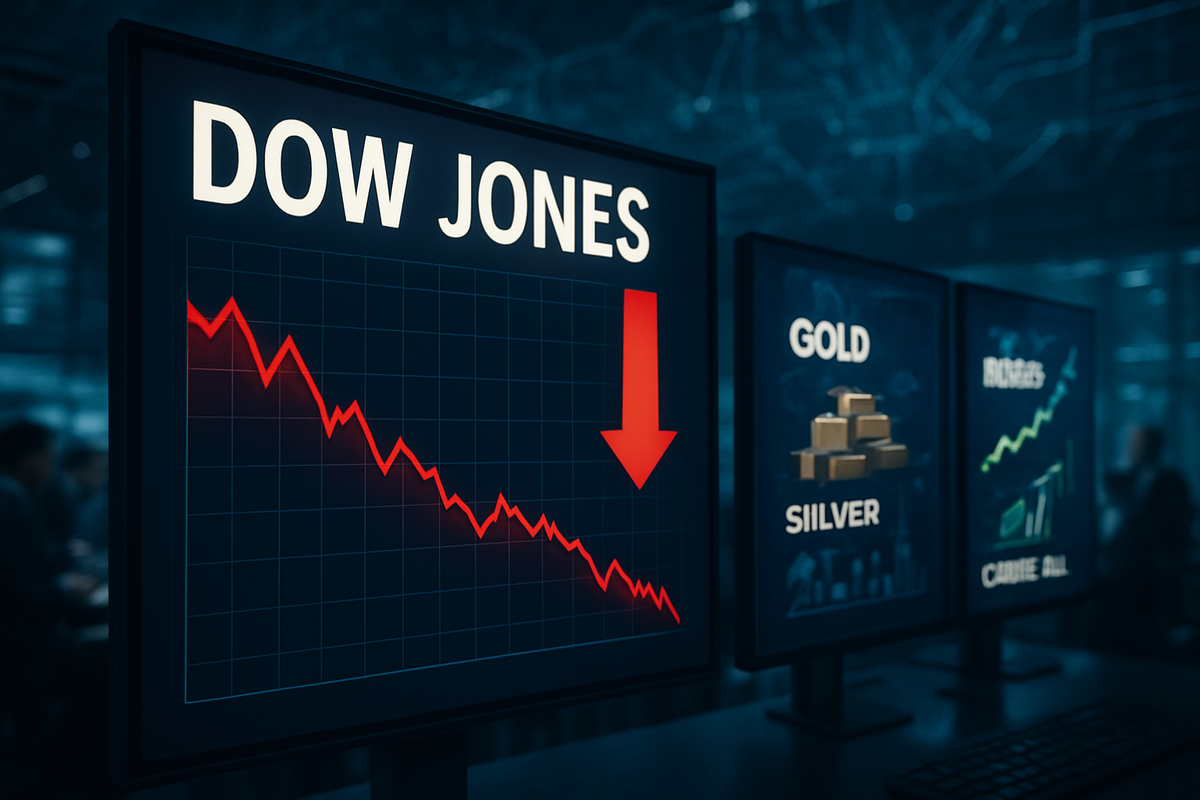
On Monday, December 29, 2025, the Dow Jones Industrial Average (DJIA) retreated from its recent record-high territory, sliding nearly 250 points in a session defined by thin holiday volume and a sudden surge in market volatility. The blue-chip index fell 249.04 points, or 0.51%, to close at 48,461.93. While the broader market has enjoyed a stellar performance throughout much of 2025, Monday’s action signaled a cautious shift as investors moved to lock in gains ahead of the New Year, spooked by a sharp correction in the commodities market and growing skepticism over the massive capital expenditures tied to the artificial intelligence boom.
The decline marks a sobering start to the final trading week of the year, typically a period associated with the "Santa Claus rally." However, the usual seasonal optimism was dampened by a "perfect storm" of technical factors and geopolitical tensions. As liquidity thinned out during the holiday-shortened week, the market proved sensitive to minor shocks, leading to a de-risking trend that saw the Dow underperform relative to its mid-month peaks.
A "Perfect Storm" of Margin Hikes and Profit-Taking
The primary catalyst for Monday’s downward pressure was an unexpected ripple effect from the commodities market. The Chicago Mercantile Exchange (CME) announced a significant hike in margin requirements for gold and silver futures, triggering a massive liquidation event. Silver, which had recently touched highs of $80 per ounce, plummeted nearly 8%, while gold dropped over 4%. This "margin hammer" forced institutional investors to raise cash quickly, leading to a spillover sell-off in blue-chip equities as traders liquidated profitable positions to meet margin calls or reduce overall portfolio risk.
Compounding the pressure was a noticeable shift in sentiment regarding the technology and industrial sectors. After a year dominated by aggressive investment in AI infrastructure, a wave of "AI fatigue" appeared to settle over the floor. Investors began to scrutinize the high valuations of tech-heavy Dow components, questioning whether the massive capital expenditures required for next-generation data centers would yield immediate returns. This skepticism, combined with year-end tax-loss harvesting and profit-taking, created a steady stream of sell orders throughout the afternoon session.
The timeline of the day's events saw the Dow open slightly lower, but the losses accelerated midday following the release of lackluster economic data. The Pending Home Sales report indicated a stagnant housing market, burdened by persistently high mortgage rates and elevated property prices. This data tempered hopes that the Federal Reserve would signal a more aggressive easing cycle in its upcoming meeting minutes, leading to a late-day slide that saw the index finish near its session lows.
Blue-Chip Laggards and the Energy Outlier
The day’s losses were felt most acutely among several high-profile Dow components. UnitedHealth Group (NYSE: UNH) continued its difficult run, ending the day as a significant drag on the price-weighted index. UNH has struggled throughout 2025, facing regulatory headwinds and rising medical cost ratios, and Monday’s performance cemented its position as the worst-performing Dow stock of the year, with a total annual loss approaching 35%.
Consumer giant McDonald’s (NYSE: MCD) also weighed heavily on the index, falling roughly 0.9% as analysts voiced concerns over softening consumer discretionary spending heading into 2026. Even the tech stalwarts were not immune; Nvidia (NASDAQ: NVDA), which joined the Dow in late 2024, saw shares slide between 1.2% and 1.8%, alongside Apple (NASDAQ: AAPL) and Microsoft (NASDAQ: MSFT). The decline in these tech leaders reflects a broader rotation out of the "growth at any cost" narrative that defined the first half of the year.
Conversely, the energy sector provided a rare bright spot. Exxon Mobil (NYSE: XOM) saw its shares rise by approximately 1.5% as oil prices surged 2% to reach $58 per barrel. The spike in crude was driven by escalating geopolitical tensions between the United States and Venezuela, raising fears of supply disruptions. While the gain in energy stocks helped mitigate some of the Dow's losses, the rising cost of fuel added to inflationary anxieties, further complicating the outlook for industrial and transportation companies.
Wider Significance: AI Skepticism and the Commodity Connection
Monday’s market action highlights a growing trend of "de-risking" that may define the transition into 2026. The sensitivity of the Dow to the CME’s margin hikes suggests that the market remains highly leveraged, particularly in the commodities space. When the "paper gold" market experiences a shock, the resulting scramble for liquidity can easily destabilize equity indices, even those comprised of supposedly stable blue-chip companies. This interconnectedness is a reminder of the fragility inherent in the current high-valuation environment.
Furthermore, the "AI fatigue" observed on Monday reflects a maturing market cycle. In 2024 and early 2025, any mention of artificial intelligence was enough to drive share prices higher. By late 2025, however, investors are demanding tangible results. The sell-off in MSFT and NVDA suggests that the market is no longer willing to give tech giants a "blank check" for AI development without seeing a clear path to monetization. This shift could lead to a more bifurcated market in the coming months, where only those companies demonstrating real productivity gains from AI will maintain their premium valuations.
The geopolitical tension in South America also adds a layer of complexity. The U.S.-Venezuela friction serves as a reminder that energy security remains a volatile factor for the global economy. For the Dow, which is heavily weighted toward industrial and manufacturing firms, sustained higher energy costs could squeeze profit margins and dampen the "soft landing" narrative that has supported the market for much of the past year.
The Road Ahead: FOMC Minutes and the January Effect
As the market moves into the final days of 2025, all eyes are on the release of the Federal Open Market Committee (FOMC) minutes from the December meeting. Investors are searching for clues regarding the Fed's trajectory for the first quarter of 2026. If the minutes suggest a more hawkish stance due to sticky inflation in the services sector, the current sell-off could extend into the new year. Conversely, any hint of a "dovish pivot" could spark a late-week recovery as traders move back into equities.
Short-term, the market faces the challenge of low liquidity. With many institutional desks thinly staffed until after the New Year’s Day holiday, price swings may remain exaggerated. Strategic pivots may be required for investors who have been overweight in tech and materials; a shift toward defensive sectors like utilities or healthcare—despite UNH's specific woes—might become more attractive if volatility persists.
Looking toward January, the "January Effect"—where stocks often rise in the first month of the year—will be tested. The key question will be whether the profit-taking seen on Monday was a temporary year-end adjustment or the beginning of a larger correction. Market participants will be watching for a stabilization in commodity prices and a cooling of geopolitical tensions as prerequisites for a sustained move back to record highs.
Summary and Investor Takeaways
Monday’s 250-point decline in the Dow Jones Industrial Average serves as a cautionary end-of-year note for an otherwise bullish market. The combination of commodity-driven liquidity crunches, AI sector exhaustion, and geopolitical jitters created a volatile environment that punished some of the market's biggest names, including UnitedHealth and McDonald's. While Exxon Mobil and the energy sector benefited from rising oil prices, the broader sentiment remained defensive.
Moving forward, investors should keep a close watch on the following:
- Commodity Volatility: Continued fluctuations in gold and silver could signal further liquidity issues in the broader market.
- Fed Commentary: The FOMC minutes will be the primary driver of interest rate expectations for the start of 2026.
- AI Capex Discipline: Corporate earnings reports in January will be scrutinized for details on how AI investments are impacting the bottom line.
While the Dow remains near historically high levels, Monday’s session is a reminder that even the most robust rallies are subject to periods of consolidation and re-evaluation. As 2025 draws to a close, the market appears to be entering a more discerning phase, where valuation and tangible performance will likely take precedence over speculation.
This content is intended for informational purposes only and is not financial advice.