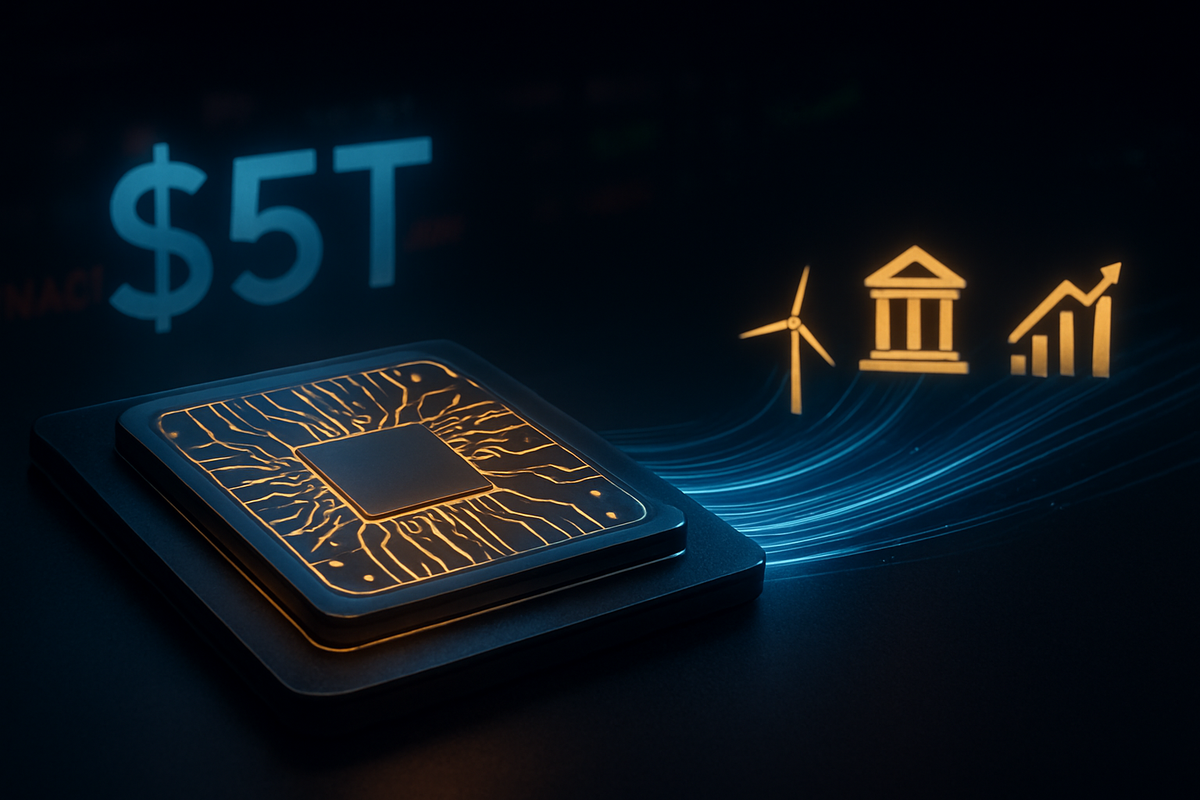
As the curtain closes on 2025, the relentless momentum of the artificial intelligence trade is facing its most significant test to date. Nvidia (NASDAQ: NVDA), the semiconductor titan that became the first company in history to eclipse a $5 trillion market capitalization earlier this autumn, has entered a pronounced pullback, shedding roughly 11% from its October highs. This year-end retreat is not merely a localized correction but the primary engine behind a broader "Great Rebalancing" that is weighing heavily on the tech-heavy Nasdaq-100 index.
The immediate implications are clear: the "winner-take-all" mentality that defined the market for much of 2024 and early 2025 is giving way to a more discerning investment landscape. As institutional players lock in gains from their high-flying tech holdings, capital is flowing into long-neglected corners of the market, including small-cap stocks, utilities, and financials. This rotation suggests that while the AI revolution remains intact, the market's tolerance for "priced-for-perfection" valuations has finally hit a ceiling.
The Peak and the Pivot: A Timeline of the Correction
The current volatility traces its roots back to late October 2025, when Nvidia (NASDAQ: NVDA) shares peaked at approximately $212, fueled by the successful, high-margin rollout of its Blackwell architecture and the anticipation of its next-generation "Rubin" platform. However, the euphoria was met with a sobering reality check in November and December. A combination of "AI spending fatigue" among major cloud service providers and a surprising efficiency breakthrough from international competitors—most notably the "DeepSeek" event earlier in the year—began to seed doubts about the long-term pricing power of premium AI hardware.
By mid-December, the narrative shifted from "how many chips can Nvidia make?" to "how much money are the buyers actually making?" This skepticism was compounded by the Federal Reserve’s December 10, 2025, decision to cut interest rates by 25 basis points. While lower rates are typically a boon for growth stocks, this specific cut served as a "starting gun" for investors to rotate into rate-sensitive sectors like regional banks and utilities, which offer more attractive dividend yields and lower valuation multiples compared to the high-multiple semiconductor space.
The pullback has been orderly but persistent. From its $5 trillion zenith, Nvidia’s market cap has contracted to roughly $4.5 trillion as of December 30, 2025. While a 35% annual return for 2025 is enviable by any standard, it represents a sharp deceleration from the triple-digit gains of 2024. This deceleration has had a magnified effect on the Nasdaq, where Nvidia’s massive weighting means that any 1% move in its share price can swing the entire index by several points, often masking strength in other sectors.
Winners and Losers in the Great Rebalancing
The primary beneficiaries of Nvidia’s (NASDAQ: NVDA) year-end malaise have been the "S&P 493"—the vast majority of the market that sat in the shadow of the Magnificent Seven for the past two years. Small-cap stocks, represented by the Russell 2000, have seen a late-quarter surge as investors bet on a "soft landing" and the benefits of lower borrowing costs. Financial giants like JPMorgan Chase & Co. (NYSE: JPM) and Goldman Sachs Group Inc. (NYSE: GS) have also seen renewed interest as the yield curve steepens and M&A activity begins to thaw.
Conversely, the semiconductor sector at large is feeling the chill. Firms like Advanced Micro Devices (NASDAQ: AMD) and Broadcom Inc. (NASDAQ: AVGO) have seen their shares trade in sympathy with Nvidia, as the market recalibrates the total addressable market (TAM) for AI accelerators. Even the "AI Adopters" in the software space, such as Microsoft Corp. (NASDAQ: MSFT) and Salesforce Inc. (NYSE: CRM), are facing increased scrutiny. Investors are no longer rewarding these companies simply for announcing AI features; they are demanding to see "AI-attributed revenue" in quarterly earnings reports, leading to a temporary stall in their stock prices.
The energy and utilities sector has emerged as a surprising "AI adjacent" winner. Companies providing the massive power requirements for data centers, such as Constellation Energy Corp. (NASDAQ: CEG) and Vistra Corp. (NYSE: VST), have remained resilient. As the market rotates out of the "builders" of AI (chips), it is rotating into the "enablers" of AI (power and infrastructure), reflecting a more mature understanding of the AI supply chain.
Wider Significance: From Training to Inference
This pullback marks a pivotal transition in the AI investment cycle: the shift from the "Training Phase" to the "Inference and ROI Phase." In 2023 and 2024, the market was dominated by the urgent need for companies to build massive AI models, a process that required an almost unlimited supply of Nvidia (NASDAQ: NVDA) GPUs. By late 2025, many of these models have been built, and the focus has shifted to "inference"—running the models for end-users. Inference is less computationally intensive and more price-sensitive, which invites competition and pressures margins.
Historically, this mirrors the "fiber optic bubble" of the late 1990s, where the companies laying the cables (the hardware) saw a massive boom followed by a correction once the infrastructure was in place, eventually giving way to the software giants that utilized that infrastructure. While few analysts believe we are in a 2000-style bubble burst, the current rotation suggests the "easy money" in hardware has been made. The ripple effects are being felt by partners like Taiwan Semiconductor Manufacturing Co. (NYSE: TSM) and ASML Holding (NASDAQ: ASML), who are seeing a shift in order types as customers prioritize efficiency over raw power.
Furthermore, the "DeepSeek" efficiency scare of 2025 has become a case study in market psychology. By demonstrating that frontier-level AI could be achieved with significantly less capital, it challenged the "Moat" around Nvidia’s high-cost ecosystem. While Nvidia’s software stack (CUDA) remains a formidable barrier to entry, the mere existence of a lower-cost path has introduced a "risk premium" that hadn't existed in previous years.
The Road Ahead: 2026 and Beyond
Looking into the first half of 2026, the short-term outlook for Nvidia (NASDAQ: NVDA) and the Nasdaq is likely to be characterized by heightened volatility. The market will be hyper-focused on the earnings reports of the "Hyperscalers"—Amazon.com Inc. (NASDAQ: AMZN), Alphabet Inc. (NASDAQ: GOOGL), and Meta Platforms Inc. (NASDAQ: META). If these companies can prove that their multi-billion dollar AI investments are translating into higher cloud margins or better ad targeting, the tech rotation may reverse. If not, the shift toward value and cyclical stocks could become a multi-quarter trend.
Strategically, Nvidia is expected to pivot more aggressively into software and services. By moving up the value chain, the company hopes to insulate itself from the commoditization of hardware. The upcoming launch of the "Rubin" architecture in 2026 will be a critical litmus test; it must offer not just more power, but a significant leap in energy efficiency to satisfy a market that is increasingly concerned with the "Total Cost of Ownership" (TCO) of AI clusters.
Market participants should also watch for potential M&A activity. With valuations in the broader tech sector cooling, cash-rich giants may look to acquire smaller AI startups that specialize in "edge AI" or specialized software. This could create a new wave of growth that is less dependent on massive data centers and more focused on integrating AI into consumer devices and industrial IoT.
Final Assessment: A Healthy Reset
The year-end pullback in Nvidia (NASDAQ: NVDA) should be viewed not as a collapse, but as a necessary "reset" for a market that had become dangerously top-heavy. The rotation into the broader S&P 500 and Russell 2000 is a sign of a healthy, diversifying economy where growth is spreading beyond a handful of Silicon Valley boardrooms. For the Nasdaq, the current drag is the price of its previous outperformance; an index so heavily weighted in a single sector must inevitably endure the pain when that sector takes a breather.
Investors should move into 2026 with a focus on "Quality and ROI." The era of "AI at any price" is over. Moving forward, the winners will be the companies that can demonstrate tangible productivity gains from AI, rather than those that simply buy the most chips. Watch for the $180 support level for Nvidia; if it holds, the stock may form a base for its next leg up. If it fails, the Nasdaq could be in for a more prolonged period of underperformance relative to the Dow and the S&P 500.
This content is intended for informational purposes only and is not financial advice.