As of late December 2025, United Parcel Service (NYSE: UPS) stands at a critical crossroads in its 118-year history. The logistics titan is currently in the final stages of a massive strategic overhaul, dubbed "Better and Bolder," a plan designed to strip away the inefficiencies of its legacy network and replace them with a hyper-automated, margin-focused machine. After a turbulent 2024 defined by labor cost spikes and a deliberate divorce from low-margin volume, the company is now under intense investor scrutiny as it enters the penultimate year of its 2026 financial roadmap.
The immediate implications of this pivot are stark. UPS has sacrificed its position as the volume leader in the United States to Amazon (NASDAQ: AMZN) in exchange for a leaner, more profitable operation. While the company’s revenue growth has lagged behind its primary rival FedEx (NYSE: FDX) throughout 2025, its third-quarter earnings beat—driven by aggressive cost-cutting and the consolidation of nearly 100 sorting facilities—has signaled to the market that CEO Carol Tomé’s "Better, Not Bigger" philosophy may finally be bearing fruit.
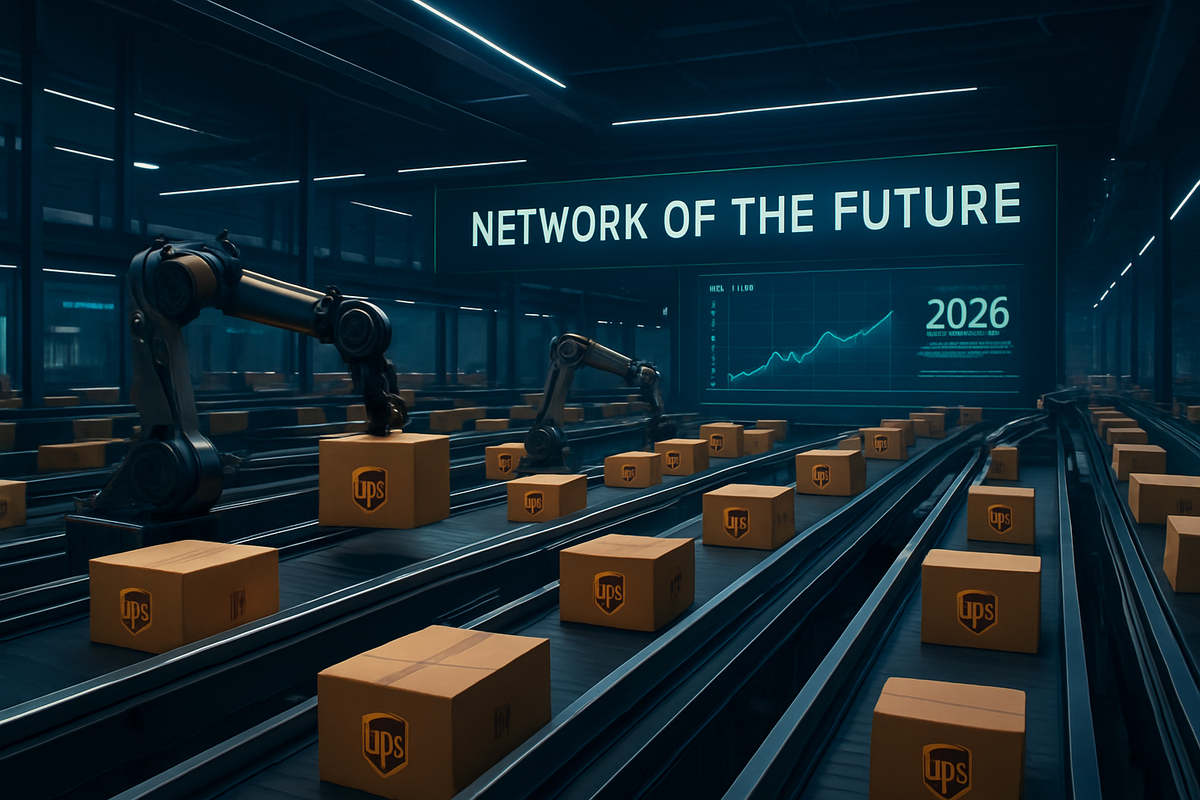
The Blueprint for a "Network of the Future"
The current strategic shift is centered on the "Network of the Future," a $9 billion initiative aimed at fundamentally altering how packages move across the globe. Since the announcement of its 2026 targets in early 2024, UPS has embarked on an aggressive timeline of facility closures and automation. By the end of 2025, the company has successfully shuttered nearly 100 of the 200 U.S. facilities slated for closure by 2028. This consolidation is not merely a downsizing effort but a modernization play; volume from these older, manual centers is being rerouted into high-capacity, automated hubs. As of this month, over 63% of UPS’s total volume is processed through these automated sites, a significant jump from 57% just two years ago.
Key to this transformation is the "Fit to Serve" program, which has targeted the company's administrative and management layers. Under the leadership of CEO Carol Tomé and EVP Nando Cesarone, UPS has eliminated approximately 48,000 roles since the start of 2024. This includes 14,000 management positions, a move designed to flatten the organization and reduce the "spans and layers" that Tomé argued were slowing down decision-making. The timeline for these cuts was accelerated in 2025 to offset the massive labor cost increases stemming from the 2023 Teamsters contract, which front-loaded 46% of its $30 billion cost into the first 12 months.
The market's reaction to these moves has been a mixture of cautious optimism and lingering skepticism. While the stock saw a 10% jump following a strong Q3 2025 earnings report—where EPS hit $1.74 against a $1.30 estimate—the company's total revenue has remained under pressure. Analysts note that while the "Network of the Future" is delivering on productivity, the strategy of shedding volume to chase higher-margin shipments is a high-wire act that leaves little room for error in a cooling global economy.
Winners and Losers in the Logistics War
In the current landscape, the clear "winner" in terms of sheer scale is Amazon (NASDAQ: AMZN), which officially surpassed UPS in package volume during the 2024 calendar year. However, UPS’s leadership views this loss of volume as a strategic victory. By reducing its reliance on Amazon—which now accounts for less than half the volume it did in 2022—UPS has freed up capacity for higher-yielding segments. The primary beneficiaries of this shift are Small and Medium Businesses (SMBs) and the healthcare sector. UPS’s "Premier Healthcare" service has seen double-digit growth in 2025, offering specialized cold-chain logistics that command significantly higher margins than standard e-commerce deliveries.
Conversely, FedEx (NYSE: FDX) has emerged as a formidable competitor by taking a different path. While UPS contracted its footprint, FedEx focused on capturing the market share UPS left behind, reporting a 13.9% revenue growth in late 2025 compared to UPS’s slight contraction. However, the "loser" in this comparison remains FedEx’s operating margin, which sits at roughly 5.9% compared to UPS’s 8.4%. This suggests that while FedEx is winning the battle for volume, UPS is currently winning the battle for efficiency.
The workforce has also felt the brunt of this overhaul. While the 2023 Teamsters contract secured higher wages for frontline workers, the massive reduction in management roles and the closure of 200 facilities represent a significant loss for long-term career stability within the company’s middle ranks. For investors, the "win" is contingent on the company’s ability to hit its 13% consolidated adjusted operating margin target by 2026—a goal that remains ambitious given the current inflationary environment.
Automation and the New Industry Standard
The UPS overhaul fits into a broader industry trend toward "autonomous logistics." The reliance on human labor, which became a liability during the post-pandemic labor shortages and subsequent union negotiations, is being systematically reduced across the sector. UPS's pivot is a bellwether for how legacy industrial giants must adapt to the "Amazon-ification" of the supply chain. By integrating AI-driven sorting and robotics, UPS is attempting to prove that a unionized workforce can still be competitive if paired with world-class technology.
This event also has significant regulatory and policy implications, particularly regarding labor relations. The success or failure of UPS to maintain its margins while paying some of the highest wages in the industry will likely dictate the leverage of labor unions in future negotiations across the transport and warehousing sectors. If UPS succeeds, it provides a blueprint for "high-wage, high-automation" models. If it fails, it may embolden competitors to pursue even more aggressive non-union strategies.
Historically, this transformation is reminiscent of the "Precision Scheduled Railroading" (PSR) movement that swept through the North American rail industry a decade ago. Like PSR, UPS is prioritizing asset utilization and profitability over service footprint and volume. However, the risk remains the same: by cutting too deep into its network, UPS could lose the "density" required to keep per-package costs low, a challenge that has plagued other logistics companies that pivoted too sharply away from scale.
The Road to 2026: Strategic Pivots Ahead
Looking toward 2026, UPS must navigate several potential hurdles to reach its $108 billion to $114 billion revenue target. In the short term, the company must prove that it can stabilize its volume. While shedding low-margin Amazon packages was intentional, a continued decline in total volume could lead to underutilized automated hubs, which are expensive to maintain. The "Network of the Future" only works if the remaining volume is high-value and consistent.
A potential strategic pivot may be required in the international sector. While domestic margins are the current focus, UPS’s international operating margin target of 18-19% is heavily dependent on a recovery in global trade, particularly between Asia and Europe. If geopolitical tensions continue to fragment global supply chains, UPS may need to shift its capital expenditure away from U.S. hub automation and toward diversifying its international "Supply Chain Solutions" (SCS) segment.
Furthermore, market opportunities in "last-mile" delivery are evolving. With the rise of drone delivery and local micro-fulfillment centers, UPS’s massive central hubs could become less relevant for urban deliveries. Investors should watch for whether UPS begins to acquire smaller, tech-focused local delivery startups to augment its "Network of the Future" with a more agile "Last-Mile of the Future."
Conclusion: A High-Yield Future?
The strategic overhaul of UPS is a definitive case study in corporate transformation. By late 2025, the company has successfully transitioned from a "growth at all costs" mindset to a disciplined, margin-first operator. The key takeaways for the market are clear: UPS is betting its future on automation and high-value niches like healthcare, even if it means ceding the title of "world's largest carrier" to Amazon.
Moving forward, the market will be watching two primary metrics: domestic operating margins and dividend sustainability. With a dividend yield currently exceeding 6.5%, UPS remains a favorite for income investors, but its free cash flow is under pressure from the $9 billion "Network of the Future" spend. For the strategy to be deemed a success, the productivity gains from automation must begin to outpace the annual wage increases guaranteed in the Teamsters contract.
As we approach 2026, the stakes could not be higher. If Carol Tomé delivers on the promised 13% margins, UPS will have successfully navigated the most difficult period in its history, emerging as a high-tech, high-margin leader. If the revenue contraction continues to outpace cost savings, the company may be forced to reconsider its "Better, Not Bigger" stance and find a way to recapture the scale it so deliberately walked away from.
This content is intended for informational purposes only and is not financial advice.