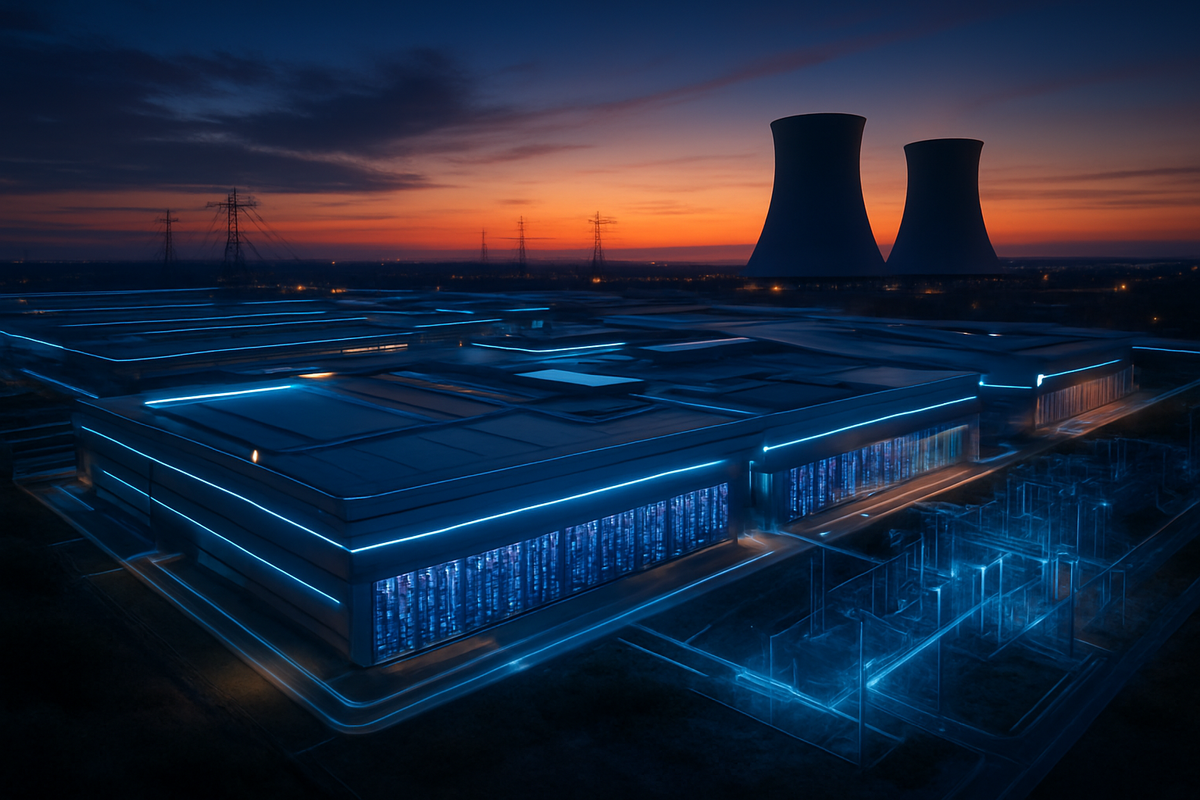
As of January 1, 2026, the global technology landscape has undergone a physical transformation that few predicted at the start of the decade. What began as a frantic scramble for specialized semiconductors in 2023 has evolved into the largest industrial infrastructure project in modern history. The "AI Arms Race" is no longer just about who has the best algorithms; it is now a high-stakes battle over concrete, copper, and carbon-free electrons. Tech giants are currently pouring hundreds of billions of dollars into "AI Superfactories"—massive data center complexes that are redefining the electrical grid and revitalizing industrial heartlands.
This infrastructure surge represents a fundamental shift in the macroeconomic narrative. For years, the tech sector was defined by "capital-light" software models. Today, the industry has pivoted toward a "capital-heavy" industrial model, with annual capital expenditures (CapEx) from the "Big Four"—Microsoft, Amazon, Alphabet, and Meta—projected to exceed $600 billion in 2026 alone. This massive deployment of capital is acting as a powerful fiscal stimulus, contributing an estimated 1.3 percentage points to U.S. GDP growth over the past year and sparking a re-industrialization of regions once left behind by the digital age.
The Rise of the AI Superfactory: From Stargate to Susquehanna
The scale of the current build-out is best exemplified by the unveiling of "Project Stargate" in early 2025. A collaborative effort between Microsoft (NASDAQ: MSFT) and OpenAI, this $500 billion multi-phase initiative aims to build a series of supercomputing clusters that dwarf any existing facility. The centerpiece is a $100 billion supercomputer (Phase 5) designed to house millions of next-generation GPUs. To put this in perspective, a single "Stargate" campus is expected to require up to 5 gigawatts of power—roughly the output of five nuclear reactors—making it one of the largest single-point consumers of electricity on the planet.
Not to be outdone, Amazon (NASDAQ: AMZN) has aggressively pivoted toward a "behind-the-meter" strategy to solve the growing energy crisis. In mid-2025, Amazon’s cloud division, AWS, finalized a $20 billion investment in Pennsylvania, centered around the Susquehanna Steam Electric Station. By connecting its data centers directly to the nuclear plant, Amazon has effectively bypassed the congested public utility grid, securing a 960-megawatt "island" of reliable, carbon-free power. This move followed a similar landmark deal by Microsoft to restart the shuttered Unit 1 reactor at Three Mile Island, now known as the Crane Clean Energy Center.
The timeline leading to this moment was defined by a critical realization in late 2024: the power grid was the ultimate bottleneck. As Alphabet (NASDAQ: GOOGL) and Meta (NASDAQ: META) scaled their respective Gemini and Llama models, they found that securing land was easy, but securing a "power envelope"—the legal right to draw massive amounts of electricity—was the true prize. This led to a 2025 characterized by "power-grabbing," where tech companies became de facto energy developers, partnering with utilities and investing in Small Modular Reactors (SMRs) to ensure their AI ambitions wouldn't be sidelined by a failing electrical grid.
The Secondary Winners: Power, Cooling, and Connectivity
While the "Big Four" are the architects of this build-out, a new class of "secondary winners" has emerged as the essential providers of the AI supply chain. The most prominent among these is Vertiv Holdings Co. (NYSE: VRT), which has seen its market valuation soar as it became the primary provider of liquid cooling systems. As AI racks now exceed 100kW of heat output, traditional air conditioning is no longer sufficient; Vertiv’s direct-to-chip cooling has become the industry standard for preventing AI "factories" from melting down.
The electrical equipment sector has also seen a renaissance. Eaton Corporation plc (NYSE: ETN) has capitalized on its "grid-to-chip" architecture, providing the high-voltage switchgear and power distribution units required for these massive loads. Similarly, GE Vernova Inc. (NYSE: GEV) has become a critical player in stabilizing the grid, supplying the transformers and gas turbines needed to balance the intermittent nature of renewable energy with the 24/7 demand of AI.
In the utilities space, the shift to nuclear has minted new market darlings. Constellation Energy Corp. (NASDAQ: CEG) and Vistra Corp. (NYSE: VST) have transitioned from sleepy utility stocks to high-growth infrastructure plays. By signing long-term power purchase agreements (PPAs) with hyperscalers, these companies have secured decades of guaranteed revenue at premium prices. Conversely, the "losers" in this environment are legacy data center providers that failed to upgrade their facilities for high-density compute, as well as traditional manufacturing firms now facing significantly higher electricity costs due to the surge in regional demand. In the PJM Interconnection region, which serves much of the Eastern U.S., capacity auction prices spiked over 1,000% by late 2025, creating a "power divide" between AI-rich tech giants and energy-starved local industries.
Macroeconomic Ripple Effects and the New Industrial Policy
The wider significance of this build-out extends far beyond Silicon Valley. We are witnessing a geographic shift in economic power. The "Rust Belt"—including Ohio, Indiana, and Pennsylvania—is being rebranded as the "Silicon Heartland." Massive construction projects are employing tens of thousands of specialized electricians and tradespeople, creating a labor market where "blue-collar" skills are as essential to AI as "white-collar" coding.
Furthermore, this surge has forced a reckoning in national energy policy. The sheer demand from data centers—which the IEA projects will consume as much energy as the country of Japan by the end of 2026—has accelerated the permitting of nuclear power and the modernization of the U.S. electrical grid. This is a historical precedent comparable to the Federal Aid Highway Act of 1956; the government is now under immense pressure to streamline regulations to ensure the U.S. maintains its lead in AI compute capacity against global rivals.
However, this rapid expansion has also raised regulatory eyebrows. Concerns over "energy equity" are mounting, as residential consumers in data center hubs begin to see higher utility bills. Policymakers are currently debating "data center taxes" or requirements for tech companies to fund local grid upgrades, a move that could alter the cost-benefit analysis for future projects.
What Lies Ahead: The 2026 "Validation Phase"
As we enter 2026, the market is shifting from a state of "build at any cost" to a phase of "AI Realism." Having spent over a trillion dollars cumulatively on infrastructure, investors are now demanding proof of monetization. The short-term focus will be on the quarterly earnings of the hyperscalers, specifically looking for "AI-attributed revenue" in their cloud divisions. If the productivity gains promised by generative AI do not materialize for enterprise customers, the massive CapEx spending could face a sharp correction.
Strategically, we expect to see more "sovereign AI" projects, where nations like Saudi Arabia and Japan build their own domestic data center clusters to ensure data residency and national security. This will provide a secondary wave of demand for networking giants like Arista Networks, Inc. (NYSE: ANET) and Broadcom Inc. (NASDAQ: AVGO), who provide the high-speed switching and custom silicon that allow these massive clusters to function as a single unit.
The long-term challenge remains sustainability. While nuclear power provides a partial solution, the industry must still solve the massive water consumption requirements for cooling and the environmental impact of the hardware lifecycle. The next frontier of innovation will likely be "Edge AI"—moving compute closer to the user to reduce the strain on centralized "superfactories."
Conclusion: A Market Redefined by Hard Assets
The AI data center build-out of 2024–2025 has permanently altered the DNA of the technology sector. The industry has moved from the ethereal world of the "cloud" to the gritty reality of massive physical infrastructure. For investors, the takeaway is clear: the AI trade has broadened. While NVIDIA (NASDAQ: NVDA) remains the heart of the movement, the "circulatory system" of the AI economy—power, cooling, and real estate—is where the next phase of value creation is occurring.
Moving forward, the market will be defined by "AI-readiness." Watch for companies that can secure their own power and those that successfully transition from training massive models to the "inference" phase—where AI is actually put to work. The 2026 "Validation Phase" will be a period of volatility, but the physical foundations being laid today suggest that the AI era is not a bubble, but a new industrial revolution.
This content is intended for informational purposes only and is not financial advice.