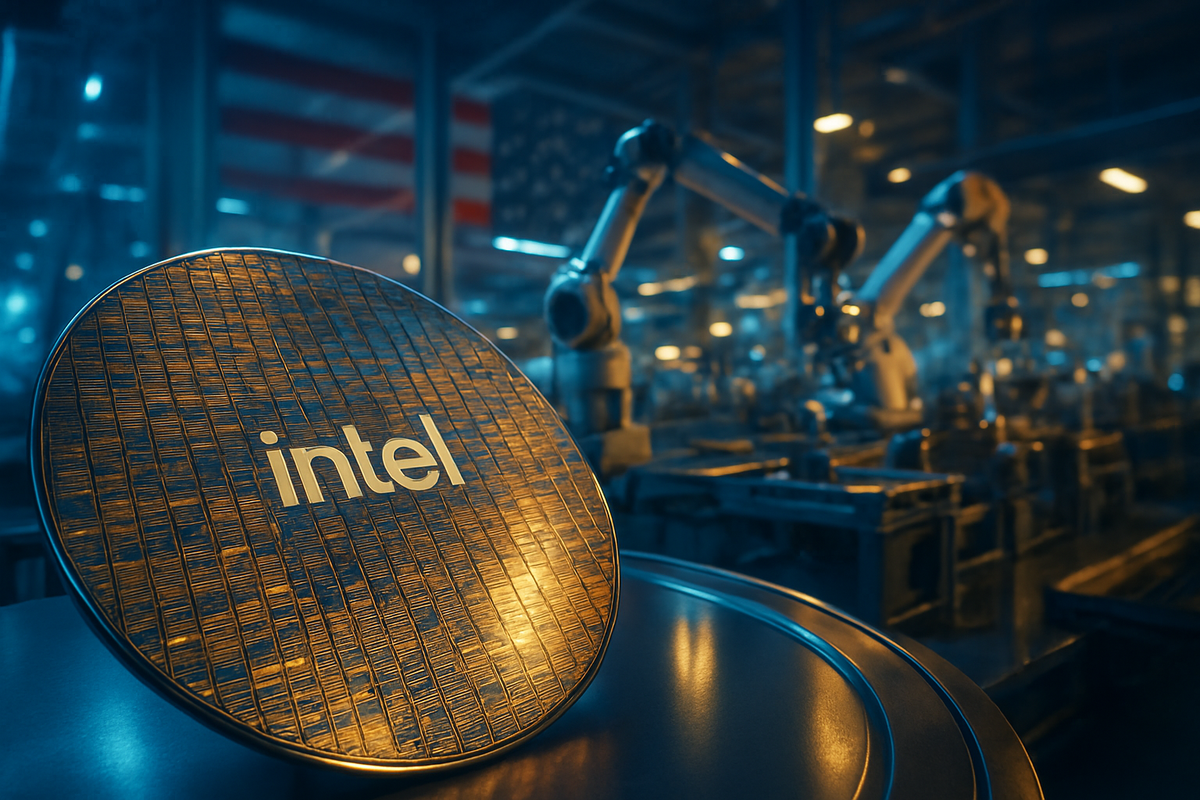
SANTA CLARA, CA — Shares of Intel Corp. (NASDAQ: INTC) surged to multi-year highs on Monday, January 12, 2026, as investors rallied behind a powerful endorsement from the White House. The rally follows a high-stakes meeting between President Donald Trump and Intel’s Chief Executive Officer, Lip-Bu Tan, after which the President designated the semiconductor giant a "national champion" for American silicon leadership. The endorsement, coupled with the successful rollout of Intel’s next-generation "Panther Lake" processors, has propelled the company’s market capitalization back toward the $200 billion mark, signaling a dramatic reversal of fortune for the once-struggling pioneer.
The immediate market reaction was electric. Intel shares jumped 10.8% in late-week trading on January 9 and maintained their momentum through the morning of January 12, trading at approximately $44.99. This surge reflects a growing consensus that the federal government’s pivot from providing grants to taking direct equity stakes in domestic manufacturers has fundamentally derisked Intel’s capital-intensive turnaround strategy. For the market, the message is clear: Intel is now seen as the centerpiece of a broader "Make in America" silicon strategy that prioritizes domestic manufacturing over global supply chain efficiency.
Political Backing and Technical Milestones
The catalyst for the current rally was a January 8, 2026, meeting at the White House where President Trump and CEO Lip-Bu Tan discussed the future of the U.S. semiconductor industry. Following the meeting, the President took to Truth Social to hail Intel as a "milestone" for American industrial strength. "We are determined to bring leading-edge chip manufacturing back to America," Trump posted, praising Tan as a "very successful CEO" who has restored operational discipline to the company. This public display of support comes just months after the U.S. government finalized an $8.9 billion investment in Intel, securing a direct equity stake of approximately 7.5% in the firm.
This political tailwind coincides with a major technical milestone. At CES 2026, Intel confirmed it had begun shipping its Core Ultra Series 3 ("Panther Lake") processors on schedule. These chips are the first to utilize the 18A (sub-2-nanometer) manufacturing node, designed and fabricated entirely within the United States. The timeline marks a significant victory for Lip-Bu Tan, who took the helm in March 2025 following the retirement of Pat Gelsinger. Tan’s focus on the "Foundry First" model and domestic reshoring has successfully navigated the company through a period of intense skepticism, proving that Intel can indeed compete on the leading edge of transistor density.
The shift in federal policy has been equally instrumental. By transitioning the CHIPS Act framework from simple subsidies to an "Industrial Sovereignty" model, the administration has tied Intel’s success directly to the national interest. President Trump noted that the government's equity stake has already appreciated significantly, claiming the investment has generated "tens of billions of dollars for the American people." This fusion of public and private interests has created a "too big to fail" aura around Intel, attracting further private investment from unlikely allies.
Winners and Losers in the New Chip Economy
The primary beneficiary of this new political reality is Intel Corp. (NASDAQ: INTC), which has transformed from a laggard into a "national champion" with a government-backed floor on its valuation. However, the ripple effects extend to its strategic partners. Nvidia Corp. (NASDAQ: NVDA) and SoftBank Group Corp. (OTC: SFTBY), both of which reportedly took multibillion-dollar stakes in Intel alongside the U.S. government in late 2025, are seeing their investments bear fruit. For Nvidia, a stable and advanced domestic foundry in Intel provides a critical hedge against geopolitical instability in the Taiwan Strait, potentially reducing its long-term reliance on foreign fabrication.
Conversely, the "National Champion" policy creates a challenging environment for foreign-based competitors. Taiwan Semiconductor Manufacturing Co. (NYSE: TSM) and Samsung Electronics (OTC: SSNLF) face a dual threat: aggressive 20% universal tariffs on imported silicon and a U.S. regulatory environment that increasingly favors domestic "sovereign" production. While TSMC has expanded its footprint in Arizona, the Trump administration’s focus on Intel as the primary "national champion" suggests that domestic firms will receive preferential treatment in government procurement and future infrastructure projects, potentially squeezing the margins of foreign-owned foundries operating on U.S. soil.
Other potential "losers" include fabless semiconductor firms that remain heavily reliant on offshore production. Companies like Apple Inc. (NASDAQ: AAPL) and Advanced Micro Devices (NASDAQ: AMD) may face increased costs due to tariffs if they cannot transition their high-volume orders to domestic foundries quickly enough. The administration’s "path to domesticity" policy essentially forces a choice: pay the tariff premium or move production to Intel’s 18A and 14A nodes. This creates a massive tailwind for Intel’s foundry services but places an immense logistical and financial burden on the broader tech ecosystem.
Industrial Sovereignty and Global Trends
The resurgence of Intel fits into a broader global trend of "industrial nationalism," where major powers are treating semiconductors not just as commodities, but as strategic assets akin to oil or steel in the 20th century. The Trump administration’s "Project Stargate"—a proposed $500 billion initiative to stimulate a manufacturing renaissance—represents a radical departure from the neoliberal trade policies of previous decades. By designating Intel as a national champion, the U.S. is following a playbook similar to those used by China and South Korea, where the state provides a protective umbrella over key technology firms to ensure long-term dominance.
This event also signals a major shift in regulatory philosophy. The revocation of previous executive orders on AI in favor of a deregulatory agenda is intended to accelerate the deployment of American-made silicon. By removing compliance hurdles, the administration hopes to allow Intel and its domestic partners to iterate faster than their international rivals. Historically, such periods of intense state-backed industrial focus—such as the aerospace boom of the 1960s—have led to rapid technological leaps but also to market distortions and trade tensions that can last for decades.
The potential ripple effects on competitors are profound. As Intel scales its 18A node with government backing, the competitive moat around TSMC’s advanced nodes is being challenged for the first time in a decade. If Intel can maintain its execution under Lip-Bu Tan, the "geographical diversification" of the semiconductor industry will move from a theoretical goal to a market reality. However, this shift comes at the cost of the globalized supply chain, likely leading to higher consumer prices for electronics as the "efficiency" of global trade is traded for the "security" of domestic production.
The Road Ahead: Scaling the National Champion
In the short term, Intel must prove it can scale its 18A production to meet the demands of not just its own product lines, but also those of external foundry customers. The market will be watching for the first high-volume external customer announcements for the 18A node, which are rumored to include major defense contractors and domestic cloud providers. The success of "Project Stargate" will also be a critical factor; if the $500 billion initiative passes through Congress, it could provide the liquidity needed for Intel to accelerate its 14A node development, potentially leapfrogging its Asian competitors by 2027.
However, challenges remain. The aggressive tariff regime could trigger retaliatory measures from trading partners, complicating the global sales of the very chips Intel is trying to manufacture. Furthermore, the "national champion" status brings with it a level of political scrutiny that could become a liability if the administration’s policies shift or if the company fails to meet its ambitious technical benchmarks. Intel will need to navigate a delicate balance between its role as a private, profit-seeking entity and its new identity as a pillar of American industrial policy.
Summary and Market Outlook
The events of January 2026 mark a turning point for Intel and the global semiconductor landscape. The combination of Lip-Bu Tan’s disciplined leadership and the Trump administration’s "National Champion" designation has transformed Intel from a symbol of American industrial decline into a spearhead for its resurgence. With a government equity stake providing a financial backstop and the 18A node delivering on its technical promises, Intel has regained the narrative on Wall Street.
Moving forward, investors should keep a close eye on the implementation of "Project Stargate" and the actual yield rates of the Panther Lake production lines. While the political and regulatory tailwinds are formidable, the ultimate test will be Intel’s ability to execute on its roadmap without the delays that plagued the company in the early 2020s. For now, the "Make in America" silicon strategy has given Intel a second lease on life, and the market is betting heavily that this time, the comeback is for real.
This content is intended for informational purposes only and is not financial advice.