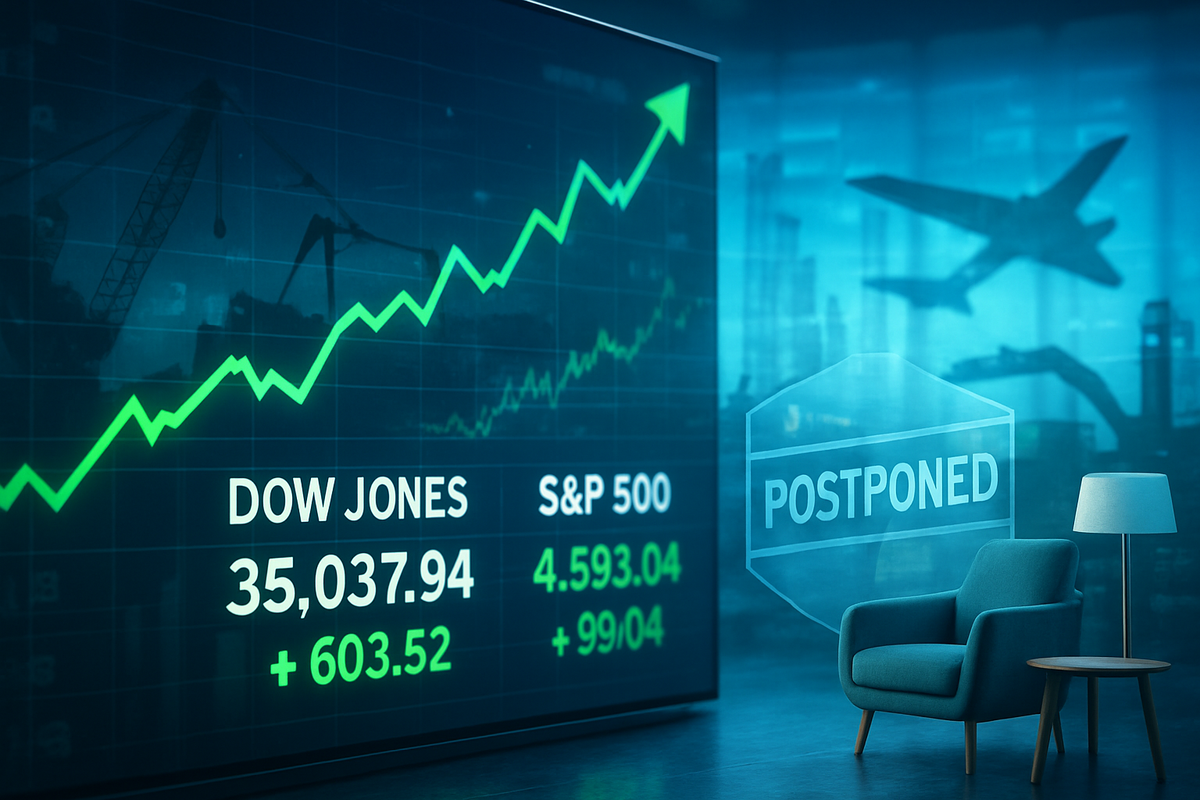
The U.S. stock market began the 2026 trading year on a resilient note as the Dow Jones Industrial Average and the S&P 500 successfully snapped a four-session losing streak on Friday. While the broader market sentiment remained cautiously bullish, the recovery was characterized by a distinct rotation into cyclical and industrial sectors, providing a much-needed reprieve from the late-December slump that had dampened investor spirits during the holiday season.
The day’s gains were largely fueled by a combination of stabilizing Treasury yields and a surprise New Year’s Eve policy announcement from the White House regarding trade tariffs. Although the tech-heavy Nasdaq Composite struggled to find its footing—ending the day fractionally lower— the recovery in blue-chip stocks signaled a potential shift in investor preference toward "Old Economy" value plays as the market grapples with a complex macroeconomic landscape in the new year.
The first trading day of 2026 provided a definitive break from the downward momentum that had plagued the final week of 2025. The Dow Jones Industrial Average (DJI) climbed 319.10 points, or 0.7%, to close at 48,382.39. This advance effectively ended a four-day skid that began on December 26, 2025, during which the index had shed significant ground amid concerns over "higher-for-longer" interest rates. Similarly, the S&P 500 (SPX) gained 12.97 points, or 0.2%, to finish at 6,858.47, also halting its four-session slide.
The timeline leading up to this recovery was marked by extreme volatility. In the final days of December, a sharp rise in 10-year Treasury yields sparked fears that the Federal Reserve might delay its anticipated easing cycle, as inflation remained stubbornly above the 2% target. This was compounded by year-end tax-loss harvesting, where institutional investors sold off underperforming positions to offset capital gains from a strong 2025. However, the mood shifted on New Year's Day following a proclamation from President Trump at Mar-a-Lago, which postponed several steep tariff hikes scheduled for January 1, 2026.
Market participants reacted positively to this "tariff ceasefire" in specific sectors, particularly home goods and furniture. The delay of planned hikes—some of which were set to jump from 25% to 50%—removed an immediate "inflationary cliff" that many analysts feared would cripple consumer discretionary spending in the first quarter. By the time the opening bell rang on January 2, a wave of buying in industrials and financials offset the continued weakness in high-growth technology stocks.
The day’s recovery produced clear winners among heavy-duty industrials and financial institutions. Caterpillar Inc. (NYSE: CAT) was a primary engine for the Dow’s recovery, jumping 4.5% as investors bet on continued domestic infrastructure demand. Boeing Co. (NYSE: BA) also provided a significant boost, rising 4.7% following reports of renewed order interest from international carriers. In the financial sector, Goldman Sachs Group Inc. (NYSE: GS) gained 3.8%, reflecting investor optimism that a stabilizing interest rate environment would benefit investment banking and capital markets activity.
The semiconductor industry also saw a robust rebound, even as the broader tech sector lagged. Intel Corp. (NASDAQ: INTC) led the charge with a 6.7% gain, while Micron Technology Inc. (NASDAQ: MU) surged 10%, building on its momentum from a stellar 2025 performance. Industry bellwether NVIDIA Corp. (NASDAQ: NVDA) rose 1.3% to close at $189.82, and Broadcom Inc. (NASDAQ: AVGO) added 1.9%, helping to stabilize the S&P 500’s technology component.
However, the day was not without its casualties. The most notable laggard was Tesla Inc. (NASDAQ: TSLA), which fell 2.6% after reporting fourth-quarter delivery figures that missed analyst estimates. This marked the second consecutive year of sales declines for the electric vehicle giant, raising concerns about its long-term growth trajectory in a more competitive global market. Amazon.com Inc. (NASDAQ: AMZN) also weighed on the S&P 500, falling more than 2% as investors rotated out of mega-cap consumer discretionary names and into the furniture retailers that benefited from the tariff reprieve, such as RH (NYSE: RH), which jumped 8%, and Wayfair Inc. (NYSE: W), which surged 6%.
The market's performance on the first day of 2026 fits into a broader trend of policy-driven volatility that has defined the "Liberation Day" tariff era. The original "Liberation Day" framework, established in April 2025, introduced a universal baseline tariff and reciprocal rates for nations with large trade surpluses. The New Year's Eve postponement of hikes on upholstered furniture and kitchen cabinets suggests a tactical pivot by the administration to manage the cost of living while maintaining pressure on trade partners like Vietnam and China.
This event also highlights the growing influence of the "Two-Tier" market, where domestic manufacturers are increasingly insulated from foreign competition by a 25% tariff barrier, while importers face compressed margins. The broader significance extends to the Federal Reserve, which is facing a leadership transition as Chair Jerome Powell’s term is set to expire in May 2026. Speculation regarding his successor has added a layer of uncertainty to the bond market, influencing the Treasury yields that drove the initial four-day losing streak.
Historically, the first few trading days of January are often viewed as a barometer for the year ahead—a phenomenon known as the "January Indicator." While the Dow and S&P 500’s recovery is a positive sign, the Nasdaq’s fifth consecutive loss serves as a reminder that the high valuations of 2025 remain a point of contention. Analysts at Bank of America have noted that stocks entered 2026 "expensive on 18 of 20 measures," suggesting that the recovery may be a consolidation phase rather than the start of a new parabolic rally.
Looking ahead, the market faces several critical hurdles in the first quarter of 2026. Investors will be closely watching the upcoming Consumer Price Index (CPI) data to see if the recent tariff postponements have successfully moderated the "price pressure" on home goods. Any sign that inflation is re-accelerating could force the Federal Reserve to maintain its restrictive stance, potentially putting renewed pressure on the cyclical stocks that led today's recovery.
Strategic pivots are already underway in the corporate world. Retailers like Williams-Sonoma Inc. (NYSE: WSM) are reportedly accelerating their supply chain shifts away from high-tariff regions to avoid the "Sword of Damocles" hanging over the 2027 tariff schedule. Furthermore, a pending Supreme Court ruling in early 2026 regarding the President's authority to use the International Emergency Economic Powers Act (IEEPA) for broad tariffs could potentially reset the entire trade landscape, creating a massive opportunity or a significant challenge for global logistics and manufacturing firms.
In the short term, the market will likely remain sensitive to "headline risk" from Washington and the evolving leadership at the Fed. While the recovery on January 2nd provided a sigh of relief, the divergence between the Dow and the Nasdaq suggests that the "Magnificent Seven" era may be giving way to a more diversified, value-oriented market environment.
The snapping of the four-session losing streak marks a crucial psychological victory for bulls at the start of 2026. The recovery was not a "rising tide lifts all boats" scenario, but rather a calculated rotation into sectors that stand to benefit from specific policy shifts and domestic economic resilience. Key takeaways include the continued strength of the industrial and semiconductor sectors, the vulnerability of mega-cap tech to delivery misses and valuation concerns, and the outsized impact of trade policy on consumer discretionary stocks.
Moving forward, the market is likely to remain in a state of "cautious transition." Investors should keep a close eye on the 10-year Treasury yield and the upcoming Fed transition, as these will be the primary drivers of equity valuations. While the Dow and S&P 500 have found their footing for now, the path of least resistance for the market will depend on whether the "Old Economy" cyclicals can continue to carry the weight of an increasingly fragmented index.
As we move deeper into January, the focus will shift from holiday policy announcements to hard economic data. For now, the resilience shown on January 2nd suggests that while the "Santa Claus rally" may have arrived late, the underlying appetite for American equities remains intact, provided the policy environment remains manageable.
This content is intended for informational purposes only and is not financial advice.