As the confetti settles from New Year’s celebrations, investors are quickly pivoting from the "Santa Claus Rally" of 2025 to a sobering reality: the first major economic hurdle of the year. On Friday, January 2, 2026, the market opened its first session of the year with a mix of optimism and anxiety, as all eyes turned toward the Bureau of Labor Statistics’ upcoming December Employment Situation report. After a year that saw the S&P 500 surge more than 16% to record highs, the "holiday calm" is being replaced by a high-stakes guessing game over the health of the American labor market and the future of interest rates.
The upcoming report, scheduled for release on January 9, is expected to serve as a critical barometer for whether the U.S. economy is heading for a "soft landing" or a more turbulent "no-landing" scenario. With the Federal Reserve having just cut rates in December to a range of 3.50%–3.75%, the labor data will determine if the central bank continues its easing cycle or hits the brakes to prevent a resurgence of inflation. Early trading on Friday already signaled a shift in sentiment, as Treasury yields spiked, suggesting that the market is bracing for a potential surprise that could disrupt the status quo.
The Data Stakes: Deciphering the "Goldilocks" Number
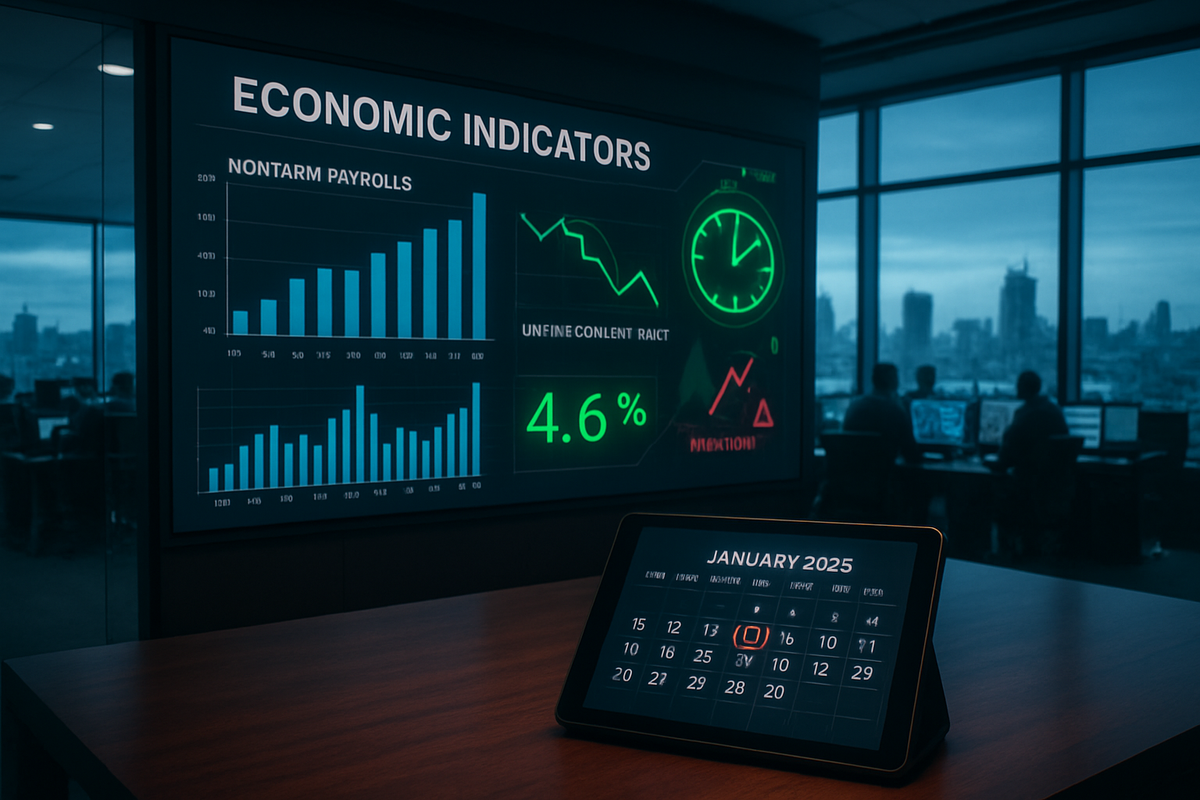
Economists are currently projecting a modest addition of approximately 55,000 to 60,000 nonfarm payrolls for December, a figure that would signal a cooling but stable labor market. This follows a similarly subdued November, which saw only 64,000 jobs added. The unemployment rate is expected to hold steady at 4.6%, a notable increase from the 4.1% seen at the start of 2025. However, analysts at major institutions like JPMorgan Chase & Co. (NYSE: JPM) point out that the "breakeven" point for job growth—the number of jobs needed to keep the unemployment rate flat—has dropped significantly due to an aging workforce and recent shifts in immigration policy.
The timeline leading up to this moment has been defined by a resilient consumer and a massive wave of technology investment. Throughout 2025, the U.S. economy defied recession predictions, posting a robust 4.3% GDP growth rate in the third quarter. Yet, the labor market has shown signs of "bifurcation." While high-tech sectors have slowed their hiring to focus on capital expenditures in artificial intelligence, the service and healthcare sectors have remained the primary engines of employment. Investors are now looking for a "Goldilocks" report: one that is weak enough to justify further Fed rate cuts, but strong enough to prove that the American consumer still has the means to spend.
Winners and Losers: A Market Divided by Yields
The anticipation of the jobs report is already creating clear winners and losers across the equity landscape. The banking sector has emerged as an early beneficiary of the new year’s volatility. As the 10-year Treasury yield surged to 4.35% on the first trading day of 2026, shares of Bank of America Corp. (NYSE: BAC) and JPMorgan Chase & Co. (NYSE: JPM) saw upward momentum. Higher yields typically allow banks to expand their net interest margins, boosting profitability on core lending activities. If the jobs report shows unexpected strength, suggesting that the Fed might pause its rate-cutting cycle, these financial giants could see further gains.
Conversely, the technology sector is feeling the heat. High-growth companies like Apple Inc. (NASDAQ: AAPL) and Microsoft Corp. (NASDAQ: MSFT) are particularly sensitive to rising interest rates, which increase the discount rate applied to their future earnings. While Nvidia Corp. (NASDAQ: NVDA) continues to ride the "AI Supercycle"—ending 2025 with a staggering $4.6 trillion market cap—even the semiconductor leader is not immune to broader macro jitters. Additionally, the retail sector is showing a sharp divide; value-oriented retailers such as Ross Stores, Inc. (NASDAQ: ROST) and Dollar General Corp. (NYSE: DG) are outperforming traditional department stores as consumers adopt a "tight-walleted" approach amid 2.7% inflation and shifting employment prospects.
The Macro Context: Policy, Tariffs, and the "No-Landing" Theory
This jobs report does not exist in a vacuum. It is the first major data point since the implementation of the "One Big Beautiful Bill Act" (OBBBA), the signature fiscal policy of the current administration. The OBBBA has introduced a complex mix of personal tax cuts and industrial incentives, which many credit for the strong GDP growth seen in late 2025. However, the act’s associated tariffs have also kept inflation "sticky," with the most recent Consumer Price Index (CPI) reading at 2.7%—still comfortably above the Fed’s 2.0% target.
The broader significance of the upcoming employment data lies in its potential to confirm the "no-landing" theory. This scenario suggests that the economy may continue to grow at a healthy clip without ever truly cooling down, forcing the Federal Reserve to keep interest rates higher for longer. This would be a significant departure from historical precedents where aggressive rate hikes usually lead to a period of contraction. If the December data shows a sudden spike in wage growth, it could reignite fears of a wage-price spiral, complicating the Fed's path and potentially ending the stock market's record-breaking run.
The Road Ahead: Strategic Pivots in a Volatile Year
Looking forward, the January 9 report will set the tone for the first quarter of 2026. If the payroll numbers miss expectations significantly, we may see a strategic pivot from the Federal Reserve toward more aggressive rate cuts to stave off a recession, which some analysts still peg at a 35% probability for the coming year. Such a move would likely re-energize the tech sector but could hurt the margins of the big banks. On the other hand, a "hot" report would almost certainly solidify the 10-year yield above 4.4%, putting further pressure on valuation multiples for the S&P 500.
Investors should also prepare for the upcoming Q4 2025 earnings season, which begins in mid-January. The commentary from CEOs regarding their hiring plans for 2026 will be just as important as the government’s data. Companies like Broadcom Inc. (NASDAQ: AVGO) and other AI infrastructure plays will be under the microscope to see if their massive capital investments are finally translating into more efficient operations that require fewer new hires—a trend that could structurally alter the labor market for years to come.
Summary and Outlook for Investors
The transition from 2025 to 2026 marks a pivotal moment for the U.S. financial markets. While the "Santa Claus Rally" provided a festive end to the previous year, the upcoming jobs report is a reminder that the fundamentals of labor and inflation remain the ultimate arbiters of market direction. The key takeaway for investors is the shift in the "breakeven" employment number; a headline gain of 50,000 jobs is no longer the sign of weakness it once was, but rather the "new normal" for an aging, tech-heavy economy.
Moving forward, the market is likely to remain in a state of heightened sensitivity to any data that challenges the Fed's current trajectory. Investors should watch the wage growth component of the report with particular care, as it remains the most potent threat to the current disinflationary trend. As we move into the first full week of 2026, the "holiday calm" is officially over, and the era of data-dependent volatility has returned in full force.
This content is intended for informational purposes only and is not financial advice.