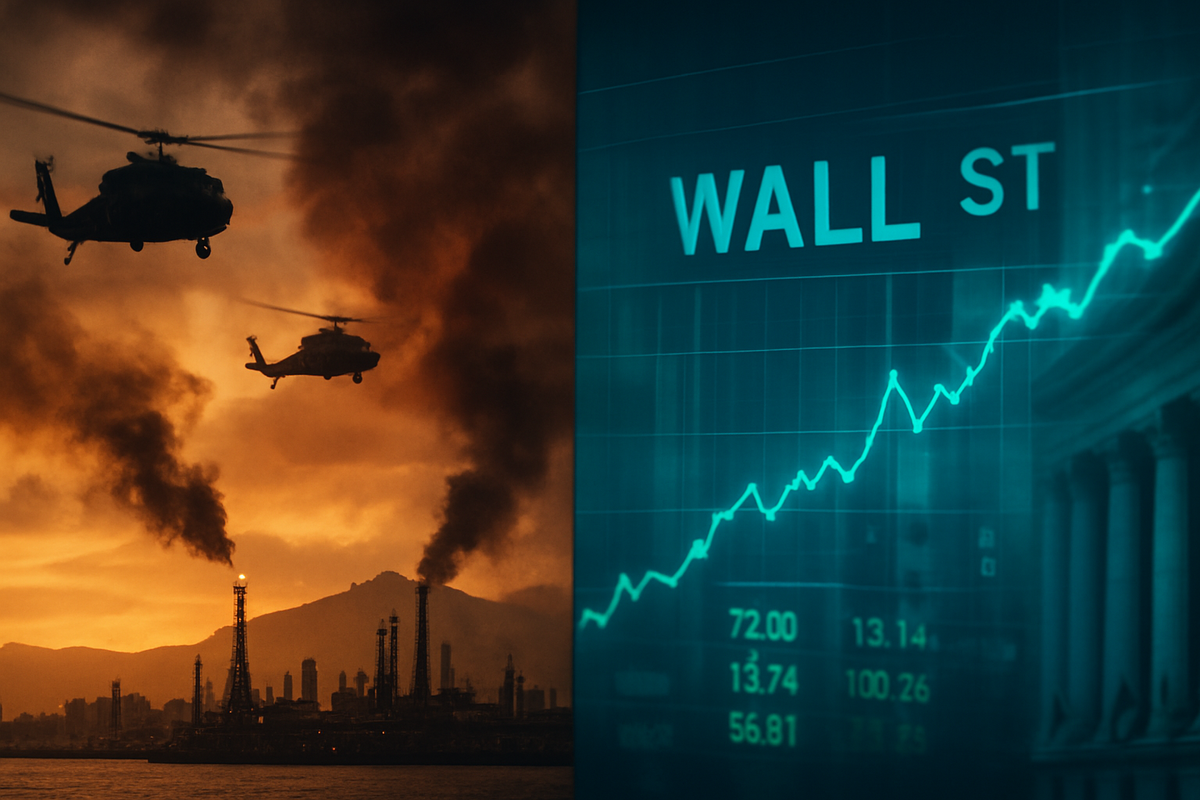
The first week of 2026 has delivered a geopolitical earthquake that few analysts saw coming with such velocity. As U.S. special operations forces executed a daring raid in Caracas to apprehend Nicolás Maduro, the global markets were thrust into a state of high-intensity volatility. The "Operation Southern Spear" mission, occurring on January 3, 2026, has effectively decapitated the Venezuelan leadership, creating a political vacuum in a nation that sits atop the world’s largest proven oil reserves. For investors, the immediate reaction was a classic flight to safety, with gold and defense stocks surging while energy markets grappled with the implications of a total U.S. naval blockade and the potential for a massive, albeit delayed, supply surge.
However, as the dust begins to settle over the Miraflores Palace, a different kind of tension is brewing on Broad and Wall. The Q4 2025 earnings season is set to kick off in earnest next week, and market participants are caught in a tug-of-war between the headlines from South America and the hard data of corporate profitability. While the "Venezuela Shock" has dominated the news cycle, the fundamental question remains: can a geopolitical crisis derail a market that is currently anchored by a projected 8.3% year-over-year earnings growth for the S&P 500?
The Fall of Caracas: A Timeline of the Shock
The events of early January were the culmination of a "maximum pressure" campaign that intensified throughout late 2025. Following a series of disputed local elections and escalating cyberattacks on the state-owned oil firm PDVSA, the U.S. military initiated "Operation Southern Spear" on January 3, 2026. The operation involved targeted airstrikes on the Fuerte Tiuna military base and the capture of Nicolás Maduro and his inner circle. By the morning of January 4, Maduro was reported to be in U.S. custody in New York, facing federal narco-terrorism charges.
The immediate aftermath has seen the appointment of Vice-President Delcy Rodríguez as interim president, though her authority is tenuous at best under the shadow of a U.S. naval blockade. Initial market reactions were swift; Brent crude prices spiked briefly on fears of supply disruptions before stabilizing as traders realized that Venezuelan production had already dwindled to a mere 963,000 barrels per day by December 2025. The real story for the markets is not the loss of current supply, but the long-term restructuring of the Venezuelan energy sector under a U.S.-aligned transitional government.
Key stakeholders, including the U.S. State Department and regional partners like Colombia and Brazil, are now navigating a precarious transition. While the military phase appears largely complete, the "reconstruction" phase—estimated to require over $100 billion in investment—is just beginning. This has created a bifurcated market sentiment: short-term fear regarding regional stability versus long-term optimism for a modernized, high-output Venezuelan oil industry.
Winners and Losers in the Wake of Intervention
The primary beneficiaries of the Caracas intervention are the American energy majors, most notably Chevron Corporation (NYSE: CVX). Having maintained a "toehold" in Venezuela through various sanctions waivers over the years, Chevron is widely seen as the frontrunner to lead the rehabilitation of the country’s aging infrastructure. Analysts expect the company to leverage its existing joint ventures to rapidly scale production once a stable transitional government is established. Similarly, Exxon Mobil Corporation (NYSE: XOM), which has focused heavily on neighboring Guyana, may now find its regional strategy expanded as the Venezuelan "no-go zone" suddenly reopens for business.
Defense contractors have also seen a predictable uptick in valuation. Lockheed Martin Corporation (NYSE: LMT) and Northrop Grumman (NYSE: NOC) saw their shares climb as the scale of "Operation Southern Spear" highlighted the continued demand for advanced precision munitions and surveillance technology. The logistical requirements of maintaining a naval blockade and supporting a transitional government suggest a sustained period of increased operational tempo for these firms.
Conversely, the "losers" in this scenario include emerging market funds with heavy exposure to Latin American sovereign debt. The uncertainty surrounding the "odious debt" of the Maduro era and how a new government will prioritize repayments has led to a sell-off in regional bonds. Furthermore, consumer-facing companies with operations in the region may face prolonged disruptions as civil unrest and hyperinflation continue to plague the Venezuelan populace during the transition.
Shifting Focus: From Geopolitics to the Bottom Line
Despite the gravity of the events in Venezuela, historical precedents suggest that geopolitical shocks often have a shorter shelf life than the market initially expects. The 1989 U.S. intervention in Panama, for instance, caused a brief tremor but was ultimately overshadowed by the prevailing economic trends of the time. In 2026, the "prevailing trend" is the massive investment in Artificial Intelligence and the Federal Reserve’s delicate management of interest rates.
The Q4 2025 earnings season is expected to show that the "Magnificent 7" stocks, led by NVIDIA Corporation (NASDAQ: NVDA), are still the primary engines of market growth. Tech EPS is projected to grow by a staggering 26.5%, a figure that far outweighs the immediate economic impact of a regime change in Caracas. The wider significance of the Venezuela shock may lie in its ability to act as a "rotation catalyst." Investors who were overextended in high-valuation tech names are using the geopolitical noise as an excuse to take profits and rotate into "old economy" energy and industrial stocks that stand to gain from South American reconstruction.
Furthermore, the Federal Reserve’s path in 2026 remains the ultimate "anchor." If the Venezuela crisis leads to a sustained, albeit unlikely, spike in energy prices, it could reignite inflationary pressures and force the Fed to pause its anticipated rate cuts. For now, however, the consensus among institutional desks at JPMorgan Chase & Co. (NYSE: JPM) and Goldman Sachs (NYSE: GS) is that the market will "look through" the Caracas headlines, focusing instead on whether corporate America can continue to deliver double-digit earnings growth in a high-interest-rate environment.
The Road Ahead: Stabilization and Reporting
In the short term, the market will be hyper-fixated on the "first-in-line" earnings reports from the major banks. JPMorgan Chase & Co. (NYSE: JPM) and Citigroup (NYSE: C) are scheduled to report mid-month, and their guidance will be crucial. Investors will be looking for clues on how the Venezuela situation is affecting trade finance, regional risk premiums, and the broader appetite for deal-making in the energy sector.
Long-term, the strategic pivot for the U.S. will be the "Marshall Plan for Venezuela." If the U.S. can successfully stabilize the country and bring its production back toward 4 million barrels per day, it could lead to a secular decline in global oil prices by 2027 or 2028. This would be a massive tailwind for the global economy but a challenge for other OPEC+ members. The challenge for investors will be timing this transition; the "reconstruction trade" is a marathon, not a sprint, and the initial euphoria could easily be dampened by the reality of a collapsed power grid and a hollowed-out workforce in Caracas.
Conclusion: Noise vs. Signal
As we move deeper into January 2026, the "Venezuela Shock" serves as a stark reminder of the inherent volatility in global markets. However, for the disciplined investor, the noise from the military strikes must be separated from the signal of corporate fundamentals. The capture of a dictator is a historic event, but the ability of a company like Apple Inc. (NASDAQ: AAPL) to maintain its margins or for the banking sector to navigate a shifting yield curve is what ultimately determines the trajectory of the S&P 500.
The key takeaway is that while geopolitics provides the drama, earnings provide the direction. The market's "center of gravity" remains firmly rooted in the health of the U.S. consumer and the continued evolution of the tech sector. Investors should watch for the Jan 13 bank earnings as the official "pivot point" where the focus will likely shift from the streets of Caracas back to the balance sheets of the Fortune 500. For now, the strategy remains: hedge for the headlines, but stay invested for the earnings.
This content is intended for informational purposes only and is not financial advice