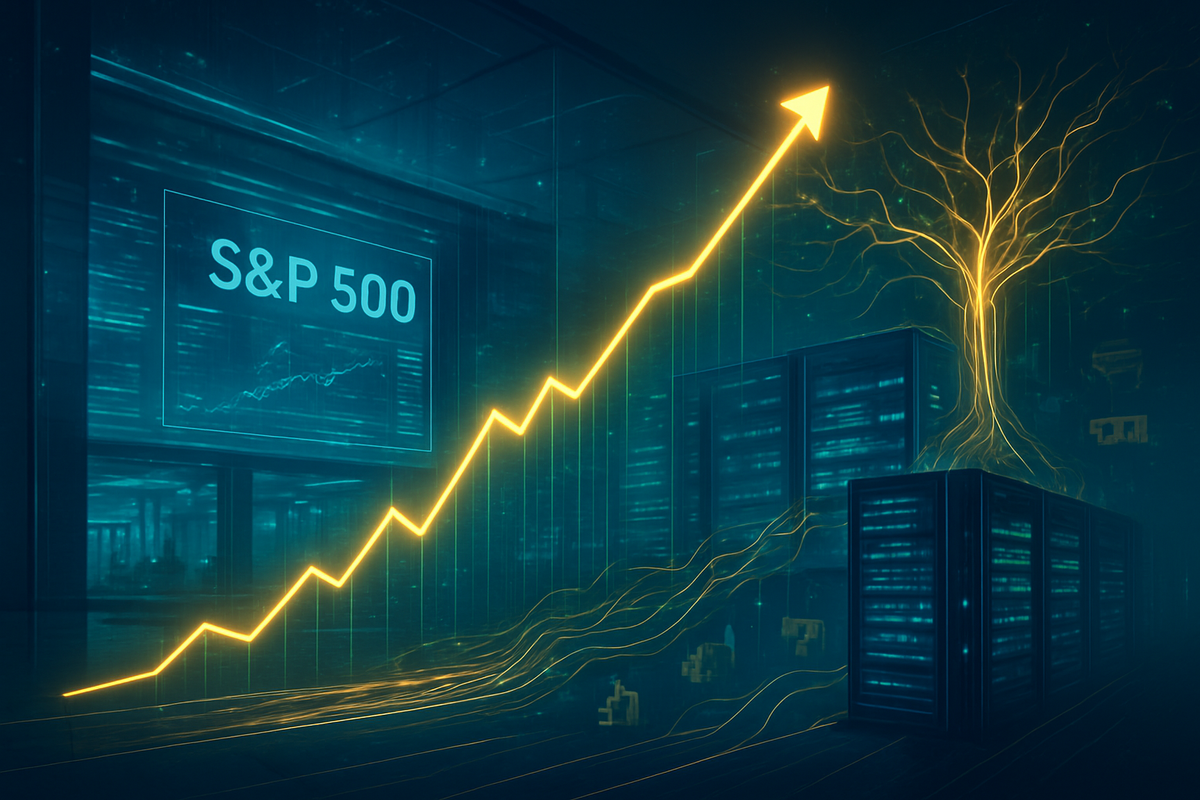
As the calendar turns to January 6, 2026, the financial world is recalibrating its expectations following a blockbuster 2025. Goldman Sachs (NYSE: GS) has set a defiant and optimistic tone for the year ahead, issuing a year-end price target of 7,600 for the S&P 500. This forecast suggests an 11% climb from current levels, underpinned by a transition from speculative artificial intelligence excitement to a tangible era of "AI execution" and corporate productivity gains.
The implications of this forecast are profound for both institutional and retail investors. Goldman’s outlook suggests that the massive capital expenditures seen over the last two years are finally beginning to filter into the bottom lines of the broader market, rather than just the semiconductor giants. This "broadening" of the bull market represents a strategic pivot for the index, moving away from a narrow reliance on a handful of tech titans and toward a more diversified growth profile that includes industrial and consumer sectors.
The Path to 7,600: Earnings Durability and Leadership Transition
The 7,600 target was unveiled in a comprehensive report led by outgoing Chief U.S. Equity Strategist David Kostin and his successor, Ben Snider. The cornerstone of their thesis is a projected 12% growth in S&P 500 Earnings Per Share (EPS), which Goldman expects to reach approximately $305 by the end of 2026. This growth is not merely a byproduct of inflation but is seen as a result of "earnings durability" in an environment where the U.S. economy is expected to maintain a steady GDP growth rate of 2.6%.
This transition in leadership at Goldman Sachs comes at a pivotal moment. David Kostin, who has steered the firm’s equity strategy through the post-pandemic recovery and the initial AI boom, is handing the reins to Snider as the market enters what they call "Phase 3 and 4" of the AI trade. The timeline leading up to this 2026 forecast involved a series of upward revisions throughout late 2025, as corporate balance sheets proved more resilient to high interest rates than many analysts had initially feared. Initial market reactions to the 7,600 target have been cautiously optimistic, with futures markets showing a steady climb as investors digest the possibility of a "productivity miracle."
The Winners and Losers of the $500 Billion AI Capex Surge
The primary winners in Goldman’s 2026 scenario are the "Hyperscalers" and the burgeoning class of "AI Platform" companies. Goldman projects that the combined capital expenditure of giants like Amazon (NASDAQ: AMZN), Meta (NASDAQ: META), Microsoft (NASDAQ: MSFT), and Alphabet (NASDAQ: GOOGL) will hit a staggering $527 billion in 2026. These companies are the backbone of the AI infrastructure, and their continued spending provides a massive floor for the tech sector. Furthermore, software firms like ServiceNow (NYSE: NOW) and Adobe (NASDAQ: ADBE) are positioned to win as they successfully monetize AI tools, moving the narrative from "buying chips" to "selling solutions."
Conversely, the "losers" in this environment are likely to be companies that fail to adapt to the shifting labor dynamics. Goldman’s research indicates a "K-shaped" influence on the labor market, where companies that do not utilize AI to automate routine tasks may face margin compression due to rising labor costs. Traditional retail and legacy manufacturing firms that have lagged in digital transformation are at risk of being left behind in a market that is increasingly rewarding efficiency and automation over raw headcount.
A Global Arms Race: AI Capex in Historical Context
The current surge in AI spending is being characterized by Goldman as a "global arms race" with few historical parallels. The firm compares the current $500 billion+ capex cycle to the telecom boom of the late 1990s. However, there is a key difference: the hyperscalers of 2026 possess significantly stronger balance sheets and higher cash flows than the telecom players of 1999. This suggests that while the spending is massive, it is better supported by fundamental profitability, reducing the risk of a total market collapse similar to the dot-com bubble.
This event fits into a broader trend of "technological sovereignty," where major corporations and even nation-states are racing to secure AI capabilities. The ripple effects are being felt across the energy sector as well, as the demand for data centers drives a resurgence in power infrastructure and nuclear energy investments. From a regulatory standpoint, the sheer scale of this spending is likely to invite further antitrust scrutiny, as the "Magnificent Seven" continue to consolidate their lead in the most critical technology of the decade.
What Comes Next: The 2027 Horizon and the Fed’s "Neutral" Stance
Looking ahead, the short-term focus for the market will be the Federal Reserve’s trajectory. Goldman Sachs expects the Fed to reach a "neutral" interest rate of roughly 3.00% to 3.25% by mid-2026. This stability is expected to unlock a wave of Mergers and Acquisitions (M&A) that has been largely dormant during the high-rate era of 2023 and 2024. If the Fed successfully sticks this "soft landing," the 7,600 target may even prove to be conservative as the cost of capital stabilizes for mid-cap companies.
In the long term, the market will be watching for the transition into "Phase 4" of the AI trade: widespread productivity gains. Goldman estimates that by 2027, AI-driven productivity could contribute as much as 1.5% to total S&P 500 EPS growth. The challenge for 2026 will be proving that the $500 billion in capex is yielding a return on investment. If hyperscalers fail to show significant revenue growth from these investments by the end of the year, a sharp re-rating of tech valuations could occur, potentially stalling the bull run.
Summary and Investor Outlook
Goldman Sachs’ 2026 outlook presents a vision of a market that is maturing rather than overheating. The 7,600 target for the S&P 500 is a vote of confidence in the American corporate sector's ability to turn massive technological investments into tangible profits. The key takeaways for investors are the importance of diversification into cyclical sectors and the need to identify "productivity beneficiaries" who can leverage AI to expand margins.
Moving forward, the market will be characterized by a shift from "AI hype" to "AI execution." Investors should closely watch quarterly earnings reports from the major hyperscalers for signs of "AI revenue" and monitor the Federal Reserve's progress toward a neutral rate. While the "arms race" in AI spending carries inherent risks, the fundamental strength of the U.S. economy and the potential for a productivity-led growth cycle provide a compelling case for the continuation of this historic bull run.
This content is intended for informational purposes only and is not financial advice.