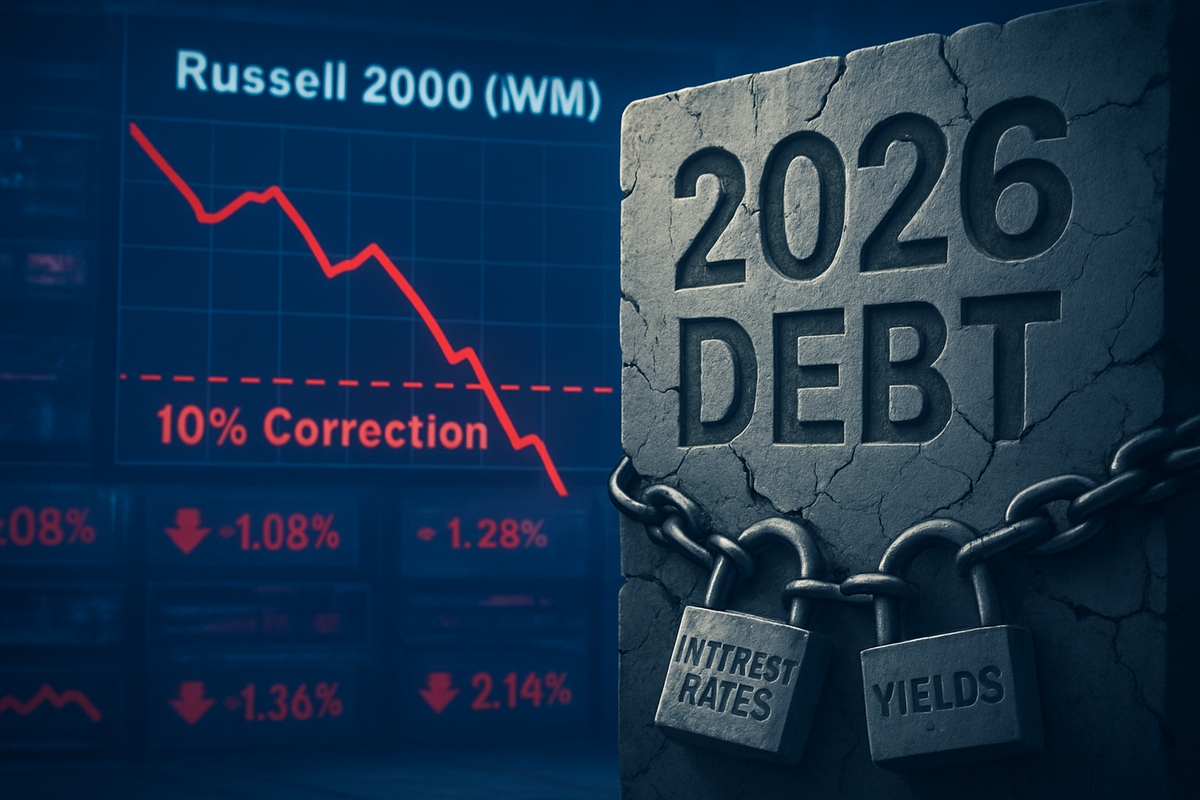
The small-cap rally that ignited hopes for a broad market expansion at the start of the year has met a violent end. As of March 24, 2026, the iShares Russell 2000 ETF (NYSE Arca: IWM) has officially entered correction territory, having plunged 10.9% from its January peak. This sharp reversal has wiped out billions in market value, signaling a stark shift in leadership back toward large-cap safety as investors grapple with a toxic combination of surging yields and a looming "maturity wall" of corporate debt.
The sudden retreat highlights a widening divergence in the equity markets. While the SPDR S&P 500 ETF Trust (NYSE Arca: SPY) has shown relative resilience, small-cap stocks are buckling under the weight of higher-for-longer interest rates. With nearly half of the index's components classified as "zombie companies"—firms unable to cover interest payments with operating profits—the market is now pricing in a period of severe refinancing stress that could redefine the landscape for American small businesses through the remainder of 2026.
A Technical Breach and a Fundamental Shock
The Russell 2000 began 2026 on a high note, fueled by a robust "January Effect" that saw the index climb to an all-time high of 2,718 on January 22. However, the optimism proved short-lived. By mid-February, hotter-than-expected Consumer Price Index (CPI) and Producer Price Index (PPI) data forced the Federal Reserve to pause its widely anticipated rate-cutting cycle. This shift sent the 10-year Treasury yield on a vertical trajectory, spiking from 3.9% in late February to a high of 4.44% by mid-March.
The technical damage was swift and severe. On March 20, the IWM slipped below its 200-day moving average of 2,437, a critical level that often separates bull markets from bear markets. This technical breach triggered a wave of algorithmic selling, accelerating the index's slide into an official 10% correction. The sell-off was further exacerbated by geopolitical instability in the Middle East, which pushed Brent crude prices toward $120 per barrel, raising the specter of "stagflation"—the dreaded combination of stagnant growth and high inflation.
Central to this collapse is the realization that the long-discussed "maturity wall" has arrived. Small-cap firms are facing a massive $1.35 trillion debt pile scheduled to mature between 2026 and 2027. In 2026 alone, approximately $368 billion in debt must be rolled over. Many of these companies are attempting to refinance debt issued during the low-interest environment of 2021 at rates of 1%–2%. In today’s market, those same loans are being priced at 6.5% to 8.0%, a "coupon shock" that is siphoning off free cash flow and threatening the viability of lower-tier cyclicals.
Winners, Losers, and the 'Zombie' Fallout
The correction has created a clear divide between "fortress" small-caps and those surviving on borrowed time. Among the hardest hit are companies with significant leverage and high cash-burn rates. Biotech and technology firms have seen aggressive selling pressure; Five9 Inc. (NASDAQ: FIVN) and Bloom Energy Corp. (NYSE: BE) have both faced sharp declines as investors flee companies that require frequent capital raises. Similarly, the SPDR S&P Regional Banking ETF (NYSE Arca: KRE) has been pummeled, as the maturity wall in Commercial Real Estate (CRE) threatens net interest margins for local lenders.
Highly leveraged entities like Clear Channel Outdoor Holdings (NYSE: CCO) and Community Health Systems (NYSE: CYH) have become posters for the maturity wall crisis. These firms face an uphill battle to refinance their existing obligations without severely diluting shareholders or sacrificing growth initiatives. Analysts estimate that 41% to 46% of the Russell 2000 components are now "zombies," and the current correction suggests a "weeding out" phase is beginning, where only the most efficient operators will survive.
Conversely, a handful of resilient "quality" small-caps are managing to navigate the storm. Fluor Corp. (NYSE: FLR) and Applied Industrial Technologies (NYSE: AIT) have managed to outperform the index, bolstered by strong cash flows and benefits from the One Big Beautiful Bill Act (OBBBA) passed in mid-2025. This legislation, which restored more favorable interest deduction limits based on EBITDA rather than EBIT, has provided a critical lifeline for profitable industrials, allowing them to maintain investment levels even as borrowing costs rise.
Wider Significance and Historical Precedents
The current correction in small caps fits into a broader historical trend where the Russell 2000 acts as the "canary in the coal mine" for the wider economy. Historically, when small caps significantly underperform large caps over a two-month period, it often signals a tightening of credit conditions that eventually impacts the S&P 500. The current "K-shaped" performance—where mega-cap tech stays aloft while small businesses struggle—mirrors the period leading up to the 2000 dot-com bust and the 2008 financial crisis, though the catalyst today is interest rate pressure rather than subprime mortgages or internet valuations.
The ripple effects are already being felt in the credit markets. Spreads on high-yield "junk" bonds have begun to widen for the first time in eighteen months, as lenders demand higher premiums for the perceived risk of small-cap defaults. Furthermore, the $120 oil price is acting as a regressive tax on the domestic-focused Russell 2000 companies, which lack the global hedging capabilities and diversified revenue streams of their large-cap counterparts. This has forced a downward revision of Q4 2025 GDP growth to a meager 0.7%, suggesting the "soft landing" narrative of late last year was premature.
Regulatory and policy implications are also coming into focus. With the OBBBA already in effect, there is growing pressure on the Treasury Department to provide additional targeted relief for small businesses facing the 2026 maturity wall. However, with inflation remaining sticky, any such move could be seen as counter-productive to the Federal Reserve’s restrictive monetary policy, creating a potential clash between fiscal support and monetary tightening.
What Comes Next: Navigating the Maturity Minefield
Looking ahead, the next three to six months will be a "survival of the fittest" period for small-cap stocks. The short-term focus will be on the Q1 2026 earnings season, where management teams will be grilled on their refinancing strategies and interest coverage ratios. Investors should expect a surge in strategic pivots, including aggressive cost-cutting measures, asset sales, and even a wave of distressed M&A as larger firms with deep pockets look to acquire struggling competitors at a discount.
A key scenario to watch is the potential for a "credit event" if a major small-cap component defaults on a significant bond maturity. Such an event could trigger a broader flight to quality, potentially dragging down mid-cap and large-cap stocks that have so far avoided the brunt of the volatility. However, if yields stabilize near 4% and the Fed hints at a resumption of rate cuts by the end of the year, the Russell 2000 could find a bottom. For tactical investors, the 2,400 level on the IWM remains the most critical support zone to monitor.
Market opportunities may emerge for those willing to sift through the wreckage. "Quality" small-caps with low debt-to-equity ratios and positive earnings revisions are currently trading at their lowest valuations relative to the S&P 500 in over two decades. If the economy manages to avoid a deep recession, these overlooked firms could offer massive upside once the "maturity wall" panic subsides.
Final Assessment: A Reality Check for Investors
The 10% correction in the Russell 2000 serves as a sobering reality check for the 2026 market. The era of "easy money" is a distant memory, and the bill for the low-rate borrowing binge of 2020-2021 has finally come due. The "maturity wall" is no longer a theoretical risk; it is a present-day obstacle that will separate the market's winners from its casualties over the coming months.
Investors should move forward with caution, prioritizing balance sheet strength and free cash flow over speculative growth stories. The resilience of the broader market will depend heavily on whether the small-cap contagion can be contained or if it is the first domino in a larger economic shift. Moving into the second quarter, all eyes will be on the bond market—if Treasury yields continue their relentless march higher, the small-cap retreat may only be getting started.
This content is intended for informational purposes only and is not financial advice.