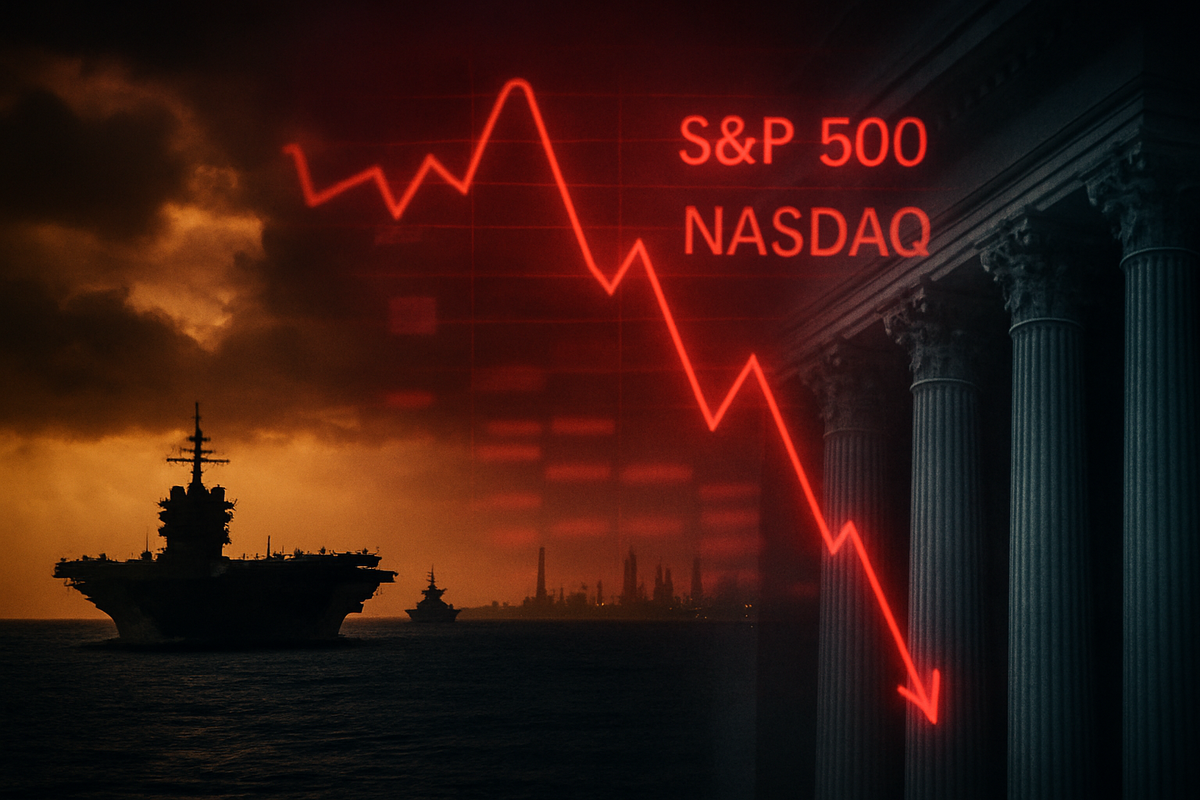
The fragile optimism that had buoyed global markets earlier this week evaporated on Thursday morning, replaced by a wave of risk aversion as a high-stakes diplomatic effort to end the war with Iran collapsed. In a sharp reversal of Wednesday's gains, S&P 500 futures tumbled 0.7% while the tech-heavy Nasdaq fell a significant 1.14% on March 26, 2026. The sell-off was triggered by Tehran’s formal rejection of a 15-point peace proposal, followed closely by a stark "final blow" warning from President Donald Trump, signaling a massive military escalation may be imminent.
The sudden shift in market sentiment underscores the fragility of the current geopolitical landscape. Just 24 hours ago, rumors of a breakthrough in negotiations had sent stocks to weekly highs, with investors betting on a de-escalation that would reopen the Strait of Hormuz and stabilize global energy prices. However, the rejection of the U.S.-backed plan has effectively slammed the door on a near-term diplomatic resolution, leaving the world’s most critical oil transit point under blockade and pushing Brent crude prices toward $107 per barrel.
Collapse of the 15-Point Plan and the 'Final Blow' Ultimatum
The fallout began late Wednesday night when Iranian Foreign Minister Abbas Araghchi characterized the U.S. 15-point peace proposal—mediated through Pakistani channels—as "unrealistic" and a "veiled demand for surrender." The proposal, which had been the source of the market's earlier rally, reportedly demanded the total dismantling of Iran’s nuclear infrastructure, an end to all regional proxy support, and the immediate, unconditional reopening of the Strait of Hormuz. In return, the United States offered a comprehensive lifting of the "maximum pressure" sanctions that have crippled the Iranian economy over the last year.
By the morning of March 26, 2026, the diplomatic failure was met with a blistering response from Washington. In a series of posts on Truth Social, President Trump warned that the time for talk had passed, stating that Iran must "get serious soon" or face a "final blow" from which there would be "NO TURNING BACK." Sources within the Pentagon suggest that the administration is now considering a massive expansion of the air campaign, potentially targeting Iran’s remaining energy hubs on Kharg Island and essential military installations in the Persian Gulf to force a decisive end to the four-week-old conflict.
The timeline leading to this morning’s market rout has been defined by rapid military and economic escalation. Since the initiation of "Operation True Promise 4" by Iran in February, the U.S. and its allies have targeted over 10,000 sites across the Islamic Republic. However, the continued closure of the Strait of Hormuz has remained the primary pain point for global trade. With Iran now reportedly attempting to formalize a "toll" system for the few vessels allowed through, the U.S. has signaled that a purely maritime response is no longer sufficient, leading to the current "final blow" rhetoric that has sent tremors through Wall Street.
Market Winners and Losers in the Wake of War
The escalation has created a stark divide in equity performance, with defense contractors and energy giants emerging as the only beneficiaries of the heightened tensions. Shares of Lockheed Martin (NYSE: LMT) and Northrop Grumman (NYSE: NOC) climbed in early trading as investors anticipated a prolonged conflict and increased government spending on advanced munitions and missile defense systems. Similarly, RTX Corporation (NYSE: RTX) saw a surge in volume, with the company’s interceptor technologies seeing record demand from both the U.S. and its regional allies like Israel and the UAE.
Conversely, the technology sector has borne the brunt of the downturn. The Nasdaq’s 1.14% drop was led by heavyweights like Apple (NASDAQ: AAPL) and Nvidia (NASDAQ: NVDA), as concerns grow over the impact of high energy costs on consumer spending and the potential for a renewed inflationary spike. Rising oil prices act as a "tax" on both corporations and consumers, and the prospect of $110+ oil is threatening the "soft landing" narrative that had dominated the market throughout early 2026.
Energy sector stalwarts such as ExxonMobil (NYSE: XOM) and Chevron (NYSE: CVX) have seen their valuations swell as the risk premium on crude oil expands. However, analysts warn that even these gains could be capped if the conflict leads to a broader regional war that disrupts the production facilities of major partners like Saudi Arabia. For now, the "war trade" is firmly in place, with capital flowing out of growth stocks and into defensive, hard-asset plays.
Broader Economic Significance and Historical Echoes
The rejection of the peace proposal and the subsequent market dip highlight a significant shift in how the 2026 conflict is being viewed by the financial community. This is no longer seen as a brief "skirmish" but as a systemic shock comparable to the 1973 oil crisis or the early days of the Russia-Ukraine conflict in 2022. The 0.7% fall in the S&P 500 represents more than just a daily fluctuation; it is a recalibration of risk as the market realizes that a diplomatic "off-ramp" is no longer on the table.
This event also signals a potential end to the Federal Reserve's pivot toward lower interest rates. With energy-driven inflation now a looming threat once again, the Fed may be forced to maintain its restrictive stance longer than previously anticipated, further pressuring the valuations of high-growth tech companies. Historically, prolonged conflicts in the Middle East have led to "stagflationary" environments—periods of stagnant growth and high inflation—which are notoriously difficult for the stock market to navigate.
Furthermore, the "final blow" warning represents a pivot in U.S. foreign policy toward a "decisive victory" model rather than containment. This change has profound implications for global trade routes and the security of the international energy supply. As Iran seeks to leverage its control of the Strait of Hormuz to demand reparations and sovereignty, the U.S. response appears increasingly geared toward removing Iran’s ability to project power entirely, a strategy that carries immense geopolitical and economic risks.
The Road Ahead: Potential Scenarios and Strategic Pivots
Looking forward, the immediate focus for investors will be on whether the "final blow" mentioned by President Trump manifests as a coordinated military strike or a intensified economic blockade. In the short term, the market will likely remain in a "risk-off" mode, with high volatility expected around daily military briefings and official statements from Tehran. A sustained break above $110 for Brent crude could trigger a more severe correction in the broader S&P 500, potentially testing key support levels at 6,400.
Strategic pivots are already beginning among institutional investors, who are increasing allocations to "disaster hedges" including commodities and specialized defense ETFs. If the U.S. does move to seize or destroy Iran’s oil export capacity on Kharg Island, the resulting supply shock could force a total reconfiguration of global energy flows, benefiting domestic U.S. shale producers and Canadian energy firms. However, any retaliatory strikes by Iran against regional refineries could neutralize these gains and lead to a global recessionary environment.
In the coming weeks, the market will be searching for any sign of a "Plan C"—a second-tier diplomatic effort perhaps led by the United Nations or a different coalition of neutral powers. Until such an alternative emerges, the threat of a "final blow" will continue to cast a long shadow over the trading floor, making any rallies short-lived and susceptible to the next headline out of Washington or the Persian Gulf.
Conclusion: A Market on the Edge
The events of March 26, 2026, mark a definitive end to the brief period of optimism that had characterized the first half of the week. The rejection of the 15-point peace plan and the aggressive rhetoric from the Trump administration have fundamentally altered the market's risk profile. Investors must now contend with the reality of a persistent conflict that threatens not only regional stability but also the global economic recovery and the future path of monetary policy.
The primary takeaway for the market is that the "geopolitical discount" has been fully replaced by a "war premium." As the S&P 500 and Nasdaq struggle to find a floor, the focus shifts to resilience and capital preservation. The coming months will be defined by the outcome of this military standoff and whether the "final blow" results in a swift resolution or a protracted, multi-front war.
For investors, the key watchwords are energy prices and defense spending. These sectors will continue to act as the primary barometers of the conflict's intensity. As we move deeper into the spring of 2026, the ability of the U.S. economy to absorb these geopolitical shocks will be tested like never before, making it a critical time for careful portfolio management and a watchful eye on the escalating headlines.
This content is intended for informational purposes only and is not financial advice