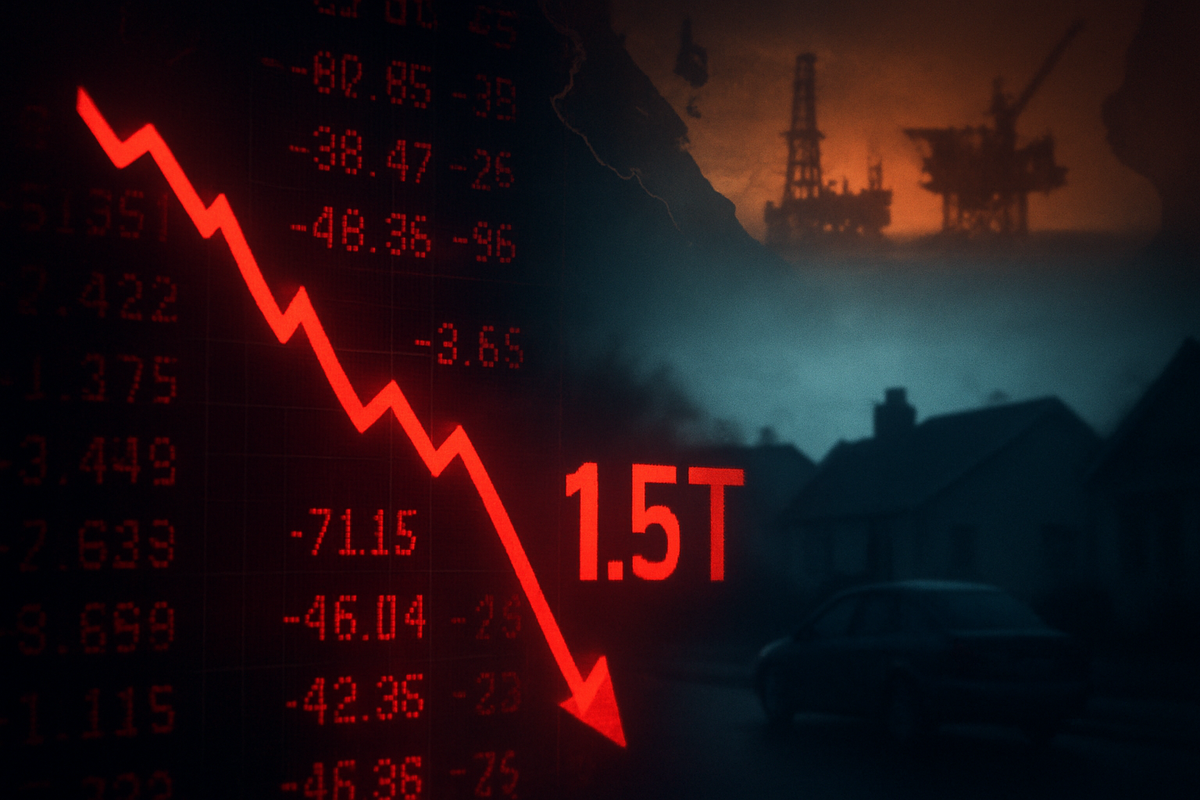
As of March 26, 2026, the American consumer is facing a sudden and severe financial headwind. A new report from Pantheon Macroeconomics reveals that U.S. household wealth has plummeted by an estimated $1.5 trillion in the first quarter of 2026 alone. This massive evaporation of net worth is the direct result of the escalating conflict in the Middle East, which has sent shockwaves through global equity and energy markets, effectively ending the period of relative stability that characterized much of 2025.
The immediate implications are stark: the "negative wealth effect"—a phenomenon where consumers spend less as the value of their assets declines—is expected to shave at least $50 billion off U.S. consumer spending in the first half of this year. With the S&P 500 (NYSEARCA: SPY) experiencing its most volatile period since the 2022 inflation crisis, the intersection of geopolitical instability and domestic financial security has become the primary concern for investors and policymakers alike.
The Path to a $1.5 Trillion Contraction
The current crisis traces its roots to a brief skirmish in June 2025, but the situation turned critical on February 28, 2026, when long-simmering tensions between the U.S., Israel, and Iran escalated into a direct military confrontation. The most damaging blow to the global economy came in early March, when Iran effectively closed the Strait of Hormuz. This narrow waterway serves as the transit point for roughly 20% of the world’s oil and liquefied natural gas (LNG), and its closure has plunged energy markets into chaos.
In the weeks following the closure, Brent crude oil prices surged past the $120-per-barrel mark, a level not seen in years. This spike acted as a double-edged sword: it drove up the cost of living for everyday Americans while simultaneously tanking the valuations of major stock indices. On March 10, the Dow Jones Industrial Average (NYSEARCA: DIA) recorded a single-day drop of nearly 2%, as the reality of a prolonged energy blockade set in.
Key stakeholders, including the International Energy Agency (IEA) and the Federal Reserve, have been forced into emergency postures. While the Fed had been hinting at interest rate cuts throughout 2025, the resurgence of energy-driven inflation has halted those plans. Federal Reserve Chair Jerome Powell recently signaled that rates would remain "higher for longer" to combat headline inflation, which has ticked back up toward 4%. This hawkish stance has further depressed bond prices, contributing to the broader $1.5 trillion wealth decline.
Markets in Flux: Winners and Losers of the Energy Crisis
The impact of this $1.5 trillion wealth reduction is not being felt equally across the board. The energy and defense sectors have seen a significant influx of capital as investors seek "war-time" hedges. ExxonMobil (NYSE: XOM) and Chevron (NYSE: CVX) have outperformed the broader market, driven by record-high crude prices and a scramble for non-Middle Eastern energy supplies. Similarly, defense giants like Lockheed Martin (NYSE: LMT) and Northrop Grumman (NYSE: NOC) have seen their order books swell as the U.S. ramps up its military presence in the region.
Conversely, the consumer discretionary and technology sectors are bearing the brunt of the sell-off. Apple (NASDAQ: AAPL) and Amazon (NASDAQ: AMZN) have seen their valuations pressured by both the decline in household paper wealth and the rising costs of logistics. With gas prices averaging $4.00 per gallon nationwide, the travel industry is also reeling; Delta Air Lines (NYSE: DAL) and Carnival Corporation (NYSE: CCL) have seen significant share price declines as families cancel spring and summer vacation plans to preserve their shrinking budgets.
The luxury goods sector, often considered resilient, has also felt the pinch. Companies like LVMH (OTC: LVMUY) are seeing a slowdown in U.S. demand, as high-income households—who hold the majority of equity-based wealth—pull back on non-essential spending. This suggests that the wealth contraction is hitting the "top" of the K-shaped economy harder than previous energy shocks, which typically disproportionately affected lower-income earners at the gas pump.
Broader Economic Significance and Historical Precedents
This event marks a significant departure from the localized geopolitical spikes of the past decade. It more closely resembles the oil shocks of the 1970s, where supply disruptions led to a period of "stagflation"—low growth combined with high inflation. The $1.5 trillion loss in wealth fits into a broader trend of increased market sensitivity to global supply chains. As the U.S. has become more integrated into global energy markets, the domestic "shield" against foreign turmoil has weakened.
The ripple effects extend far beyond the stock market. Small businesses are reporting higher input costs, while the housing market—already strained by high interest rates—is seeing a further cooling as potential buyers watch their down-payment funds evaporate in their brokerage accounts. This "wealth shock" is likely to influence the 2026 midterm election cycle, as the "misery index" (the sum of the unemployment and inflation rates) begins to climb for the first time in eighteen months.
Furthermore, the closure of the Strait of Hormuz has forced a massive reconfiguration of global shipping. Companies that rely on just-in-time manufacturing are now facing delays and surcharges, which will eventually be passed on to the consumer. This reinforces the "higher-for-longer" inflationary environment, making the Federal Reserve's job of engineering a "soft landing" significantly more difficult, if not impossible.
Looking Ahead: Strategic Pivots and Scenarios
In the short term, market participants should expect continued volatility as the diplomatic situation remains fluid. If the Strait of Hormuz remains closed through the end of Q2, some analysts warn that the $1.5 trillion wealth reduction could double as the risk of a full-scale recession rises to over 30%. Corporations are already beginning to pivot, with many shifting their focus toward cost-cutting measures and building up cash reserves to weather a potential downturn.
There is, however, a potential for a "relief rally" if a diplomatic breakthrough is achieved. Should the U.S. and its allies successfully reopen the shipping lanes, the sudden drop in oil prices could spark a rapid recovery in household wealth. Investors are currently watching for any signs of de-escalation, but the strategic requirement for the coming months is defensive positioning. Opportunities may emerge in "safe-haven" assets like Gold ETFs (NYSEARCA: GLD) or high-yield savings vehicles, which are benefiting from the stalled rate cuts.
Closing Thoughts: A Precarious Moment for the Market
The $1.5 trillion reduction in U.S. household wealth serves as a stark reminder of how quickly geopolitical events can dismantle years of financial progress. For the average investor, the current environment demands a reassessment of risk tolerance. The era of low-volatility growth that many expected for 2026 has been replaced by a period of profound uncertainty, driven by forces far beyond the control of Wall Street.
Moving forward, the market will be laser-focused on three key factors: the duration of the energy blockade, the Federal Reserve’s updated inflation forecasts, and consumer sentiment data. If the "wealth effect" continues to dampen spending, we may see a broader economic contraction that persists well into 2027. For now, the "wait and see" approach remains the dominant strategy, as the world watches to see if the Middle East conflict can be contained before it triggers a global economic reset.
This content is intended for informational purposes only and is not financial advice