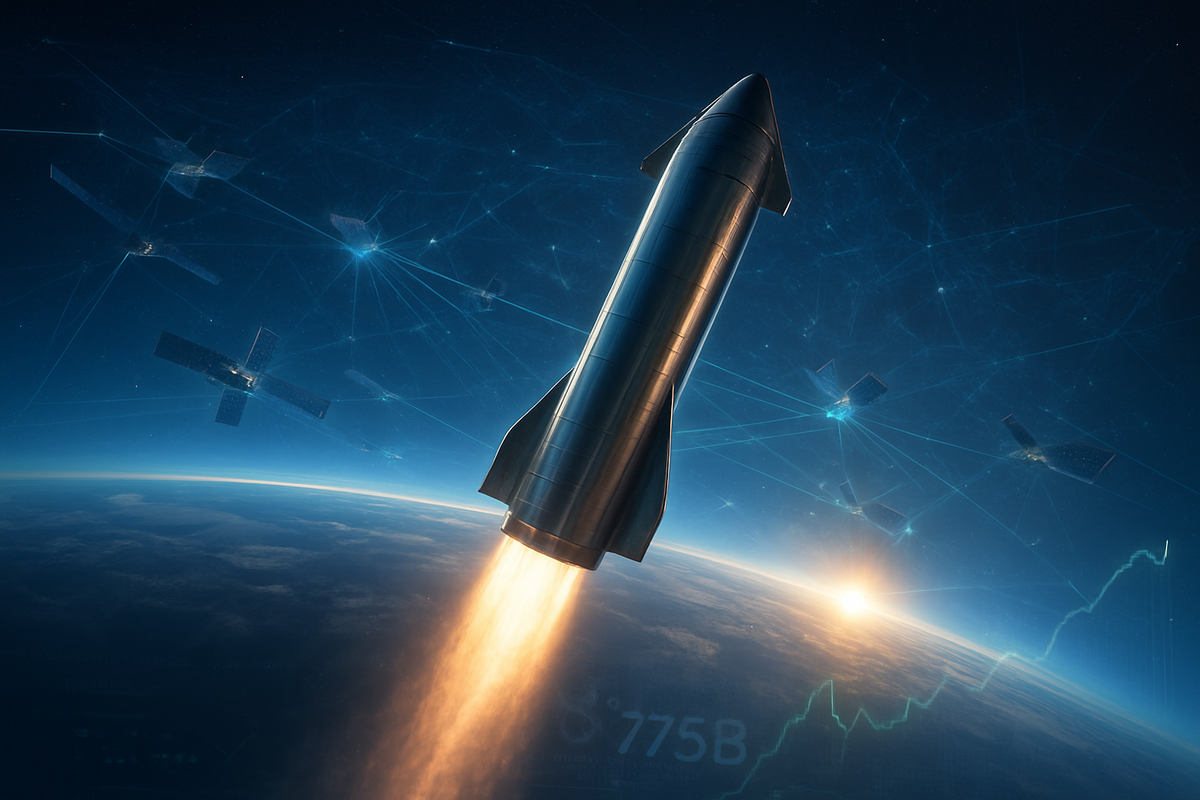
In a move that promises to redefine the global financial landscape, SpaceX is reportedly preparing to file its long-awaited S-1 prospectus as early as this week, marking the beginning of the largest initial public offering in history. Sources familiar with the matter indicate that the Hawthorne-based aerospace giant is targeting a public debut in June 2026, with a capital raise exceeding $75 billion. The offering is expected to value the combined entity at a staggering $1.25 trillion to $1.75 trillion, solidifying Elon Musk's empire as the preeminent force in both the burgeoning space economy and the next frontier of artificial intelligence.
The ripple effects of this announcement were felt immediately across the aerospace sector. While broader markets remained relatively flat, shares of industry peers surged on the news. Rocket Lab (Nasdaq: RKLB) saw its stock price jump 8% in early trading on March 26, 2026, as investors bet on a "rising tide" effect for the entire space industry. Other major players, including Intuitive Machines (Nasdaq: LUNR) and Redwire (NYSE: RDW), also experienced significant gains, reflecting a renewed investor appetite for space-based infrastructure.
A Historic Leap to the Public Markets
The path to this moment has been paved by a series of unprecedented technical and financial milestones. Just two years ago, in June 2024, SpaceX was valued at approximately $210 billion. By December 2025, following a highly successful secondary share sale at $421 per share, that private valuation had ballooned to $800 billion. The jump to the trillion-dollar club was catalyzed by the strategic merger with Musk’s artificial intelligence venture, xAI, in February 2026. This integration has shifted the narrative from a simple launch provider to a vertically integrated "innovation engine" that combines orbital logistics with massive AI compute capabilities.
Under the leadership of Elon Musk and COO Gwynne Shotwell, SpaceX has transitioned Starlink from a capital-intensive project into a global telecommunications utility. As of early 2026, Starlink boasts over 9.2 million active subscribers and is projected to generate between $20 billion and $24 billion in revenue this year alone. The successful deployment of Starship—the largest and most powerful rocket ever built—has drastically lowered the cost of putting mass into orbit, enabling the rapid launch of Starlink V3 satellites and the first generation of "orbital data centers."
The inclusion of xAI into the IPO narrative is perhaps the most audacious aspect of the filing. By leveraging the near-constant solar energy and natural radiative cooling of space, SpaceX intends to host xAI’s "Grok" models on specialized orbital hardware. This move aims to bypass the massive power and land requirements of terrestrial data centers. Musk has articulated a vision where the Starlink laser mesh network acts as the primary conduit for a space-based AI backbone, providing low-latency, high-security compute power for both commercial and defense applications via the "Starshield" program.
Market analysts from Morgan Stanley and Goldman Sachs, who are expected to lead the underwriting team, suggest that the $75 billion capital raise will be used to accelerate the development of Mars-bound infrastructure and the "100-gigawatt" solar-compute constellation. The timing of the filing suggests that SpaceX is eager to capitalize on its current technical dominance before legacy competitors can close the gap in reusable launch technology.
Winners and Losers in the New Space Race
The immediate "winner" in the wake of the SpaceX IPO news is undoubtedly the specialized space infrastructure sector. Rocket Lab (Nasdaq: RKLB) has benefited immensely from the validation of the space economy, with its stock price hitting multi-year highs as it prepares for the upcoming debut of its Neutron rocket. Investors are increasingly viewing companies like Rocket Lab not just as competitors to SpaceX, but as essential secondary players in a rapidly expanding market that requires multiple launch options and diversified satellite services.
Intuitive Machines (Nasdaq: LUNR) has also emerged as a significant beneficiary. Having recently completed a major acquisition of space systems assets, the company is now seen as a "multi-domain space prime" that can coexist with SpaceX by focusing on lunar logistics and deep-space communication. The influx of capital into the sector is expected to lower the cost of capital for these mid-cap players, allowing them to fund more aggressive R&D cycles.
On the other side of the ledger, legacy defense and aerospace contractors face a daunting challenge. Companies such as Boeing (NYSE: BA) and Lockheed Martin (NYSE: LMT) have struggled to match the pace of SpaceX's innovation and cost efficiency. As SpaceX cements its status as a trillion-dollar public entity, these traditional giants risk losing further market share in both the commercial launch and satellite manufacturing sectors. Analysts suggest that the "SpaceX effect" may force these legacy firms to undergo significant restructuring or divestiture of their space divisions to remain competitive.
Additionally, terrestrial telecommunications providers like AT&T (NYSE: T) and Verizon (NYSE: VZ) are watching the Starlink expansion with growing concern. With SpaceX targeting 25 million monthly active users for its Direct-to-Cell service by the end of 2026, the traditional boundaries between terrestrial and orbital mobile networks are dissolving. The massive capital infusion from the IPO will only accelerate SpaceX's ability to disrupt the $1.5 trillion global telecom market.
The Significance of a Trillion-Dollar Launch
The SpaceX IPO is more than just a financial event; it is a paradigm shift for the global capital markets. If the company achieves its $75 billion fundraising target, it will comfortably surpass Saudi Aramco’s 2019 record of $25.6 billion, making it the largest initial public offering ever recorded. This event signals that "New Space" has matured from a speculative venture-backed niche into a foundational pillar of the global economy, comparable to the tech boom of the late 1990s or the emergence of the oil industry in the early 20th century.
From a regulatory standpoint, the IPO will bring unprecedented transparency to SpaceX's operations. For the first time, the SEC and the public will have access to detailed financial audits of Starlink's profitability and the capital expenditures required for Starship. This move also raises complex questions regarding the "Musk Ecosystem." Regulators are expected to closely scrutinize the inter-connectivity between Tesla (Nasdaq: TSLA), SpaceX, and xAI, particularly regarding data sharing, cross-company labor, and potential conflicts of interest among shareholders.
The integration of AI into the space narrative also has profound geopolitical and policy implications. As SpaceX builds out its orbital compute capacity, it effectively creates a "sovereign-free" zone for data processing, which may challenge existing international laws regarding data residency and national security. The U.S. government, while supportive through its NASA and Space Force contracts, will likely face pressure to establish new frameworks for how private entities manage critical infrastructure in the "high ground" of orbit.
Historically, only a handful of companies have managed to maintain valuations above $1 trillion. By entering the public markets at this level, SpaceX is betting that it can sustain a growth trajectory that outpaces the broader economy. Comparisons are already being made to the 2012 IPO of Facebook (now Meta (Nasdaq: META))—which initially struggled but eventually dominated its sector—and the 2014 debut of Alibaba (NYSE: BABA). However, the capital-intensive nature of rocket science makes this a unique experiment in the history of finance.
The Road to June 2026 and Beyond
As the filing becomes official, the financial community will shift its focus to the upcoming roadshows. Investors will be looking for concrete data on Starlink’s churn rates, the reliability of the Starship launch schedule, and the specific technical synergies between xAI’s Grok and the Starlink network. A key question will be whether Musk intends to spin off Starlink as a separate entity post-IPO, or if the "all-in-one" model of SpaceX 2.0 will remain the long-term structure.
In the short term, the market should prepare for heightened volatility in all space-related tickers. The "proxy rally" seen in stocks like Rocket Lab may face corrections if the SpaceX filing reveals any hidden financial weaknesses or if regulatory hurdles delay the June 2026 listing. Conversely, a successful IPO could trigger a wave of mergers and acquisitions as smaller space startups seek to align themselves with the newly public giant or consolidate to survive.
Strategic pivots will also be required for SpaceX itself. Transitioning from a private company controlled largely by Musk to a public entity with fiduciary duties to thousands of shareholders will necessitate a cultural shift in Hawthorne. The company will need to balance its aggressive, "fail-fast" engineering philosophy with the quarterly earnings expectations of Wall Street. This tension will be the primary narrative to watch as the company moves toward its historic debut.
A New Era for Investors
The impending SpaceX IPO marks the end of the "early adopter" phase of space investing and the beginning of a new era where orbital assets are a standard component of institutional portfolios. The combined might of $24 billion in projected revenue and a $1.75 trillion valuation reflects a world where the stars are no longer just for exploration, but for commerce, communication, and computation.
Investors should maintain a cautious but optimistic outlook as the S-1 filing becomes public. Key metrics to monitor include the frequency of Starship launches, the growth of Starlink's enterprise and maritime revenue, and any further updates on the orbital data center initiative. While the $75 billion price tag is historic, the true value of SpaceX will be determined by its ability to execute on a vision that spans from the Earth's surface to the far reaches of the solar system.
Moving forward, the market will never be the same. The "Musk Ecosystem" is now the primary gravitational force in the financial universe, and the SpaceX IPO is the event that will determine whether that force can propel the world into a truly space-faring future. As we approach the June 2026 listing, one thing is certain: the sky is no longer the limit—it is simply the first stop.
This content is intended for informational purposes only and is not financial advice.