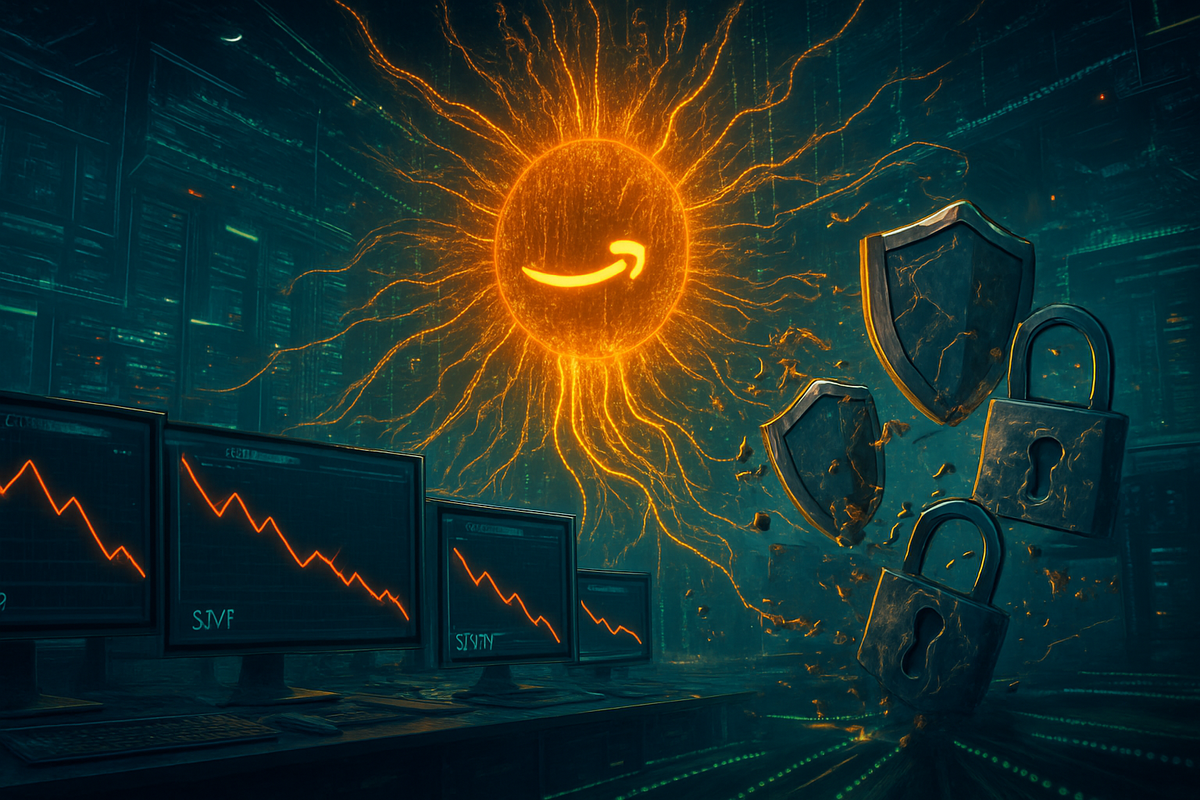
The cybersecurity landscape faced a seismic shift this week as Amazon.com Inc. (NASDAQ: AMZN) unveiled its most advanced suite of autonomous AI security agents to date. These tools, which have evolved from the long-rumored "Project Metis," represent a move toward truly autonomous "agentic" security, capable of identifying vulnerabilities and deploying self-healing code without human intervention. The announcement has triggered an immediate reassessment of the value proposition offered by traditional endpoint security providers.
The fallout was felt most acutely by CrowdStrike Holdings, Inc. (NASDAQ: CRWD), which saw its stock price crater as investors grappled with the prospect of Amazon "in-sourcing" its security needs and offering those same capabilities to AWS customers. As of today, March 27, 2026, CrowdStrike shares have fallen over 7% in a single trading session, capping off a week of significant volatility that has wiped billions from the market caps of pure-play cybersecurity firms.
The Rise of the Machine: Amazon’s Agentic Security Suite
The events leading to this week’s market turmoil began on Tuesday, March 24, when internal reports leaked detailing the "AWS Security Agent" in a private preview. By the time Amazon officially confirmed the rollout during a developer keynote, the implications were clear: the era of the "Copilot" is being superseded by the era of the "Agent." Unlike previous AI tools that merely flagged issues for human review, Amazon’s new Autonomous Threat Analysis (ATA) system utilizes a competitive-agent architecture. In this setup, "Red-Team" and "Blue-Team" AI agents continuously attack and defend the cloud environment, reducing manual security workflows that once took weeks down to just four hours.
Key to this disruption is the "self-healing" capability. Amazon’s agents are now integrated directly into the development lifecycle, performing on-demand penetration testing and autonomously generating patches for discovered bugs. Once a patch is generated, the AI validates it in a sandbox and prepares it for deployment, drastically narrowing the "blast radius" of human errors. The timeline of this release coincides with the RSA Conference 2026, traditionally a showcase for cybersecurity incumbents, effectively stealing the spotlight and forcing a defensive pivot from the industry's largest players.
Winners and Losers: A Valuation Crisis for Cybersecurity Pure-Plays
The primary "winner" in this scenario is undoubtedly Amazon. By integrating sophisticated, autonomous security directly into the AWS fabric, the company increases its "stickiness" for enterprise clients and reduces the total cost of ownership for cloud infrastructure. For Amazon, security is no longer just a shared responsibility; it is becoming a proprietary product feature that could render third-party security layers redundant for many small to mid-sized enterprises.
On the losing end, CrowdStrike (NASDAQ: CRWD) faces a potential existential threat to its growth narrative. Investors are particularly concerned about a high-profile 2025 agreement where CrowdStrike provided protection to Amazon Business Prime members. Analysts now fear that if Amazon’s internal AI agents can perform these tasks natively, the partnership may be quietly phased out. Palo Alto Networks, Inc. (NASDAQ: PANW) has also seen its shares drop nearly 29% from their quarterly highs, as the market begins to price in a "vendor consolidation" cycle where cloud hyperscalers absorb the functions previously handled by specialized software.
The "27-Second Breakout": Why Autonomous Security is Non-Negotiable
This shift is not merely a corporate power play; it is a response to a rapidly deteriorating threat environment. According to recent data, AI-empowered cybercriminals have reduced "eCrime breakout times"—the time it takes an intruder to move from an initial breach to other parts of a network—to as low as 27 seconds. At these speeds, human-led Security Operations Centers (SOCs) are functionally obsolete.
Amazon’s move fits into a broader industry trend where "Agentic AI" is becoming the standard for enterprise resilience. This evolution mirrors historical precedents in the tech industry, such as when Microsoft Corp. (NASDAQ: MSFT) integrated basic antivirus features into Windows, eventually disrupting the consumer antivirus market. However, the scale of this disruption is far greater, as it involves the very "brain" of corporate IT infrastructure. Regulators are already taking notice, with concerns being raised about the concentration of security power within a handful of cloud giants, potentially creating a single point of failure for the global economy.
Strategic Pivots: The Path Forward for the Disrupted
In the short term, pure-play cybersecurity firms are scrambling to prove their relevance. At the RSA Conference today, CrowdStrike launched its "Charlotte AI AgentWorks" ecosystem, a no-code platform that allows security teams to build their own custom agents using a variety of models, including those from OpenAI and even Amazon’s own Bedrock. This "Switzerland-style" approach aims to offer flexibility that a single-cloud provider like Amazon might not support in multi-cloud environments.
Long-term, the industry may see a wave of consolidation. Smaller firms with niche AI capabilities may be acquired by larger players looking to bolster their agentic offerings. For companies like CrowdStrike and Palo Alto Networks, the challenge will be to move beyond being "security tools" and become "agentic operating systems" that can manage a company’s security posture across AWS, Azure, and on-premises servers simultaneously—a "cross-cloud" advantage that Amazon has little incentive to provide.
Market Outlook: What Investors Must Watch
The market’s reaction this week suggests a fundamental repricing of the software sector. The iShares Expanded Tech-Software Sector ETF (BATS:IGV) is down over 30% year-to-date, reflecting a broader fear that AI will automate away the high-margin per-seat licensing models that have sustained the industry for a decade. The key takeaway for investors is that the "AI tailwind" is now a double-edged sword; while it creates efficiency, it also commoditizes specialized labor and software.
Moving forward, investors should watch for the official termination or renewal of the Amazon-CrowdStrike partnership as a bellwether for the sector. Additionally, keep a close eye on "Shadow AI" risks—the emergence of unmanaged AI tools within enterprises—which could create a new niche for specialized security firms to fill. The "AI Agent Apocalypse" may have arrived, but for those companies that can successfully pivot to managing autonomous systems rather than just detecting threats, a new era of growth may yet emerge from the volatility.
This content is intended for informational purposes only and is not financial advice.