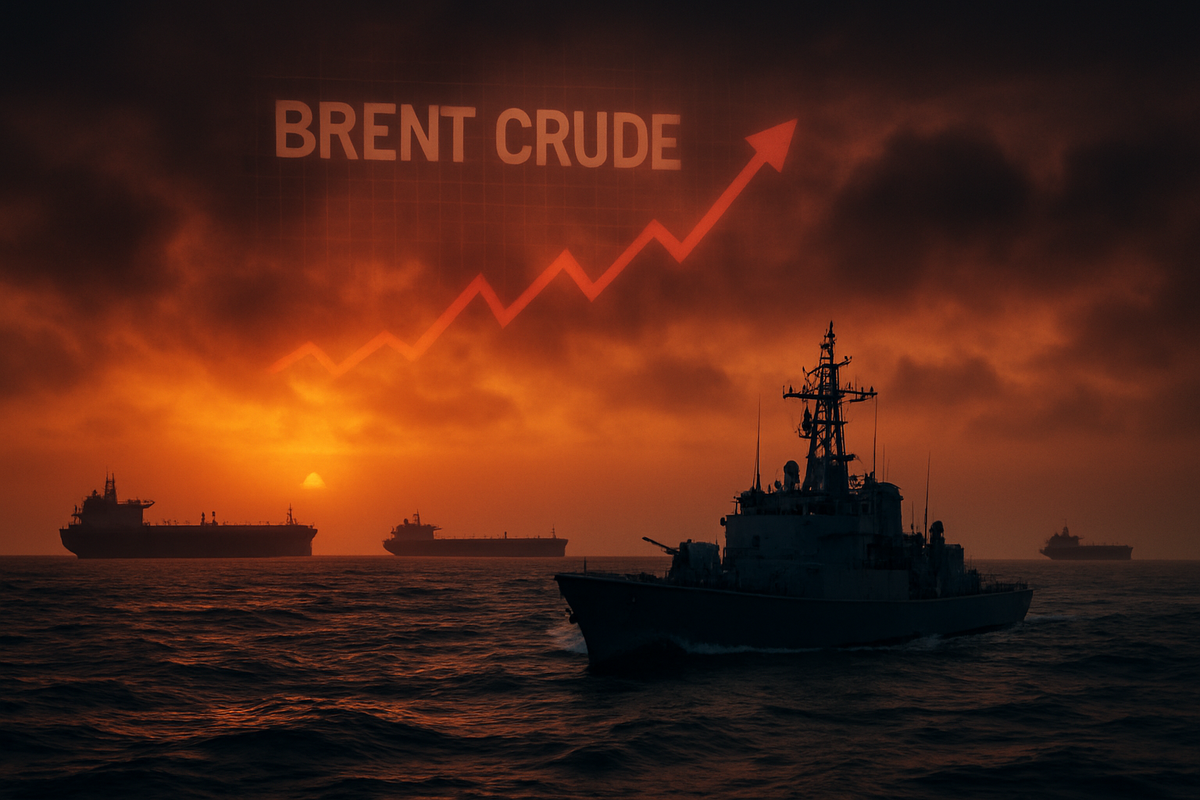
The global energy landscape shifted violently this week as Brent crude oil prices surged past the $110 per barrel mark, a level not seen with such volatility since the early days of the Ukraine conflict years ago. The primary catalyst for this historic spike is the total closure of the Strait of Hormuz, a critical maritime chokepoint through which approximately 20% of the world’s oil and 25% of its liquefied natural gas (LNG) flows. Following a dramatic escalation in military hostilities between a U.S.-led coalition and Iran, the Islamic Revolutionary Guard Corps (IRGC) officially declared the waterway closed to all commercial traffic, effectively strangling the primary artery of global energy trade.
The immediate implications are staggering. With over 20 million barrels of oil per day now effectively trapped within the Persian Gulf, regional benchmarks have decoupled from global reality. While prices in the United States and Europe skyrocket due to supply fears, tankers are sitting idle in the Gulf of Oman, facing insurance premiums that have climbed as much as 600% in a single week. For the average consumer, this means the return of $5-per-gallon gasoline is no longer a threat but a reality, while industries ranging from aviation to manufacturing are bracing for a period of intense "demand destruction."
The Path to 'Operation Epic Fury' and the Retaliation
The current crisis is the culmination of a multi-year breakdown in Middle Eastern diplomacy. Throughout 2025, tensions simmered following the failure of nuclear negotiations and a series of covert strikes on Iranian enrichment facilities. The situation reached a breaking point on February 28, 2026, when the United States and Israel launched "Operation Epic Fury," a massive aerial campaign targeting Iranian leadership and military command centers. The operation, which resulted in the confirmed deaths of several high-ranking Iranian officials, was intended to neutralize Tehran's nuclear capabilities and proxy networks once and for all.
However, the military success of the strikes was immediately met with an asymmetric economic counter-response. On March 2, 2026, the Iranian Navy began mining the Strait of Hormuz and utilizing "swarm" drone tactics to target merchant vessels. By mid-March, 21 commercial ships had been struck or seized, prompting the world’s major shipping lines to halt all transit through the region. The U.S. Navy has since initiated a counter-blockade operation, but the technical challenge of clearing mines while under constant missile threat from the Iranian coast has made the waterway impassable for standard tankers.
Key stakeholders, including Saudi Arabia (TADAWUL:2222) and the United Arab Emirates, have attempted to mitigate the fallout by ramping up exports via overland pipelines to the Red Sea. However, the capacity of these "bypass" routes—such as Saudi Aramco's East-West pipeline—is insufficient to cover the 10 million barrel-per-day deficit created by the Hormuz closure. As of March 27, 2026, the global market remains in a state of "force majeure," with QatarEnergy announcing a total halt to LNG shipments, sending European natural gas futures to record highs.
Market Winners and Losers: From Defense to Logistics
The surge to $110 oil has created a stark divide in the equity markets. The clearest beneficiaries are domestic U.S. energy producers who are insulated from the physical blockade but profit immensely from the global price spike. Occidental Petroleum (NYSE: OXY) and ExxonMobil (NYSE: XOM) have seen their shares rally by over 15% this month, as investors bet on increased production from the Permian Basin to fill the global void. Similarly, Chevron (NYSE: CVX) has benefited from its diversified portfolio, though its international operations remain under a cloud of geopolitical risk.
On the other side of the ledger, the aerospace and defense sector is seeing a massive influx of capital. Lockheed Martin (NYSE: LMT) and RTX Corporation (NYSE: RTX) have reported record-breaking backlogs as the U.S. and its allies scramble to replenish munitions and air defense systems like the Patriot and Tomahawk missiles used in "Epic Fury." Palantir Technologies (NYSE: PLTR) has also seen a significant stock bump, as its AI-driven target acquisition platforms have reportedly played a central role in the coalition’s tactical successes.
Conversely, the losers are numerous and hard-hit. The airline industry, already struggling with thin margins, is reeling from the sudden doubling of jet fuel costs. Delta Air Lines (NYSE: DAL) and American Airlines (NASDAQ: AAL) have seen their stocks tumble as they announce emergency fuel surcharges and flight cancellations. Additionally, energy services firms like SLB (NYSE: SLB) and Halliburton (NYSE: HAL) face a complex outlook: while they will eventually be needed for the multi-billion dollar reconstruction of Gulf infrastructure, their immediate operations in the Middle East have been paralyzed by the conflict, leading to short-term volatility.
A New Era of Energy Insecurity
This event fits into a broader, more alarming trend of "energy weaponization" that has defined the mid-2020s. The closure of the Strait of Hormuz is the 21st-century equivalent of the 1973 oil embargo, but with far more complex global supply chains. The crisis has exposed the fragility of the "Just-in-Time" energy model and is likely to trigger a permanent shift in how nations view energy security. We are seeing an immediate acceleration of the transition to domestic renewables and nuclear power in Europe and Asia, not just for environmental reasons, but as a matter of national survival.
The regulatory implications will be profound. Governments in Japan and South Korea, which are nearly 90% dependent on Middle Eastern oil passing through Hormuz, are already drafting emergency legislation to mandate larger strategic reserves and subsidize rapid-response LNG terminals on their eastern coasts. In the United States, the Biden-Trump transition era has left a legacy of conflicting energy policies, but the current crisis is forcing a bipartisan consensus on the need for "energy independence 2.0," potentially leading to eased permitting for domestic pipelines and offshore drilling to ensure North American self-sufficiency.
The Road Ahead: Ultimatums and Scenarios
The next ten days will be the most critical for the global economy in decades. President Donald Trump has issued a formal ultimatum to Tehran: reopen the Strait of Hormuz by April 6, 2026, or face the "total obliteration" of Iran’s domestic energy grid and refining capacity. This "escalate to de-escalate" strategy carries immense risks. If Iran complies, we could see oil prices stabilize back toward the $85–$90 range. However, if Iran chooses a "scorched earth" policy, analysts at Goldman Sachs warn that prices could theoretically touch $200 per barrel as the conflict expands to include the destruction of Gulf production facilities.
In the short term, look for a surge in "dark fleet" tanker activity—vessels operating without traditional insurance or transponders—as desperate buyers in Asia attempt to smuggle oil out of the region. Long-term, the strategic pivot for most global corporations will involve diversifying supply chains away from any single geographic chokepoint. The "Hormuz Premium" is likely here to stay, meaning that even if the strait reopens tomorrow, the cost of doing business in the Middle East has fundamentally changed.
Conclusion: Navigating the $110 Reality
The surge of crude oil past $110 per barrel is more than just a market fluctuation; it is a signal that the era of "cheap security" has ended. The closure of the Strait of Hormuz has paralyzed 20% of the world’s oil supply, forcing a radical repricing of risk across every asset class. For investors, the takeaways are clear: defense contractors and domestic energy producers have become the new "safe havens," while consumer-facing sectors and heavy transport face a period of prolonged pain.
Moving forward, the market will be hyper-sensitive to any news regarding the April 6 deadline and the U.S. Navy’s progress in mine-clearing operations. While the immediate focus is on the price at the pump, the lasting impact will be the restructuring of global trade routes and a renewed urgency for energy sovereignity. Investors should maintain a high degree of liquidity and watch for signs of "demand destruction" in the coming months, as the global economy attempts to absorb this massive inflationary shock.
This content is intended for informational purposes only and is not financial advice.