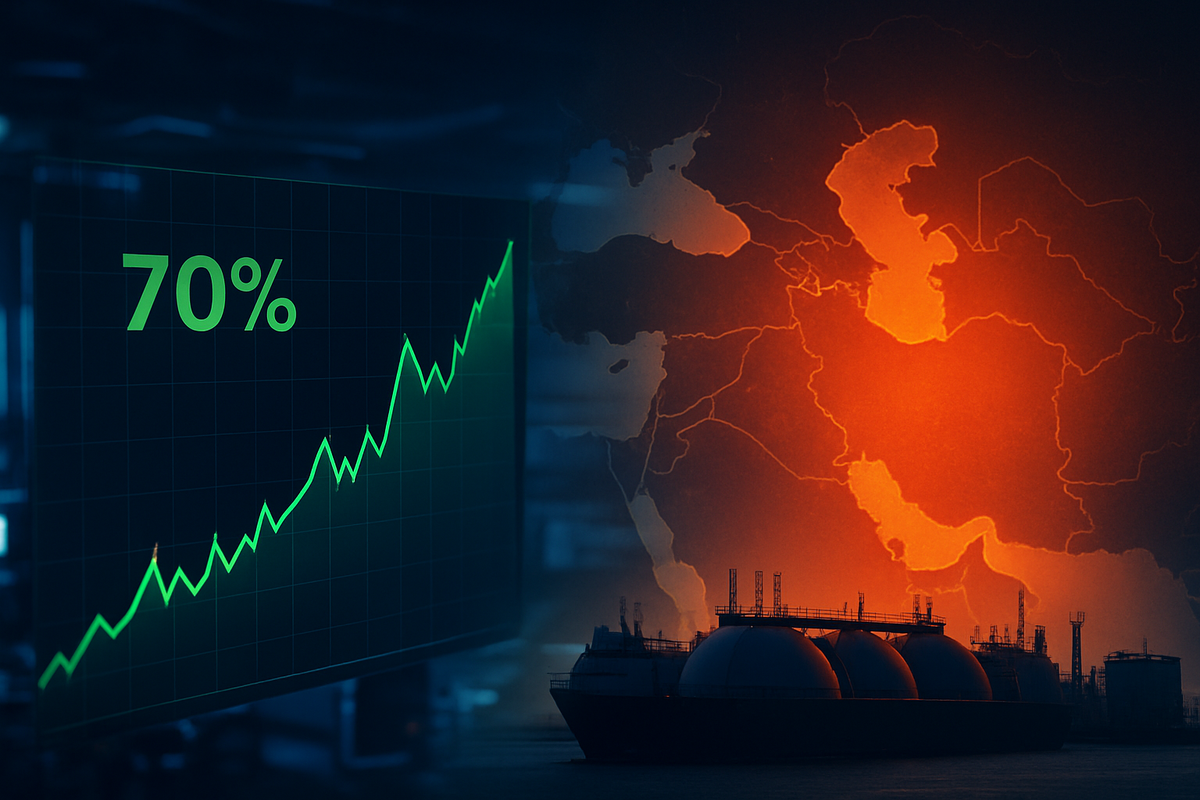
European energy markets have been thrown into a state of high-velocity volatility this month, with natural gas prices surging a staggering 70% in March 2026. As of today, March 27, the Dutch TTF benchmark—the gold standard for European gas pricing—is trading at 54.5 euros per megawatt hour, marking a daily increase of over 3%. This dramatic spike is the direct result of a deepening geopolitical crisis in West Asia, which has triggered a systematic and aggressive repricing of energy benchmarks across the globe.
The sudden escalation of hostilities has shattered the relative stability of the early 2020s, forcing traders and policymakers to confront a reality where energy security is no longer guaranteed. With the continent entering the critical summer storage-refill season with dangerously low inventories, the immediate implications are clear: higher utility bills for consumers, mounting pressure on heavy industry, and a significant headache for central bankers struggling to contain a new wave of imported inflation.
The Siege of Hormuz and the Qatar Shock
The roots of the current crisis trace back to February 28, 2026, when coordinated military strikes in the Persian Gulf region led to the effective closure of the Strait of Hormuz. This narrow waterway, a vital artery for global commerce, handles roughly 20% of the world’s liquefied natural gas (LNG) and 25% of its oil. The blockade has essentially stranded millions of tonnes of fuel intended for European and Asian markets. Compounding the supply shock was the reported destruction of infrastructure at Ras Laffan Industrial City in Qatar. Analysts suggest that nearly 17% of Qatar’s LNG capacity could be offline for three to five years, transforming a temporary disruption into a long-term structural deficit.
The timing of the West Asia crisis could not have been worse for the European Union. Following an unusually harsh winter, European gas storage levels were estimated to be at a mere 28–31% capacity in early March. Without the usual "buffer" of stored fuel, the market has become hyper-sensitive to any news of supply interruptions. This sensitivity has led to a "cascading effect" across global energy infrastructure, where a delay in a single tanker now triggers price spikes from London to Tokyo. The market’s reaction was near-instantaneous; prices that sat at 31 euros per megawatt hour in late February breached the 50-euro mark within weeks, as the industry scrambled to secure alternative supplies.
Corporate Winners and the Industrial Fallout
In this high-stakes environment, Equinor ASA (NYSE: EQNR) has emerged as the primary beneficiary. As Europe’s largest provider of pipeline gas, the Norwegian giant’s supply is currently viewed by the market as "zero-risk." Shares of Equinor have surged 73% year-to-date, as investors bet on the company’s ability to command premium prices while maintaining stable production. Conversely, TotalEnergies SE (NYSE: TTE) and Shell PLC (NYSE: SHEL) are facing significant headwinds. Both companies have high exposure to the Middle East; TotalEnergies has seen approximately 15% of its global production shut down due to the conflict, while Shell was forced to halt operations at its Pearl GTL plant in Qatar.
The impact extends far beyond the energy producers themselves. European heavy industry is currently in "survival mode." Steel manufacturing giant ArcelorMittal S.A. (NYSE: MT) and ThyssenKrupp AG (OTC: TKAMY) have reportedly withdrawn price offers for future contracts, citing "incalculable" energy costs that make long-term planning impossible. Perhaps most critically, fertilizer producer Yara International ASA (OTC: YARIY) is facing an existential threat. Since natural gas is a primary feedstock for nitrogen-based fertilizers, the 70% price surge threatens to shutter plants across the continent, raising the specter of a secondary crisis in food inflation by late 2026.
Systemic Repricing and the Central Bank Pivot
The current energy shock represents more than just a price spike; it is a systematic repricing of the world’s energy benchmarks. The "cascading effects" are even reaching the renewable sector. RWE AG (OTC: RWEOY), a major player in offshore wind, has warned of delays to North Sea projects because critical components manufactured in UAE fabrication yards are now trapped behind the blockade in the Strait of Hormuz. This interconnectivity illustrates how deeply the West Asia crisis has permeated every facet of global infrastructure, slowing the green transition even as the need for non-fossil alternatives becomes more desperate.
For central banks, the situation is increasingly perilous. In its March 19 meeting, the European Central Bank (ECB) was forced to raise its 2026 inflation forecast to 2.6%, up from a previous estimate of 1.9%. ECB President Christine Lagarde has noted that "inflation memory" is playing a role, as firms pass on energy costs to consumers much faster than they did in previous decades. This has led to fears of stagflation—a period of stagnant economic growth coupled with high inflation—reminiscent of the 1970s. Markets are now pricing in at least two interest rate hikes before the end of the year, a sharp pivot from the "hold" strategy that dominated early 2026.
The Road Ahead: Strategic Pivots and Scenarios
In the short term, Europe will be forced to look toward the "Southern Gas Corridor" and increased shipments from North America to fill the void left by Qatari and Iranian supplies. BP PLC (NYSE: BP) has already announced an acceleration of its $10 billion investment in Azerbaijan to boost pipeline capacity by 2027. However, these are long-term solutions for a short-term emergency. Over the next six months, the market should expect mandatory energy rationing for industrial users and possible government-led "energy solidarity" pacts between EU member states to ensure residential heating remains viable through the next winter.
The long-term outlook depends entirely on the duration of the conflict in West Asia. If the Strait of Hormuz remains closed through the end of 2026, the global economy could face a synchronized recession. However, this crisis may also serve as the final catalyst for a massive, state-funded acceleration of domestic energy production, including nuclear and green hydrogen. Companies that can pivot their supply chains away from the Middle East or provide energy-efficiency technologies will likely find themselves in a dominant position as the "new energy economy" takes shape under duress.
Final Assessment: What Investors Must Watch
The 70% surge in European natural gas prices this March is a watershed moment for the global economy. It marks the end of the era of cheap, reliable energy and the beginning of a period defined by geopolitical risk premiums. The immediate takeaway for the market is that energy security has become the primary driver of equity valuations in the industrial and utility sectors. Investors must closely monitor the front-month TTF futures and the status of the Strait of Hormuz, as any further escalation could push prices toward the historic highs of 2022.
Moving forward, the focus will shift to how quickly European infrastructure can adapt. Watch for updates on LNG regasification capacity in Germany and the Netherlands, and pay close attention to the ECB’s monthly inflation prints. While Equinor and other non-OPEC producers currently hold the advantage, the broader market remains vulnerable to the second-round effects of high energy costs. The next few months will determine whether this is a temporary shock or a permanent shift in the global economic order.
This content is intended for informational purposes only and is not financial advice