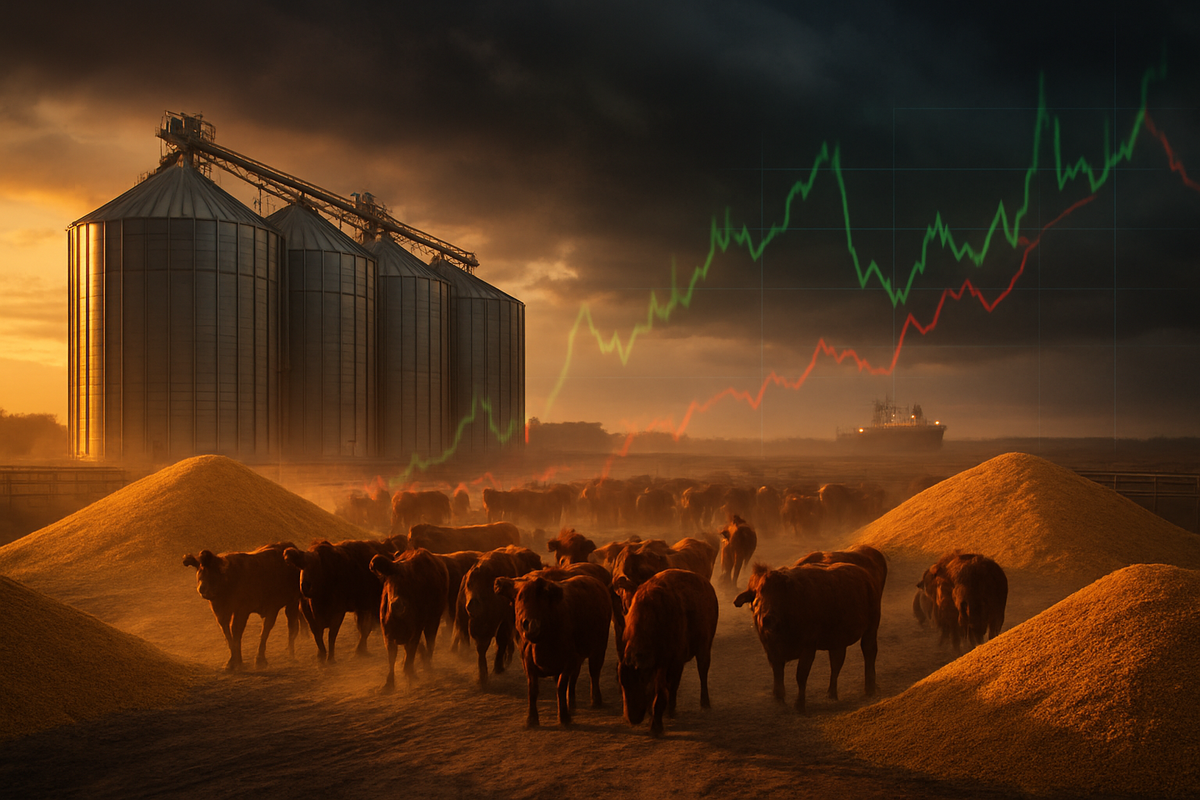
The global livestock market is currently grappling with a "perfect storm" of geopolitical instability and soaring input costs, as the escalating conflict in the Middle East sends energy and grain prices to levels not seen in years. As of late March 2026, the convergence of high energy costs—driven by the closure of the Strait of Hormuz—and a sharp spike in fertilizer prices has pushed feed grain costs to a breaking point, placing immense pressure on the margins of cattle and hog producers worldwide.
While consumer demand for protein remains resilient, the volatility in the futures pits is palpable. Feeder cattle and lean hog contracts are swinging wildly as traders attempt to price in a "war premium" alongside the fundamental reality of tightening domestic supplies. With feed grains like corn and barley tracking energy markets higher, the industry is witnessing a significant shift in production dynamics that threatens to push retail meat prices even higher for the average consumer.
The current period of volatility traces back to late February 2026, when escalating tensions between Iran, Israel, and the United States transitioned into open conflict. The immediate consequence was the disruption of the Strait of Hormuz, a critical maritime chokepoint through which approximately 20% of the world's oil and natural gas flows. This sent Brent Crude prices skyrocketing past $120 per barrel in early March, before stabilizing near the $100 mark. The energy surge triggered a secondary crisis in the agricultural sector: a massive spike in nitrogen-based fertilizer prices.
Middle Eastern exports of urea and ammonia were severely restricted, causing wholesale urea prices to jump from under $500 per ton to over $650 per ton in less than three weeks. This fertilizer crunch has directly impacted the outlook for spring planting. On the Chicago Board of Trade, May 2026 corn futures have surged to approximately $4.67 per bushel. Meanwhile, feed barley prices in key regions like Lethbridge, Canada, have climbed to nearly $295 per tonne, effectively pricing out some marginal feedlot operations and weighing heavily on the value of feeder cattle.
The market reaction has been swift and unforgiving. Feeder cattle futures, while trading at historically high levels near $355 per hundredweight (cwt), have seen daily price swings of $2.00 or more as the market weighs high input costs against the scarcity of available calves. A complicating factor emerged in late March 2026 with a significant labor strike at major processing facilities, notably affecting JBS USA. This disruption has widened the spread between the price packers pay for livestock and the price they charge for "boxed beef," further squeezing the profits of independent ranchers who are already paying record prices for fuel and feed.
The current environment of high volatility and rising costs creates a clear divide between large-scale, diversified agribusinesses and pure-play meat processors. Tyson Foods (NYSE: TSN) and the recently re-listed Smithfield Foods (NASDAQ: SFD) find themselves in a precarious position. As the largest U.S. protein producers, they are highly sensitive to the margins between livestock costs and retail prices. While high prices at the grocery store help offset costs, the inability to fully pass on a 30% spike in feed and energy expenses could lead to significant earnings misses in the coming quarters.
Conversely, global commodity giants like Archer-Daniels-Midland (NYSE: ADM) are positioned to potentially benefit from the increased volatility and higher grain prices. As a key player in grain processing and global trading, ADM often thrives in environments where supply chain disruptions create arbitrage opportunities and higher handling margins. Similarly, Corteva (NYSE: CTVA) is a critical stakeholder to watch. As a major provider of seeds and crop protection, the company may see shifts in demand as farmers contemplate moving acreage from nitrogen-heavy corn to soybeans in response to the fertilizer crisis.
Hormel Foods (NYSE: HRL) may offer a more defensive play for investors. Known for its strong portfolio of value-added and branded products, Hormel historically possesses greater "pricing power" than commodity meat packers. By focusing on processed goods rather than raw protein, they are somewhat more insulated from the immediate swings in the "live" and "feeder" futures markets, though they remain vulnerable to the broader energy-driven inflationary environment that affects logistics and packaging.
The current livestock crisis fits into a broader historical trend of "energy-linked agriculture." Since the expansion of the ethanol mandate decades ago, the correlation between oil prices and corn prices has remained high. However, the 2026 conflict has introduced a fertilizer component that mimics the supply shocks seen in 2022, but with much tighter global livestock inventories. Unlike previous cycles where producers could "expand out" of high prices, the current U.S. cattle herd is at its smallest level in decades, meaning there is no "cushion" of supply to absorb these shocks.
This event is also highlighting a critical shift in productivity. According to the USDA Quarterly Hogs and Pigs Report released on March 26, 2026, hog producers have achieved record-breaking litter rates of 11.90 pigs per litter. This technological and genetic advancement has allowed pork production to remain steady despite a contraction in the breeding herd. However, even record productivity may not be enough to offset the double-digit percentage increases in feed barley and corn costs, which typically account for 60-70% of the cost of raising an animal to market weight.
From a regulatory standpoint, the ongoing volatility is likely to reignite debates in Washington and Brussels regarding food security and the dependence on foreign energy and fertilizer. There is increasing pressure on policymakers to provide emergency subsidies for fertilizer or to relax conservation land requirements to allow for more domestic grain production. Historical precedents, such as the grain price spikes of 2008 and 2012, suggest that without government intervention or a swift resolution to the Iran conflict, the "inflationary floor" for meat products will remain elevated for the foreseeable future.
Looking ahead, the short-term trajectory of the livestock market depends almost entirely on the de-escalation of tensions in the Persian Gulf. If the Strait of Hormuz remains contested, the "war premium" on corn and energy will likely persist through the 2026 planting season, potentially leading to a massive shift in crop rotations that will impact feed availability well into 2027. Producers will need to make strategic pivots, perhaps leaning more heavily on alternative feed ingredients or reducing herd sizes further to manage risk.
In the long term, we may see an accelerated move toward "vertical integration 2.0," where meat processors take even more direct control over their grain supply chains to hedge against such volatility. For investors, the next several months will be a period of high alert. The "Cattle on Feed" reports and grain acreage intentions will be scrutinized more than ever. There is a potential scenario where a resolution to the conflict leads to a "relief rally" in livestock as input costs crash, but until that happens, the market is effectively "trading the headlines."
The events of March 2026 serve as a stark reminder of the interconnectedness of modern global markets. A conflict thousands of miles away can directly influence the price of a steak in a Midwest grocery store through the complex transmission of energy prices, fertilizer availability, and grain futures. The key takeaway for the market is that while demand for protein is high, the "cost to produce" is undergoing a structural shift that may permanently raise the price ceiling for cattle and hogs.
Moving forward, investors should keep a close eye on the shipping lanes of the Middle East and the domestic labor situation at JBS and other major packers. The livestock market remains fundamentally strong due to low supply, but the operational stress of $100+ oil and $6.00+ fertilizer is a significant headwind. As we move into the second quarter of 2026, the industry’s ability to pass on these costs to a consumer already weary of inflation will be the ultimate test of its resilience.
This content is intended for informational purposes only and is not financial advice.