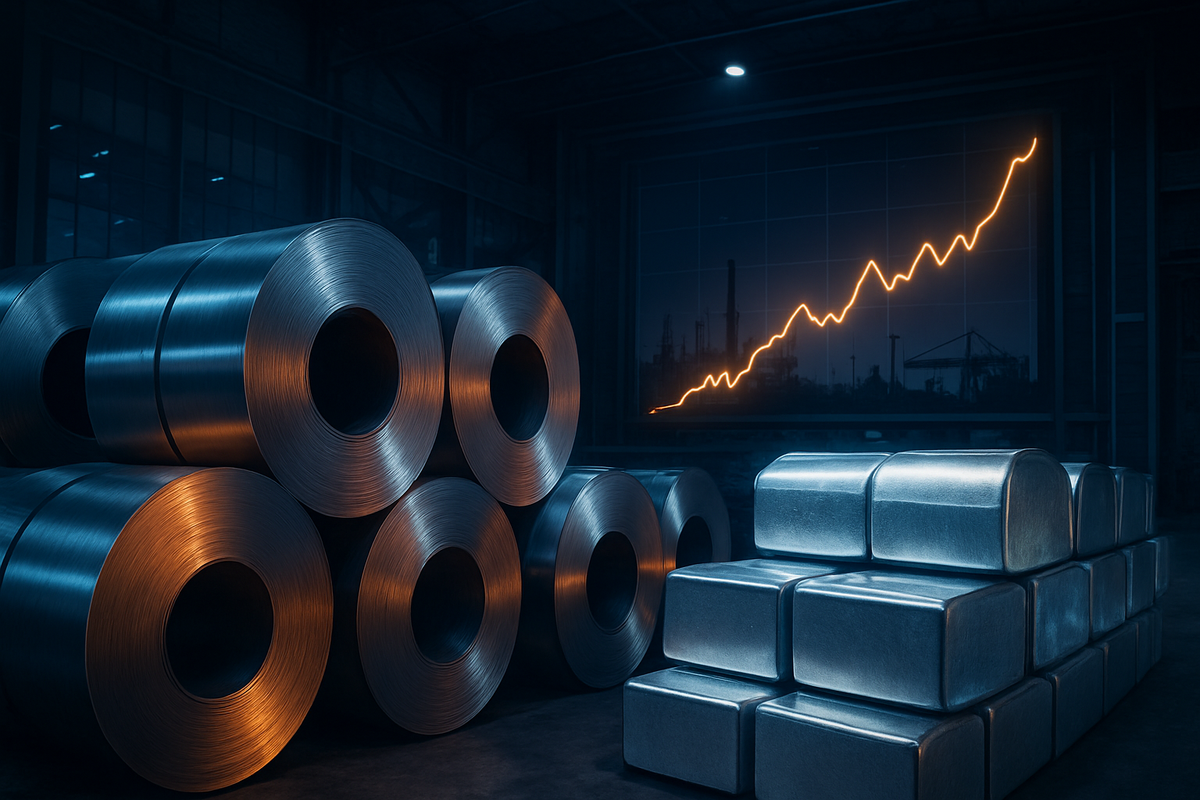
The global manufacturing sector is facing a severe supply-side shock as industrial metal prices have soared to their highest levels in years. As of late March 2026, aluminum is trading near a four-year high on the London Metal Exchange (LME), while hot-rolled coil (HRC) steel has decisively breached the $1,000 per ton threshold for the first time since 2024. This rally is driven by a "perfect storm" of structural supply deficits, surging demand from AI-related infrastructure, and a critical spike in energy costs sparked by escalating geopolitical tensions in the Middle East.
The immediate implications are stark: manufacturing costs are ballooning for everything from electric vehicles to power grids, threatening to reignite inflationary pressures that central banks had only recently brought under control. With key transit routes like the Strait of Hormuz facing disruption, the cost of smelting and transporting these energy-intensive materials has reached a breaking point, forcing producers to pass record-high premiums onto a market already struggling with low inventory levels.
Structural Scarcity: The Timeline of a Metal Supercycle
The current spike in metal prices is not a sudden anomaly but the culmination of structural shifts that began in 2025. In early March 2026, benchmark aluminum prices on the LME surged to between $3,300 and $3,450 per metric ton, the highest level recorded since the post-pandemic supply crunch of 2022. In the United States, domestic manufacturers are seeing "all-in" prices approach $5,000 per metric ton when factoring in record-high physical premiums and 50% import tariffs. This price action is largely attributed to China reaching its rigid 45-million-ton annual production ceiling, which has effectively removed the world’s largest producer as a "swing supplier" for international markets.
Simultaneously, the steel market has entered a new era of pricing discipline. For the first time since the 2024 correction, domestic hot-rolled coil (HRC) steel crossed the $1,000 per short ton mark. Leading the charge, Nucor Corporation (NYSE: NUE) raised its Consumer Spot Price to $1,025 per ton in the third week of March, while West Coast prices via California Steel Industries hit $1,075 per ton. This price strength persists despite soft demand in the housing and heavy truck sectors, as domestic mills leverage trade barriers and reduced import flows to maintain immense pricing power.
The catalyst for the most recent leg of this rally is the geopolitical instability in the Middle East. With crude oil prices (Brent) spiking to $120 per barrel following regional strikes, energy-intensive smelting has become prohibitively expensive. Energy typically accounts for 20% to 25% of the cash costs for aluminum production. The virtual closure of the Strait of Hormuz has forced Aluminium Bahrain (Alba), one of the world’s largest smelters, to declare force majeure on several production lines, removing nearly 20% of its capacity from the global market.
Winners and Losers in a High-Cost Environment
Primary producers with localized energy security and domestic market dominance are the clear winners of this price surge. Alcoa Corporation (NYSE: AA) has seen its margins expand significantly as it benefits from higher LME prices and its relatively insulated North American and Australian production base. Similarly, Rio Tinto (NYSE: RIO) remains a key beneficiary, as its massive aluminum smelting operations in Canada rely on hydroelectric power, shielding it from the natural gas and oil spikes currently crippling European and Middle Eastern competitors.
On the steel side, vertically integrated players like Cleveland-Cliffs Inc. (NYSE: CLF) and United States Steel Corporation (NYSE: X) are positioned to capitalize on the $1,000+ HRC environment. By controlling their own iron ore supply and focusing on the high-margin automotive and infrastructure segments, these firms are capturing the "green steel" premium as demand for low-carbon materials increases. Service centers and distributors like Reliance Steel & Aluminum Co. (NYSE: RS) are also seeing windfall profits as the value of their existing inventory appreciates rapidly.
Conversely, the losers are concentrated in the downstream manufacturing and consumer discretionary sectors. Automotive giants like General Motors (NYSE: GM) and Ford Motor Company (NYSE: F) are facing a double-edged sword: rising raw material costs for traditional steel frames and even higher costs for the aluminum intensive bodies of electric vehicles. Construction firms and heavy equipment manufacturers like Caterpillar Inc. (NYSE: CAT) are also seeing their project margins compressed, as long-term contracts signed in 2025 did not account for a 30% jump in steel and aluminum costs over a single quarter.
AI Demand and the New "Green Metal" Paradigm
The wider significance of this rally lies in a fundamental shift in demand drivers. While industrial metals have historically been cyclical, the 2026 market is being driven by the non-cyclical buildout of AI data centers. A single hyperscale facility can require up to 50,000 tons of copper and massive quantities of aluminum for power distribution and cooling systems. This "AI-infrastructure demand" has created a floor for prices that did not exist in previous decades, making the market less sensitive to traditional economic slowdowns.
Furthermore, the "remilitarization" of global economies has placed a premium on aerospace-grade aluminum and high-strength steel. This mirrors historical precedents from the mid-20th century, where geopolitical tension led to a sustained period of high commodity prices. The current situation also highlights the vulnerability of the "Green Transition." As countries rush to build out power grids and EV charging networks, the scarcity of aluminum—often called the "metal of energy"—is becoming a bottleneck for climate goals, potentially leading to government intervention or strategic stockpiling.
The Path Ahead: Supply Shocks and Strategic Pivots
In the short term, the market will remain hostage to the geopolitical situation in the Middle East. If the Strait of Hormuz remains a high-risk zone, the "logistics surcharge" of $45 to $60 per ton for land-bridge transport will become a permanent fixture of metal pricing. We may see a strategic pivot among manufacturers toward "material substitution" or increased use of recycled (secondary) aluminum, which requires 95% less energy to produce than primary metal. Companies like Commercial Metals Company (NYSE: CMC), which specializes in recycled steel and rebar, are likely to see increased demand as primary production costs remain elevated.
In the long term, the market faces a period of "structural scarcity." With China's production capped and Western smelters in Europe struggling with high energy costs, the world is looking toward South America and Africa for new capacity. However, these regions face their own challenges with labor disputes and power stability. Investors should expect a volatile "higher-for-longer" price environment for the remainder of 2026, with any dip in prices likely being met by aggressive buying from industrial consumers looking to de-risk their supply chains.
Wrap-Up: What Investors Should Watch
The surge of aluminum to 4-year highs and HRC steel beyond $1,000 per ton marks a turning point for the global economy in March 2026. The convergence of energy instability, trade protectionism, and new demand from the AI sector has ended the era of cheap industrial commodities. For investors, the focus must shift from pure volume growth to margin protection and energy efficiency.
Moving forward, the key indicators to watch are the regional natural gas prices in Europe (TTF) and the operational status of Middle Eastern smelters like Alba and Qatalum. Any resolution to the Middle East conflict could see a quick "relief sell-off" in prices, but the underlying supply deficits in aluminum and the pricing power of U.S. steel mills suggest that the floor for these commodities has permanently shifted higher. Watch for Q2 earnings reports from the major miners and steelmakers to see how effectively they are navigating the increased freight and energy costs, as these will be the ultimate bellwethers for the sector’s health.
This content is intended for informational purposes only and is not financial advice.