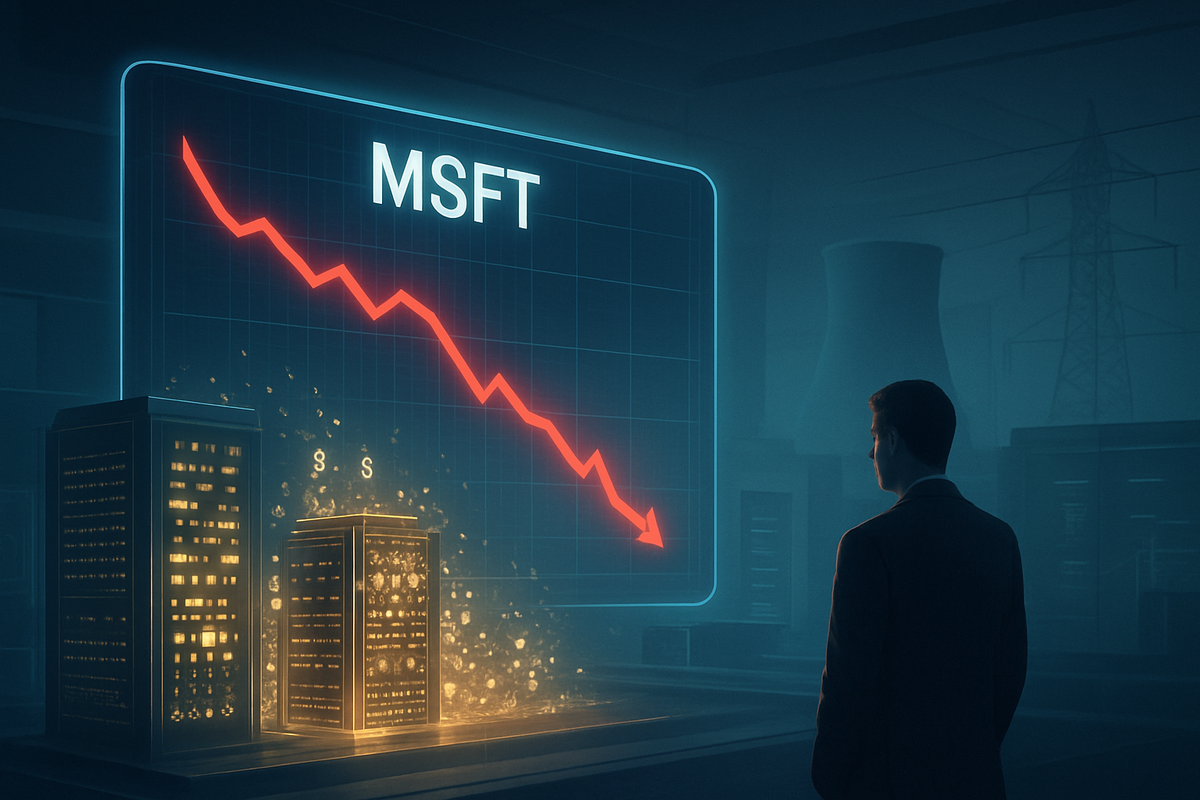
On March 27, 2026, shares of Microsoft Corp. (NASDAQ: MSFT) fell 3.4%, extending a challenging year for the tech giant as investor patience for its massive artificial intelligence (AI) investments begins to wear thin. The slide comes as fresh analyst reports project the company’s capital expenditure (CapEx) for fiscal year 2026 could reach a staggering $146 billion—a more than 230% increase from just two years ago. While Microsoft continues to report double-digit growth in its cloud division, the sheer scale of the "AI tax" is starting to weigh on its valuation, leaving Wall Street questioning when these enormous outlays will translate into sustainable, high-margin profits.
The immediate market reaction reflects a broader "valuation digestion" period that has seen Microsoft’s stock retreat roughly 24% year-to-date. Investors are no longer content with the promise of AI potential; they are now demanding a clear path to recouping the billions spent on data centers, custom silicon, and power infrastructure. Today’s sell-off was triggered by a leaked internal memo suggesting that the depreciation of expensive Blackwell and Rubin GPUs from Nvidia Corp. (NASDAQ: NVDA) has begun to compress Azure’s gross margins more rapidly than previously forecasted.
The $146 Billion Gamble and the 'SaaSpocalypse' Narrative
The timeline leading to today’s volatility is rooted in a massive acceleration of infrastructure spending that began in late 2023. By early 2026, Microsoft’s quarterly CapEx run-rate hit $37.5 billion, a 66% year-over-year increase that has shocked even seasoned tech analysts. This spending is split between "short-lived assets"—the high-performance chips required to train and run large language models—and the long-term construction of "AI Factories." While Microsoft CEO Satya Nadella has consistently defended this "once-in-a-generation" build-out, the sheer magnitude of the spending has created a disconnect between infrastructure costs and current software revenue.
A central concern for the market is what some analysts are calling the "SaaSpocalypse." For decades, Microsoft’s business model has relied on a "per-seat" licensing structure. However, the rise of "agentic AI"—autonomous software capable of performing tasks once handled by humans—threatens this model. If a single AI agent can do the work of ten employees, the total number of "seats" sold by Microsoft could theoretically decline, even as the value provided by the software increases. This structural shift has left investors nervous about whether the planned launch of the high-priced "Microsoft 365 E7" tier, expected to cost $99 per user monthly, can offset the potential loss of volume.
Initial industry reactions have been polarized. Bulls, including prominent tech analysts, point to Microsoft’s $625 billion in Remaining Performance Obligation (RPO) as evidence of massive, locked-in future demand. They argue that the current stock retreat is a "healthy reset" and a generational buying opportunity. Conversely, skeptics at major investment banks have warned that the "free pass" for AI spending expired at the end of 2025. They note that at current adoption rates, it may take the company six to eight years to break even on its 2026 infrastructure investments, a timeline many institutional investors find uncomfortably long.
Winners and Losers in the Great AI Build-Out
As Microsoft’s stock struggles, the ripple effects are being felt across the tech ecosystem. Nvidia Corp. (NASDAQ: NVDA) remains a primary winner in terms of pure sales, as it continues to supply the "picks and shovels" for the AI gold rush. However, Nvidia’s own stock has faced pressure as investors fear that Microsoft and other "hyperscalers" may eventually reach a saturation point or pivot more aggressively toward in-house silicon, such as Microsoft’s Maia chips, to reduce costs.
In the cloud space, Alphabet Inc. (NASDAQ: GOOGL) and Amazon.com Inc. (NASDAQ: AMZN) are also facing intense scrutiny. Amazon is currently leading the pack in raw spending, with its 2026 CapEx projected to hit $200 billion as it races to secure power for its Amazon Web Services (AWS) data centers. While these companies are technically competitors, they are all currently "losers" in the court of investor sentiment, as the market punishes any company where CapEx growth outpaces operating earnings growth.
The surprising winners in this environment are energy and utility companies. As the "Power Crisis" of 2026 intensifies, companies that can provide reliable, 24/7 electricity have become the new gatekeepers of AI growth. Vistra Corp. (NYSE: VST) and Oklo Inc. (NYSE: OKLO) have seen significant interest as tech giants sign massive, multi-billion dollar "behind-the-meter" nuclear and renewable energy deals to bypass the 7-year wait times for traditional grid connections. Microsoft’s own deal to restart the Three Mile Island nuclear plant is a prime example of the lengths to which tech companies must go to secure their AI future.
Beyond the Chips: Power, Regulation, and Historical Precedents
The current situation fits into a broader industry trend where the primary bottleneck for AI has shifted from silicon to electricity. The 2026 "Power Crisis" is not just a logistical hurdle but a financial one. A single AI-related task can consume up to 1,000 times more energy than a traditional web search, leading to skyrocketing capacity costs on major power grids. This has forced Microsoft and its peers to sign the "Ratepayer Protection Pledge," committing to fund their own power infrastructure to prevent residential electricity prices from surging—a regulatory burden that adds even more weight to their already bloated CapEx budgets.
Historically, this period draws comparisons to the fiber-optic build-out of the late 1990s and early 2000s. During that era, companies spent billions laying down infrastructure that would not be fully utilized for a decade. While the "dot-com bubble" eventually burst, that infrastructure laid the foundation for the modern internet. Today’s AI build-out may follow a similar path: a painful "hangover" period for investors followed by long-term societal transformation.
Furthermore, regulatory and policy implications are looming. Governments are increasingly looking at the environmental impact of these massive "AI Factories." Microsoft’s ability to navigate the transition to "carbon-free" power while maintaining growth will be a defining challenge for the rest of the decade. Any new carbon taxes or energy restrictions could further delay the ROI that investors are so desperately seeking on March 27, 2026.
The Road Ahead: Strategic Pivots and the 'Show Me' Era
Looking forward, Microsoft must navigate a delicate balancing act. In the short term, the market will be laser-focused on the adoption of "agentic AI" and the success of the upcoming M365 E7 tier. If Microsoft can prove that it can capture more value per user through AI agents than it loses in total seat counts, the narrative could shift back to optimism. A successful transition to agent-based pricing would represent a significant strategic pivot that could redefine the software-as-a-service (SaaS) industry.
In the long term, Microsoft may be forced to decelerate its CapEx growth. Analysts expect that the "runaway" acceleration of spending will peak in late 2026 as the initial global footprint of the AI infrastructure is established. If Microsoft can show that it is successfully moving from the "build" phase to the "optimization" phase, it could see a significant re-rating of its stock. However, a failure to demonstrate improving Azure AI margins by the end of 2026 could lead to a more prolonged period of underperformance.
Market opportunities may also emerge from the "shadow grids" Microsoft is building. By owning its own power generation and storage, Microsoft could eventually become a minor utility provider in its own right, selling excess power back to the grid during peak demand. This diversification could provide a new, albeit smaller, revenue stream to offset the costs of its primary business.
Wrap-Up: What Investors Should Watch
The events of March 27, 2026, serve as a stark reminder that even the most dominant companies are not immune to the laws of financial gravity. The key takeaway is that the "AI honeymoon" is over; we have entered the "show me the money" era of technology investing. Microsoft remains a fundamental powerhouse with massive recurring revenue and a commanding lead in enterprise AI, but its stock is currently being re-priced to reflect the reality of its enormous capital requirements.
Moving forward, the market will be characterized by extreme sensitivity to margin compression. Investors should watch for three critical indicators in the coming months:
- Azure AI Margin Trends: Any sign that the depreciation of Nvidia hardware is being offset by more efficient software operations will be viewed as a major positive.
- E7 Tier Adoption: The early take-rate for the $99/month AI tier will be a litmus test for Microsoft’s ability to monetize agentic AI.
- Power Connection Milestones: Successful progress on nuclear and renewable energy projects will signal that the company can overcome the physical bottlenecks limiting its growth.
Ultimately, Microsoft's current slide is less a reflection of a failing strategy and more a symptom of a market that has finally asked for the bill. Whether that bill is eventually paid by a new wave of AI-driven productivity remains the most important question for the financial world in 2026.
This content is intended for informational purposes only and is not financial advice.