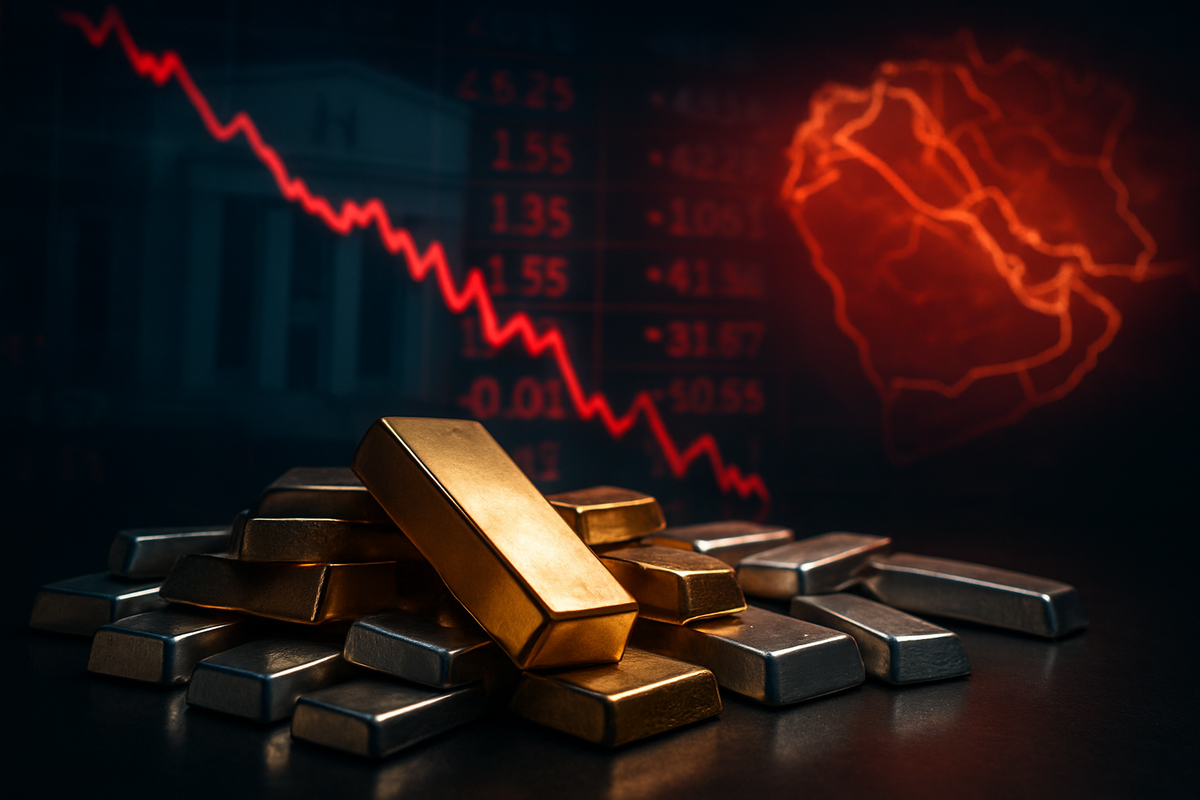
The global commodities market was rocked this week as a brutal selloff in precious metals intensified following the Federal Reserve's decision to maintain a surprisingly hawkish stance. On March 19, 2026, the Federal Open Market Committee (FOMC) opted to keep the federal funds rate at a restrictive 3.5% to 3.75%, defying widespread market expectations of a dovish pivot in the face of escalating Middle Eastern conflict. The announcement sent gold prices tumbling 6%, landing at approximately $4,607 per ounce, while silver suffered an even more catastrophic 8.8% decline, settling at $70.77 per ounce.
The immediate implications of this crash have sent shockwaves through the financial sector, as the traditional "safe-haven" status of gold and silver appears to be temporarily suspended by a desperate search for liquidity. Investors who had flocked to metals as a hedge against the ongoing war between the U.S.-Israel coalition and Iran are now finding themselves squeezed by "higher-for-longer" interest rates that increase the opportunity cost of holding non-yielding assets. This liquidity vortex has forced massive liquidations, as margin calls in other sectors compel traders to sell their most liquid winners, including gold and silver.
The Hawkish Hold: Powell vs. The War Premium
The volatility of the past week is the culmination of a high-stakes standoff between monetary policy and geopolitical instability. The FOMC meeting on March 19 arrived at a critical juncture; while the U.S. and Israel are currently engaged in "Operation Epic Fury"—a multi-front military campaign targeting Iranian infrastructure—energy prices have spiked, with Brent crude briefly touching triple digits. Despite the wartime footing, Fed Chair Jerome Powell signaled that the central bank remains laser-focused on its inflation mandate. In his post-meeting press conference, Powell stated that the disinflationary trend has "plateaued" and cited "stubbornly persistent" price pressures driven by the energy shock, effectively cooling any hopes for rate cuts before the second half of the year.
The timeline leading to this crash began in late February 2026, when the initial strikes in the Middle East caused gold to peak near $5,000 as investors fled to safety. However, the reality of 3.5% interest rates in a high-inflation environment has created a "war-flation" paradox. Unlike previous conflicts where the Fed might have eased to support the economy, the current administration’s fiscal spending on the war effort has left the Fed with little room to move without risking a hyper-inflationary spiral.
The market reaction was swift. The $4,607 support level for gold, which many analysts considered a "floor" based on historical 2025 trends, was breached within hours of the Fed’s statement. Silver's drop to $70.77 was even more violent, marking its worst single-day performance in over a decade. Major financial institutions like Goldman Sachs Group, Inc. (NYSE: GS) had initially characterized the market's war reaction as "benign," but that narrative crumbled as the liquidity crunch deepened across the board.
Mining Giants and ETFs Caught in the Crossfire
The carnage in the metals market has been particularly devastating for the world’s largest miners. Newmont Corporation (NYSE: NEM), the top gold producer, saw its shares plummet 8.4% as investors repriced the company’s future cash flows against a lower gold price and rising operational costs. Similarly, Barrick Gold Corporation (NYSE: GOLD) fell 6.4%, with analysts citing the "double whammy" of declining asset prices and high energy costs required for mining operations in an increasingly unstable global supply chain.
The selloff was not limited to individual stocks, as broad-based exchange-traded funds (ETFs) became the primary vehicles for institutional exits. The SPDR Gold Shares (NYSE Arca: GLD) and the VanEck Gold Miners ETF (NYSE Arca: GDX) saw some of their highest outflow volumes since the 2022 tightening cycle. For many institutional holders, these ETFs are the easiest assets to liquidate when facing redemptions or margin requirements in the private credit and equity markets. The iShares Silver Trust (NYSE Arca: SLV) also faced a massive drawdown, as the industrial component of silver’s demand is being questioned amidst fears of a wider global economic slowdown.
While miners are the primary losers, some financial giants are navigating the volatility by tightening credit. JPMorgan Chase & Co. (NYSE: JPM) reportedly restricted lending to certain private credit providers following the crash, signalizing a migration of risk from "shadow banking" into the broader financial system. Meanwhile, BlackRock, Inc. (NYSE: BLK) has faced significant redemption requests in its corporate lending funds as the liquidity squeeze persists, forcing the firm to manage capital outflows strictly.
The Geopolitical Shift and Policy Tension
The wider significance of this crash lies in its departure from historical precedents. Traditionally, gold is the ultimate hedge against war and inflation. However, the "Operation Epic Fury" scenario has created a unique environment where the Fed’s commitment to high rates is clashing with a massive sovereign fiscal override. This event fits into a broader trend of "geopolitical repricing," where the cost of capital is staying high even during military crises—a significant shift from the low-interest environments of the early 21st-century conflicts.
The ripple effects are felt most acutely in the "War-Flation" paradox: as energy prices rise due to the disruption of the Strait of Hormuz, the Fed is forced to keep rates high, which in turn strengthens the U.S. dollar and crushes the dollar-denominated price of gold. This creates a feedback loop where the more "successful" the military operations are in the short term, the more pressure is placed on the Fed to remain hawkish to combat the resulting energy inflation.
Furthermore, the policy implications are fraught with tension. Within Washington, there are reports of a "civil war" between the Federal Reserve and the Treasury. With Jerome Powell’s term ending in May 2026, the current administration is reportedly eyeing more dovish successors who might prioritize war funding over inflation targets. The current crash in metals is, in many ways, a market bet on the Fed's current independence—a bet that may be tested if the conflict in the Middle East continues to escalate.
Looking Forward: The May Pivot and Market Scenarios
Looking ahead, the short-term outlook for gold and silver remains precarious as long as the 3.5%–3.75% rate floor holds. Strategic pivots may be required for major mining firms, who will likely need to focus on extreme cost-cutting and high-grade production to remain profitable if gold settles into a new, lower range below $4,500. Investors are closely watching for any signs of a "sovereign fiscal override," where government deficit spending for the war effort becomes so massive that the Fed’s interest rate hikes lose their ability to cool the economy.
Two primary scenarios emerge for the coming months. In the first, the Fed holds its ground, gold stabilizes around $4,000, and a "bunker mentality" takes over the market, favoring cash and defense contractors. In the second, the energy shock becomes so severe that the Fed is forced to pivot despite inflation, which could trigger a massive, vertical "snap-back" rally in precious metals as the dollar devalues. Market participants should prepare for extreme volatility as the May succession of the Fed Chair approaches, which will likely be the next major catalyst for the metals market.
Summary of a Historic Correction
The March 19th Federal Reserve meeting has fundamentally altered the trajectory of the 2026 bull market. By choosing a hawkish hold at 3.5%–3.75% in the midst of a regional war, the Fed has sent a clear message: inflation is still the primary enemy, even if it comes at the expense of the safe-haven trade. The 6% drop in gold to $4,607 and the 8.8% dive in silver to $70.77 represent a painful reset for an overextended market that had priced in a much more accommodative central bank.
For investors, the coming months will be a test of resilience. Key indicators to watch include the monthly CPI data, which will reveal if the energy spike is truly "plateauing" as Powell suggested, and the progression of "Operation Epic Fury," which continues to dictate the global risk premium. While the miners like Newmont and Barrick struggle with the immediate price shock, the long-term significance of this event may be the official end of the era of "easy money" during wartime.
This content is intended for informational purposes only and is not financial advice