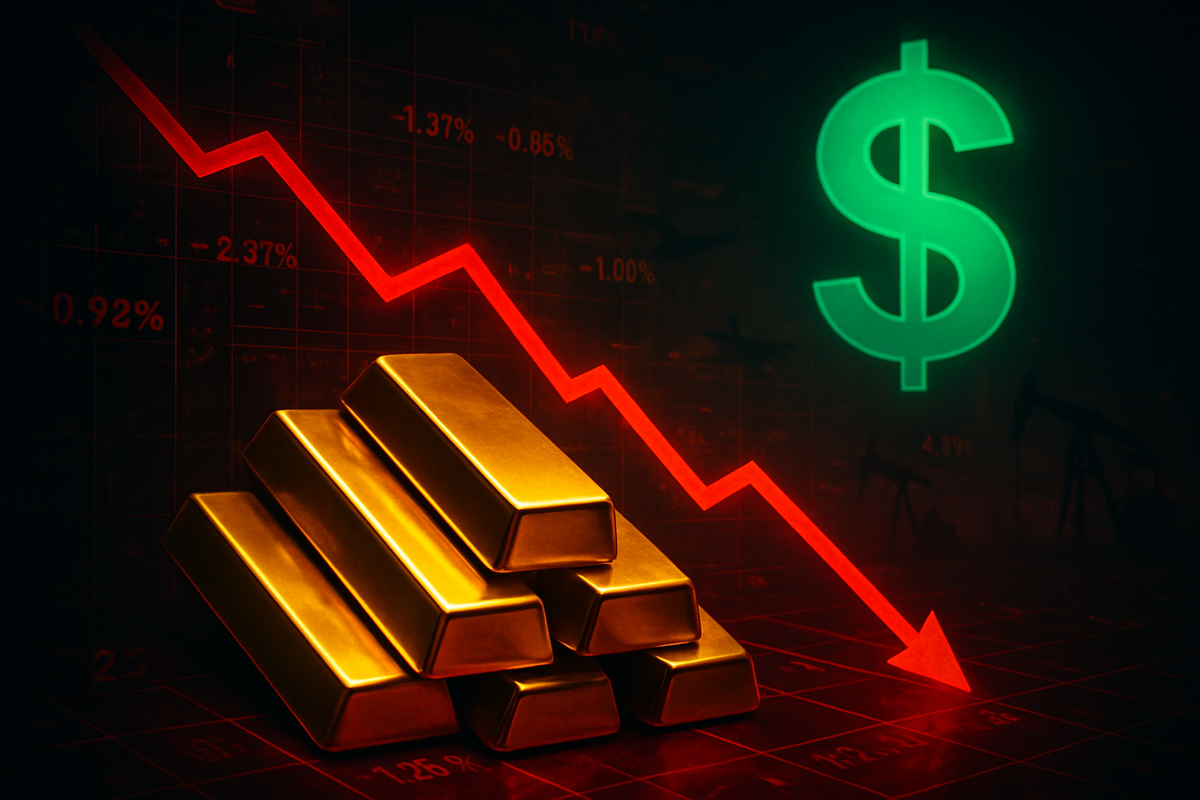
Gold markets are currently grappling with a historic "counter-intuitive" sell-off that has defied traditional economic wisdom. As of March 27, 2026, spot gold has stabilized in the $4,370 to $4,400 per ounce range, marking a staggering correction of more than 20% from its late January peak of approximately $5,589. This rapid descent into bear market territory comes at a time when geopolitical tensions are at a fever pitch, a scenario that would typically send the yellow metal to record-breaking heights.
The immediate implications of this price collapse are felt across the global financial landscape. While institutional investors have historically viewed gold as the ultimate "safe haven," the current "dash for cash" and a surging U.S. Dollar have stripped bullion of its protective status. For the first time in decades, the market is prioritizing liquidity and interest rate differentials over geopolitical risk premiums, creating a volatile environment for commodities and mining stocks alike.
A Perfect Storm: The Path to $4,400
The narrative of gold’s decline began in late February 2026, shortly after the metal hit its all-time high. The catalyst for the initial shift was the launch of "Operation Epic Fury" on February 28—a significant military campaign in the Middle East that initially caused a brief, frantic spike in gold prices. However, the secondary effects of this conflict quickly overshadowed the initial fear. The war triggered a massive oil shock, with Brent Crude prices skyrocketing above $115 per barrel, reigniting fears of a 1970s-style inflationary spiral driven by energy costs.
This energy-driven inflation forced the Federal Reserve’s hand. During the FOMC meeting held on March 18–19, 2026, Fed Chair Jerome Powell adopted a resolutely hawkish stance, maintaining interest rates at a restrictive 3.5%–3.75%. Powell explicitly noted that rate cuts are "off the table" for the remainder of the year and hinted at further hikes to combat the "stubbornly persistent" cost of energy. This policy pivot effectively neutralized gold’s appeal; as real Treasury yields climbed to multi-year highs, the opportunity cost of holding the non-yielding asset became too great for many institutional desks to bear.
The final blow came from the "Bloomberg Dollar Spot Index," which saw the U.S. Dollar emerge as the preferred safe haven of 2026. The combination of a "war premium" on the greenback and American "rate exceptionalism" has made gold prohibitively expensive for international buyers. Throughout March, the market witnessed a series of forced liquidations as hedge funds faced margin calls in a declining equity market, using their gold gains from earlier in the year to cover losses elsewhere, further accelerating the downward slide.
Mining Giants and ETFs Caught in the Crossfire
The volatility in the underlying commodity has sent shockwaves through the equities market, particularly affecting major mining corporations. Newmont Corporation (NYSE: NEM), the world’s largest gold miner, has seen its stock price tumble from January highs near $132 down to approximately $99.00. The company faces a dual-threat: a lower realized price for its primary product and significantly higher operational costs due to the spike in diesel and energy prices required for large-scale mining operations.
Similarly, Barrick Gold Corporation (NYSE: GOLD) has experienced a sharp correction, with shares trading in the $37.50–$43.00 range as of late March. While Barrick’s robust balance sheet provides some cushion, the evaporation of the $5,000/oz gold price floor has forced the company to re-evaluate its capital expenditure plans for 2027. Agnico Eagle Mines Limited (NYSE: AEM) has also felt the pressure, retreating from record highs of $255 to approximately $188.00, as investors rotate out of the sector in favor of high-yielding short-term debt.
On the investment side, the SPDR Gold Shares (NYSE Arca: GLD), the world’s largest gold-backed ETF, has seen its largest monthly outflow in years. Trading near $400–$404, the ETF's decline reflects a broader institutional exodus. More speculative vehicles, such as the VanEck Gold Miners ETF (NYSE Arca: GDX) and the VanEck Junior Gold Miners ETF (NYSE Arca: GDXJ), have suffered even more acute losses, with GDX dropping nearly 28% in March alone. For these funds, the "higher-for-longer" interest rate environment is a direct headwind that negates the geopolitical tailwinds traditionally associated with war.
Decoupling from Geopolitics: A Shift in Market Logic
The current market behavior marks a significant departure from historical precedents. Historically, major conflicts—such as the 1979 Soviet invasion of Afghanistan or the 2022 invasion of Ukraine—provided a sustained floor for gold prices. However, the 2026 "decoupling" suggests that the global financial system is currently more sensitive to central bank policy and liquidity than to regional instability. This event mirrors the early 1980s, when Fed Chair Paul Volcker’s aggressive rate hikes crushed gold’s bull market despite a backdrop of global cold-war tensions.
The ripple effects of this sell-off are extending beyond just gold. Silver and platinum have followed bullion lower, while the strengthening dollar is putting immense pressure on emerging market economies that carry dollar-denominated debt. Regulators and policy analysts are closely watching the "real rate" movement; if inflation remains high while gold falls, it suggests a market that has total confidence in the Federal Reserve's ability to eventually break the back of inflation, even at the cost of a recession.
Furthermore, this event highlights a shift in the "safe-haven" hierarchy. In 2026, the U.S. Treasury bill and the U.S. Dollar have reclaimed the top spots, leaving gold to behave more like a high-duration commodity than a monetary substitute. The policy implication is clear: the Federal Reserve is currently the most powerful force in the market, capable of overriding even the most severe geopolitical disruptions through the sheer weight of monetary tightening.
Looking Ahead: Support Levels and Strategic Pivots
In the short term, the $4,300 to $4,350 range is viewed as a critical technical support level for gold. Should prices break below $4,300, technical analysts warn of a potential slide toward the $4,000 mark, a level not seen since the "Green Recovery" of 2024. For mining companies, a "strategic pivot" toward cost-reduction and automation is likely to be the theme of the upcoming Q2 earnings calls, as they adjust to a world where $5,000 gold is no longer a certainty.
Long-term possibilities, however, remain cautiously optimistic for gold bugs. Analysts at major firms like JPMorgan suggest that the current sell-off is a "liquidity event" rather than a fundamental rejection of gold's value. They argue that once the initial shock of the Middle East conflict is absorbed and the Federal Reserve eventually reaches its terminal rate, the structural demand for gold from central banks—particularly in the "Global South"—will likely re-establish a floor. Some scenarios even project a return to $6,000 by late 2027 if the U.S. economy enters a stagflationary period.
Market Outlook and Final Thoughts
The gold market's 20% plunge in early 2026 serves as a stark reminder that no asset class is immune to the gravity of a hawkish Federal Reserve and a dominant U.S. Dollar. The "Golden Paradox" of falling prices during a major conflict highlights a new era of market dynamics where liquidity and interest rate expectations take precedence over traditional risk hedges. Investors have learned a hard lesson: geopolitics may drive the headlines, but the Fed drives the price.
Moving forward, the market will be hyper-focused on upcoming inflation prints and the Fed’s dot plot. If energy costs begin to cool, the Fed may find room to soften its stance, which would be the primary catalyst for a gold recovery. Conversely, a continued march upward in the U.S. Dollar Index will keep the pressure on bullion. For now, the "dash for cash" remains the dominant trade, and gold investors should watch the $4,370 level closely as a harbinger of the market’s next major move.
This content is intended for informational purposes only and is not financial advice.