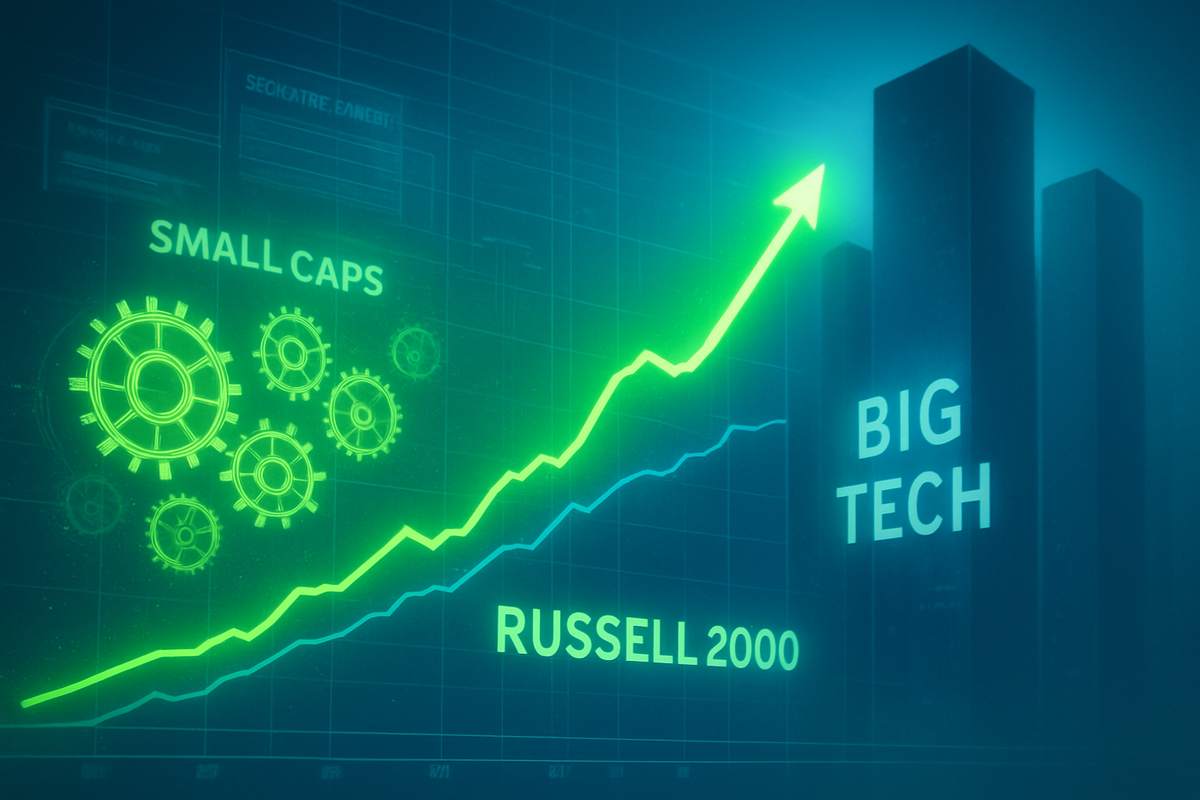
The financial landscape of 2026 has been defined by a seismic shift in capital allocation that few analysts predicted with such intensity. For the first time in over a decade, the long-dormant Russell 2000 index (NYSE Arca: IWM) is not just participating in a market rally—it is leading it. As of late March 2026, the small-cap index has surged a staggering 12% year-to-date, dwarfing the meager 1.5% gain of the S&P 500 (NYSE Arca: SPY). This "Great Rotation" marks a historic pivot away from the mega-cap technology "safe havens" that dominated the early 2020s and toward the "real economy" companies that form the backbone of American industry.
The immediate implications are profound for both institutional and retail portfolios. We are witnessing a massive "de-grossing" event where hedge funds are harvesting gains from overextended AI leaders to fund positions in undervalued, domestic-focused firms. This transition is not merely a seasonal fluke but the result of a "perfect storm" of macroeconomic policy, stabilizing monetary conditions, and a fundamental rethink of equity valuations that had reached 30-year extremes.
The January Breakout and the Path to Parity
The seeds of this rotation were sown in the final quarter of 2025, but the explosive breakout occurred in the opening weeks of 2026. Between January 2 and January 22, the Russell 2000 outperformed the S&P 500 for 14 consecutive trading sessions—the longest such winning streak since 1996. This rally pushed the small-cap index to an all-time high of 2,718.77, breaking a years-long period of stagnation. The catalyst for this sudden burst of energy was the Federal Reserve’s successful orchestration of a "soft landing." Following three strategic 25-basis-point interest rate cuts in late 2025, the Federal Funds Rate stabilized at a range of 3.50% to 3.75%, providing much-needed clarity for capital-intensive businesses.
Key players in this narrative include the institutional heavyweights who moved early. Firms like BlackRock and Vanguard reported record inflows into small-cap value funds in early February, as the valuation gap became impossible to ignore. Entering 2026, the S&P 500 was trading at a rich forward P/E ratio of roughly 25x, while the Russell 2000 sat at a modest 17x. This 30% discount, combined with the removal of the "higher-for-longer" interest rate threat, triggered a massive short-covering rally in regional banks and industrial suppliers. The market reaction was swift, with small-cap volatility (RVX) dropping to three-year lows as investors grew confident in the sustainability of the domestic recovery.
Winners and Losers in the Reshuffled Market
The primary beneficiaries of this rotation have been firms that were previously punished by high borrowing costs. Regional banks, such as KeyCorp (NYSE: KEY), UMB Financial (NASDAQ: UMBF), and Axos Financial (NYSE: AX), have seen their margins expand as the yield curve steepened and middle-market M&A activity returned to pre-pandemic levels. Similarly, industrial and "picks and shovels" companies like Gorman-Rupp (NYSE: GRC) and Strattec Security (NASDAQ: STRT) are thriving under a new era of domestic infrastructure spending. In the healthcare space, biotech innovators like Cogent Biosciences (NASDAQ: COGT) and ADMA Biologics (NASDAQ: ADMA) have secured fresh capital as investors move back into high-growth, small-cap risk assets.
Conversely, the "Magnificent Seven" have faced a rare period of underperformance. Companies like Nvidia (NASDAQ: NVDA), Microsoft (NASDAQ: MSFT), and Alphabet (NASDAQ: GOOGL) have struggled with "AI capex fatigue," as investors demand more immediate, tangible returns from the trillions spent on data centers. While Apple (NASDAQ: AAPL) and Meta (NASDAQ: META) remain profitable behemoths, their stock prices have been used as "ATMs" by fund managers seeking to rebalance into the surging small-cap sector. Tesla (NASDAQ: TSLA) and Amazon (NASDAQ: AMZN) have also felt the pinch, as the premium once assigned to "limitless growth" has been reassigned to "reliable domestic value."
Policy Fuel: The One Big Beautiful Bill Act
The "Great Rotation" is being powered by more than just interest rate optimism; it is fueled by a massive fiscal tailwind. In July 2025, the passage of the "One Big Beautiful Bill Act" (OBBBA) fundamentally altered the tax landscape for small and mid-sized businesses. The act restored 100% bonus depreciation and immediate R&D expensing, allowing companies to fully deduct capital investments in the first year. Perhaps most crucially for the Russell 2000, the OBBBA shifted the interest deduction limit back to 30% of EBITDA, reversing a more restrictive EBIT-based calculation that had disproportionately burdened smaller, high-debt companies.
This policy shift fits into a broader industry trend of "reshoring"—the movement of manufacturing and supply chains back to U.S. soil. By lowering the corporate tax rate from 21% to 15% specifically for domestic manufacturers, the OBBBA has made small-cap industrials the most attractive play on the board. This mirrors the historic tax reforms of the mid-1980s, which similarly sparked a multi-year period of small-cap dominance. Furthermore, the introduction of new tax-advantaged "Trump Accounts" for long-term domestic investment has created a permanent liquidity floor for these stocks, insulating them from the global volatility that often plagues multi-national large-caps.
Short-Term Volatility and the Long-Term Outlook
Looking ahead, the market faces a transition period. In the short term, we may see tactical pullbacks as the Russell 2000 enters "overbought" territory following its 12% Q1 run. Strategic pivots will be required for traditional "60/40" portfolios, which have been historically underweight in small-cap domestic equities. Asset managers are already scrambling to launch new small-cap focused ETFs and private equity vehicles to capture the "alpha" that the mega-cap tech names are no longer providing.
In the long term, the scenario could evolve into a multi-year secular bull market for the "Real Economy." If the Federal Reserve maintains its stable rate environment and the OBBBA incentives remain in place through 2028, the Russell 2000 could realistically double from its current levels. However, challenges remain; any resurgence in inflation or a sudden geopolitical shock to domestic energy prices could stall this momentum. Investors should watch the upcoming Q2 earnings calls for small-cap banks and industrials to see if the forecasted margin expansions are translating into actual bottom-line growth.
Final Assessment: A Structural Change in Market Leadership
The 2026 Great Rotation is more than just a temporary trade; it is a fundamental re-rating of the American economy. The era of "growth at any cost" driven by a handful of tech giants is giving way to a more diversified and resilient market structure. The key takeaway for investors is that the "quality" trade has moved down the market-cap ladder. As small companies capitalize on tax incentives and stabilized rates, they are becoming the primary engines of market returns.
Moving forward, the market will likely remain bifurcated. While the S&P 500 may see lackluster performance due to its heavy weighting in stagnant tech giants, the broader market participation is a healthy sign for the economy's long-term prospects. Investors should keep a close eye on regional bank credit quality and domestic manufacturing data in the coming months. The message of 2026 is clear: the giants are resting, and the small-caps are finally running.
This content is intended for informational purposes only and is not financial advice