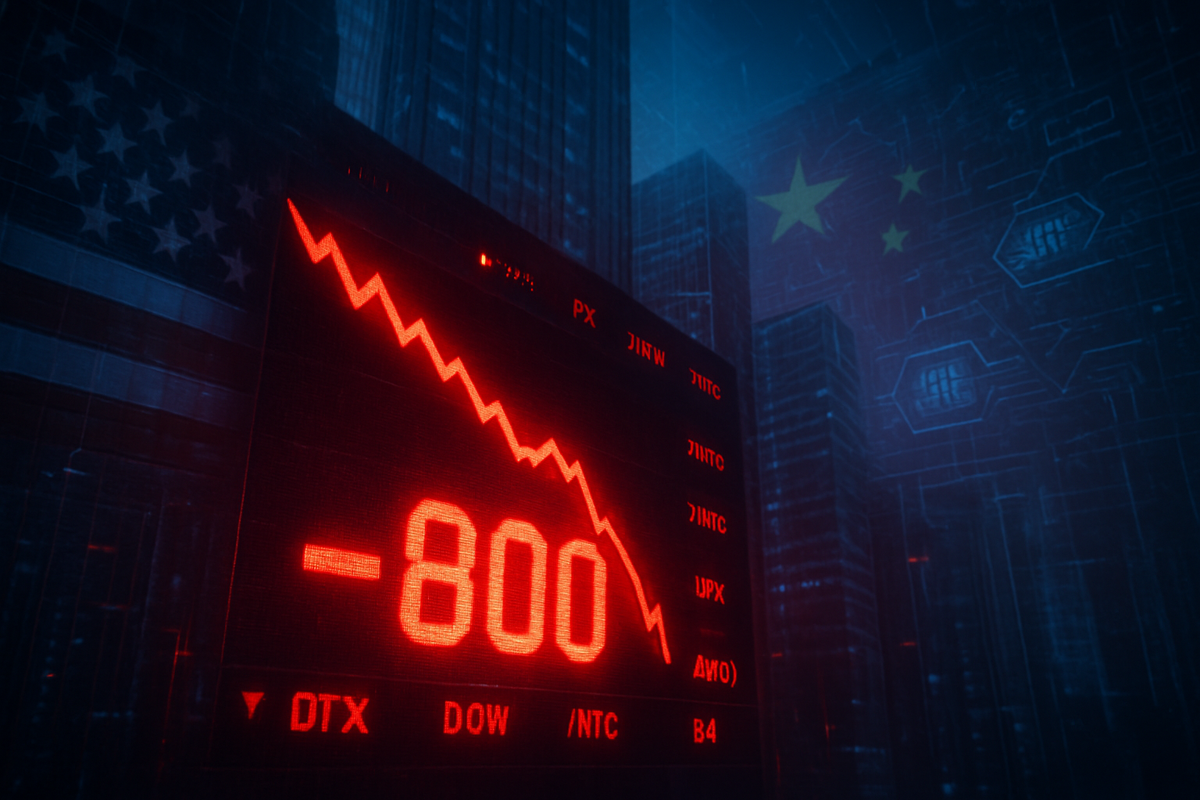
The delicate balance of global trade was upended today as the Dow Jones Industrial Average plummeted nearly 800 points following a provocative announcement from Beijing. On March 27, 2026, China’s Ministry of Commerce (MOFCOM) unveiled two sweeping trade investigations targeting the United States, a move that analysts characterize as a direct retaliatory strike against recent American regulatory pressures. The escalation has sent shockwaves through Wall Street, raising fears of a renewed, full-scale trade war between the world’s two largest economies.
The immediate market reaction was swift and severe, with the Dow Jones Industrial Average (INDEXDJX:.DJI) falling 821 points, or approximately 1.7%, by the closing bell. While high energy prices—driven by geopolitical friction in the Middle East—compounded the day's losses, the primary catalyst was the sudden "tit-for-tat" trade maneuver from China. This development effectively erodes the stability that had characterized U.S.-China relations since late 2025, leaving investors to grapple with heightened execution risks for multinational corporations.
Escalation in the Pacific: The Anatomy of the New Trade Probes
The current friction reached a boiling point this morning when MOFCOM announced the initiation of the "Global Industrial and Supply Chain Probe" and the "Green Products Trade Barrier Probe." These investigations were explicitly described by Chinese officials as "reciprocal measures" in response to Section 301 investigations launched by the U.S. Trade Representative earlier this month. The U.S. had previously targeted Chinese "overcapacity" and labor practices, a move that Beijing had warned would not go unanswered.
The timeline of this flare-up began in mid-March 2026, when Washington tightened export controls on advanced artificial intelligence hardware and semiconductor manufacturing equipment. Beijing’s response today targets the very heart of American industrial policy. The Supply Chain Probe focuses on U.S. measures that China claims disrupt global production, specifically targeting export controls on advanced technology. Meanwhile, the Green Products Probe alleges that U.S. policies have unfairly hindered the export of Chinese solar and battery technologies, which are critical to the global energy transition.
The market’s initial reaction was a "flight to safety," though even traditional safe havens felt the pressure of the 800-point Dow slide. Traders noted that the speed of China’s response caught many off guard. "We were expecting a rhetorical response, not a formal legal investigation into supply chain barriers," said one senior analyst at a major Manhattan brokerage. The move gives Beijing "legally defensible tools" to implement future tariffs or restrict U.S. firms' operations within China if the probes do not yield a favorable diplomatic outcome.
The Corporate Battlefield: Winners and Losers
The tech sector bore the brunt of the sell-off, with high-growth companies most exposed to Chinese manufacturing and consumer markets seeing significant declines. The "Magnificent Seven" were central to the downturn. Alphabet Inc. (NASDAQ: GOOGL) and Meta Platforms, Inc. (NASDAQ: META) saw their shares retreat as investors weighed the possibility of new digital trade barriers. Perhaps most vulnerable are the semiconductor giants like NVIDIA Corporation (NASDAQ: NVDA), which relies heavily on complex global supply chains that the new Chinese probes specifically target.
Conversely, some domestic-focused industrials and alternative energy providers saw a mixed reaction. While the overall market was down, U.S.-based solar manufacturers like First Solar, Inc. (NASDAQ: FSLR) could theoretically benefit if the trade spat lead to further restrictions on Chinese imports; however, the broader market panic and rising cost of materials due to supply chain uncertainty largely offset these potential gains today. Tesla, Inc. (NASDAQ: TSLA) found itself in a precarious position, caught between its massive production footprint in Shanghai and the new "Green Products" probe that could complicate its battery sourcing and cross-border tech transfers.
Large-cap industrials with significant Chinese revenue, such as Caterpillar Inc. (NYSE: CAT) and The Boeing Company (NYSE: BA), also saw their stock prices dip. For Boeing, the fear is that trade probes are often a precursor to the suspension of aircraft orders, a tactic Beijing has utilized in the past. Investors are increasingly wary that these companies are becoming pawns in a high-stakes geopolitical game where the rules of engagement are being rewritten in real-time.
A Broader Shift in the Global Economic Order
This event is not an isolated incident but rather a symptom of the deepening "de-risking" trend that has defined the mid-2020s. The Chinese probes signify a shift from passive resistance to active regulatory combat. By targeting "supply chain disruptions" and "green barriers," Beijing is adopting the same language used by Western regulators, effectively turning the U.S.'s own policy framework against it. This suggests a new era of "regulatory symmetry" where every U.S. trade restriction is met with a mirrored Chinese investigation.
The ripple effects extend far beyond the Dow. Partners in Europe and Southeast Asia are now under immense pressure to choose sides or risk being caught in the crossfire of the new supply chain probe. Historically, trade tensions of this magnitude have led to prolonged periods of market volatility and a "tax" on global growth. The 2026 probes mirror the 2018-2019 trade war but with a critical difference: the focus has shifted from soybeans and steel to the high-stakes sectors of the future—AI, semiconductors, and the green energy transition.
Regulatory implications are also looming for U.S. domestic policy. The Biden administration, and the subsequent Trump administration policies currently in play, have focused on "friend-shoring" and domestic manufacturing incentives. China’s new probes specifically target these subsidies, labeling them as trade barriers. This could lead to challenges within the World Trade Organization (WTO), although the effectiveness of that body remains hampered by the same geopolitical divisions causing the current crisis.
Looking Ahead: The Road to the May Summit
In the short term, markets are likely to remain volatile as investors wait for the first "preliminary findings" of the MOFCOM probes. However, many political analysts view these investigations as "bargaining chips" designed to provide President Xi Jinping with maximum leverage ahead of his scheduled summit with President Donald Trump on May 14–15, 2026. The probes carry a six-month window, which strategically places their conclusion well after the planned diplomatic talks in Beijing.
Strategic pivots are already underway. Multi-national corporations are expected to accelerate their "China Plus One" strategies, moving more manufacturing to India, Vietnam, or Mexico to mitigate the risks of further Chinese retaliation. Meanwhile, we may see a surge in lobbying efforts in Washington as tech leaders urge the U.S. government to de-escalate before the MOFCOM investigations transition from "probes" to "penalties." The primary scenario for a market recovery hinges on a "grand bargain" being struck in May, which would see a mutual suspension of these new investigations.
Summary and Investor Outlook
The 800-point drop in the Dow on March 27, 2026, marks a definitive end to the brief trade truce of the last year. Beijing’s decision to launch two sophisticated trade probes into U.S. supply chain and green energy practices represents a calculated escalation in the ongoing struggle for technological and economic supremacy. While the immediate impact is a painful contraction in equity values, the long-term significance lies in the institutionalization of trade conflict—where legal probes are used as standard tools of economic statecraft.
Moving forward, the market will be hypersensitive to any rhetoric coming from the Ministry of Commerce in Beijing or the USTR in Washington. Investors should keep a close watch on the "Magnificent Seven" and the semiconductor sector, as they remain the most accurate barometers of trade-related sentiment. Until the May summit provides more clarity, the "war premium" on stocks is likely to persist, and the path of least resistance for the market may remain downward or sideways as the world waits to see if these probes are a prelude to a handshake or a hammer.
This content is intended for informational purposes only and is not financial advice