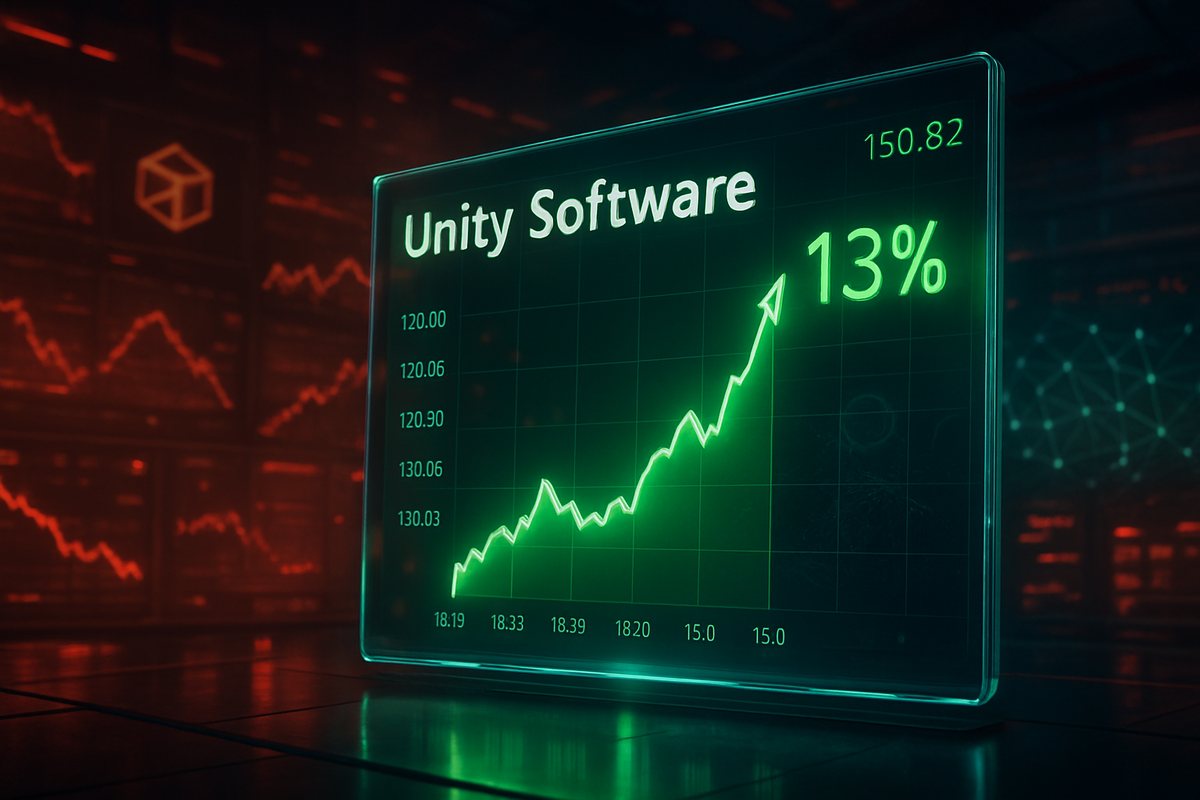
SAN FRANCISCO — In a trading session defined by geopolitical anxiety and broad-market liquidations, Unity Software (NYSE: U) emerged as a rare beacon of optimism on Friday, March 27, 2026. The real-time 3D development platform saw its shares rocket over 13%, currently trading near $19.64, after the company released preliminary first-quarter financial data that shattered its own previous guidance. The surge represents a dramatic reversal for a stock that had hit a 52-week low of $15.33 just days earlier, providing a "green shoot" for investors weathering a brutal "risk-off" environment in the wider technology sector.
The rally comes at a critical juncture for Unity, which has spent the better part of 2025 and early 2026 undergoing a painful structural "reset." By delivering a preliminary revenue range of $505 million to $508 million—comfortably beating its February guidance of $480 million to $490 million—Unity has signaled that its pivot toward AI-integrated advertising and lean operations is finally gaining traction. In a market where the Nasdaq Composite (NASDAQ: IXIC) plummeted more than 2% into technical correction territory, Unity’s double-digit gain stands out as a significant decoupling from the macro-driven sell-off.
A Strategic Pivot and a Profitability Powerhouse
The catalyst for Friday’s move was not just a revenue beat, but a massive upward revision in profitability. Unity projected adjusted EBITDA for the first quarter of 2026 to land between $130 million and $135 million, representing a staggering 58% year-over-year increase. This figure far outpaced the initial forecast of $105 million to $110 million, suggesting an EBITDA margin of 26%—four points higher than previously anticipated. The primary engine behind this outperformance is Unity Vector, the company’s AI-powered advertising platform, which reportedly saw 78% year-over-year growth as developers migrate toward automated, high-conversion ad solutions.
This financial turnaround follows a period of extreme volatility. In February 2026, Unity shares had cratered 25% in a single day following a lackluster earnings report that many analysts labeled "messy." Since then, CEO Matt Bromberg—who took the helm in May 2024—has moved aggressively to simplify the company's labyrinthine business model. Alongside the preliminary results, Unity announced it will sunset the ironSource Ads Network by April 30, 2026, and has hired advisors to divest Supersonic, its game publishing arm. These moves are designed to shed lower-margin legacy businesses and re-center Unity as a high-margin software and AI utility.
Initial market reactions were swift. Analysts at major firms noted that the sunsetting of ironSource, once considered a cornerstone of Unity's growth strategy under former leadership, is being viewed by the Street as "addition by subtraction." By removing the operational drag of the aging ad network and the capital-intensive publishing business, Unity is positioning itself as a "pure play" on the intersection of generative AI and the gaming engine economy.
Winners and Losers in the Shift to AI Ads
The primary winner of this week’s developments is undoubtedly Unity’s current leadership and long-term shareholders who maintained positions during the 60% year-to-date decline. Matt Bromberg’s "Clean Unity" strategy appears to be validated, providing him with the political capital within the firm to continue his aggressive restructuring. Conversely, the "losers" include short sellers who had piled into the stock as it touched multi-year lows, as well as stakeholders in the ironSource legacy ecosystem who now face a rapid wind-down of their primary platform.
In the competitive landscape, the ripple effects are being felt by AppLovin (NASDAQ: APP). While AppLovin has been the dominant force in the mobile ad-tech space for the past two years, the rapid ascent of Unity Vector suggests that Unity is clawing back market share in the high-end, AI-optimized ad segment. While AppLovin remains a formidable incumbent, Unity’s leaner structure may allow it to compete more aggressively on price and performance in the coming quarters. Meanwhile, smaller independent ad networks may find themselves squeezed as the industry consolidates around the massive data moats held by AI-first platforms like Unity and Meta Platforms (NASDAQ: META).
Navigating the Geopolitical Storm and Industry Trends
Unity’s surge is particularly remarkable given the dire macroeconomic backdrop of March 2026. The S&P 500 (NYSEARCA: SPY) fell 1.7% on Friday, marking its fifth consecutive weekly loss—the longest such streak in four years. Investors are currently grappling with an escalating conflict in the Middle East involving the U.S., Israel, and Iran, which has sent Brent crude oil prices soaring above $110 per barrel. The effective closure of the Strait of Hormuz has triggered an energy crisis that has historically been anathema to growth-oriented tech stocks.
Despite these headwinds, Unity fits into a broader industry trend of "profitable AI." After years of speculative spending on the "metaverse," the 2026 market is rewarding companies that can demonstrate immediate, cash-flow-positive applications of artificial intelligence. Unity Vector is a prime example, using AI to automate game authoring and ad targeting, turning what was once a manual, labor-intensive process into a high-margin software service. This mirrors the trajectory of other "comeback" stories in the sector where legacy software firms have successfully re-engineered their cores around generative models.
The Road Ahead: From Recovery to Resilience
Looking forward, Unity faces a short-term hurdle in the divestiture of Supersonic. The success of this sale will be a key indicator of management's ability to execute complex corporate actions in a high-interest-rate environment. Strategic pivots of this magnitude often come with integration risks and the potential for talent attrition, particularly as the company transitions away from its identity as a conglomerate and toward a specialized AI engine.
In the long term, the question remains whether Unity can sustain the 78% growth rate of its Vector platform. As competitors respond with their own AI-driven offerings, Unity must continue to innovate within its "Create" segment—the core engine used by developers—to ensure that the "Grow" segment (advertising) has a steady stream of high-quality content to monetize. The market will be watching the formal Q1 earnings call in May for more granular data on the Supersonic sale and the specific timeline for the ironSource sunset.
Final Assessment: A Turning Point for the Engine of Gaming
The 13% jump in Unity Software shares on March 27, 2026, serves as a poignant reminder that company-specific fundamentals can still triumph over even the most bearish macro environments. By exceeding revenue and EBITDA guidance during a period of global instability, Unity has proven that its restructuring is more than just corporate jargon—it is producing tangible financial results.
For investors, the key takeaway is that the "messy" era of Unity appears to be ending. Moving forward, the company will be judged on the purity of its margins and the adoption rate of its AI tools. While the broader market may remain under pressure from high oil prices and geopolitical conflict, Unity has established itself as a "self-help" story with significant upside potential if it can maintain its current trajectory. Investors should closely monitor the Supersonic bidding process and subsequent Q2 guidance for signs that this rally has true staying power.
This content is intended for informational purposes only and is not financial advice.