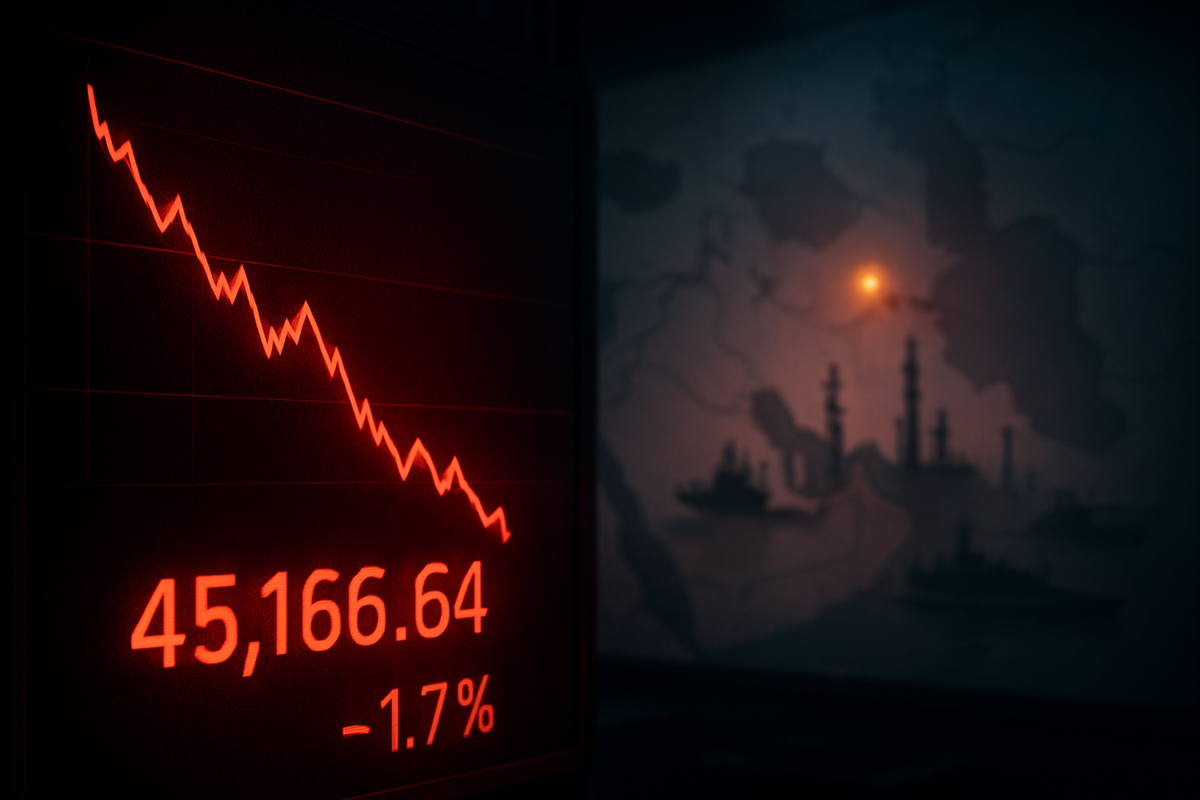
The Dow Jones Industrial Average (DJIA) officially entered correction territory on Monday, March 30, 2026, as a wave of geopolitical instability in the Middle East sent shockwaves through global financial hubs. Closing at 45,166.64, the blue-chip index fell 793 points, or 1.7%, marking a cumulative decline of 10.1% from the record highs established in mid-February. This technical milestone—defined as a 10% drop from a recent peak—reflects a sharp reversal from the optimistic "soft landing" narrative that dominated the market throughout much of 2025 and early 2026.
The immediate catalyst for the sell-off is the rapidly escalating conflict involving Iran and a U.S.-Israeli coalition, which has raised the specter of a prolonged energy crisis. With the Strait of Hormuz—a vital artery for 20% of the world's oil supply—now facing threats of a total blockade, investors have shifted into a defensive posture. The sudden transition from an "exhaustion rally" in January to a full-blown correction in March has left traders grappling with the dual threats of supply-chain disruptions and renewed inflationary pressure.
The Descent from the Peak: A Month of Volatility
The journey to correction territory began after the Dow reached a staggering peak near 50,250 in mid-February 2026. At that time, the market was buoyed by robust corporate earnings and the continued integration of artificial intelligence across the industrial sector. However, the mood soured as reports of "Operation Epic Fury"—a series of targeted strikes against Iranian leadership and military infrastructure—surfaced in late February. These actions, intended to neutralize regional threats and support the "Winter Uprising" internal civil unrest in Iran, instead triggered a multi-front retaliatory response that has drawn in proxy forces across the Middle East.
Throughout March, the market experienced a slow bleed that accelerated into a rout over the final week of the month. The timeline of the decline shows a clear correlation between the rising probability of a direct kinetic conflict and the erosion of investor confidence. While the Dow managed to hold key support levels in early March, the confirmed reports of retaliatory strikes on Gulf Cooperation Council (GCC) energy infrastructure proved to be the breaking point. The 793-point drop on March 30th is the culmination of a month-long realization that the "geopolitical discount" previously applied to markets was woefully inadequate.
Winners and Losers in a K-Shaped Correction
The current market correction is not affecting all sectors equally; instead, it has created a stark "K-shaped" divergence. The primary casualties of the 10% slide have been the high-flying technology and consumer discretionary sectors. Companies like NVIDIA (NASDAQ: NVDA) and Microsoft (NASDAQ: MSFT), which led the 2025 rally, have seen significant valuation compression as investors fret over the impact of higher energy costs on corporate margins and consumer spending. The tech-heavy Nasdaq has outpaced the Dow's decline, falling nearly 15% from its highs as the "risk-off" sentiment takes hold.
Conversely, the energy and defense sectors have emerged as the primary beneficiaries of the volatility. ExxonMobil (NYSE: XOM) and Chevron (NYSE: CVX) have seen their share prices surge as Brent Crude prices rocketed toward $120 per barrel following the latest developments in the Persian Gulf. Defense giants have also seen a spike in demand; Lockheed Martin (NYSE: LMT) and Northrop Grumman (NYSE: NOC) are trading near 52-week highs as governments worldwide accelerate procurement cycles in response to the Middle Eastern theater. For these "hard asset" and "contract-backed" companies, the correction in the broader index is a backdrop to their own localized bull market.
Wider Significance and Historical Precedents
The Dow’s fall into correction territory is more than just a technical statistic; it represents a fundamental shift in the global economic outlook for 2026. Analysts are drawing parallels to the 1990 Gulf War oil shock, where the market suffered a similar double-digit percentage decline following an unexpected disruption in Middle Eastern supply. The current situation, however, is complicated by a global economy that is already hyper-sensitive to inflationary trends. The prospect of "stagflation"—stagnant growth combined with high inflation—has moved from a fringe theory to a central concern for the Federal Reserve.
The ripple effects extend far beyond the United States. Emerging markets, particularly those dependent on energy imports, are seeing their currencies weaken against the dollar, which reached a two-year high today. Furthermore, the regulatory focus is likely to shift toward energy security and defense spending, potentially stalling legislative efforts aimed at environmental transitions or social programs. Historically, corrections triggered by geopolitical shocks tend to be shorter in duration than those caused by internal economic cycles, but they often require a definitive resolution to the conflict before a sustained recovery can begin.
What Comes Next: Support Levels and Strategic Pivots
As the Dow enters April 2026, market participants are looking for a potential floor. Technical analysts point to the 43,000 level as a crucial support zone where buying interest might stabilize the index. In the short term, the market will remain hostage to headlines from the Strait of Hormuz. Any sign of a de-escalation or a successful diplomatic intervention could spark a "relief rally," but most strategists are advising clients to remain positioned for continued volatility.
A strategic pivot toward "defensive value" is already underway. Institutional investors are rotating out of growth-oriented tech stocks and into high-yield utilities and consumer staples that can withstand an inflationary environment. There is also an emerging opportunity in the "rebuilding" sector; companies involved in logistics and energy infrastructure are being closely watched as potential leaders once the immediate conflict subsides. The primary challenge for the coming months will be the Federal Reserve's response: Will they prioritize fighting the energy-driven inflation spike, or will they pause rate hikes to prevent the correction from turning into a full-scale recession?
Wrapping Up the March 2026 Correction
The Dow's 1.7% drop on March 30 to close at 45,166.64 marks a sobering end to the first quarter of 2026. The 10% decline from February's peak serves as a reminder that geopolitical risks remain the ultimate "black swan" for global markets. While the energy and defense sectors have provided a hedge for some, the broader impact on consumer confidence and corporate profitability cannot be ignored. The "soft landing" that seemed so certain just two months ago is now under extreme duress.
Looking ahead, the market's trajectory will be defined by the duration and intensity of the Iran conflict. Investors should closely monitor the price of crude oil and the stability of global shipping lanes as leading indicators for the next leg of the market's journey. While a 10% correction is often a healthy part of a long-term bull market, the unique stagflationary pressures of 2026 suggest that the path back to 50,000 may be long and fraught with further volatility.
This content is intended for informational purposes only and is not financial advice.