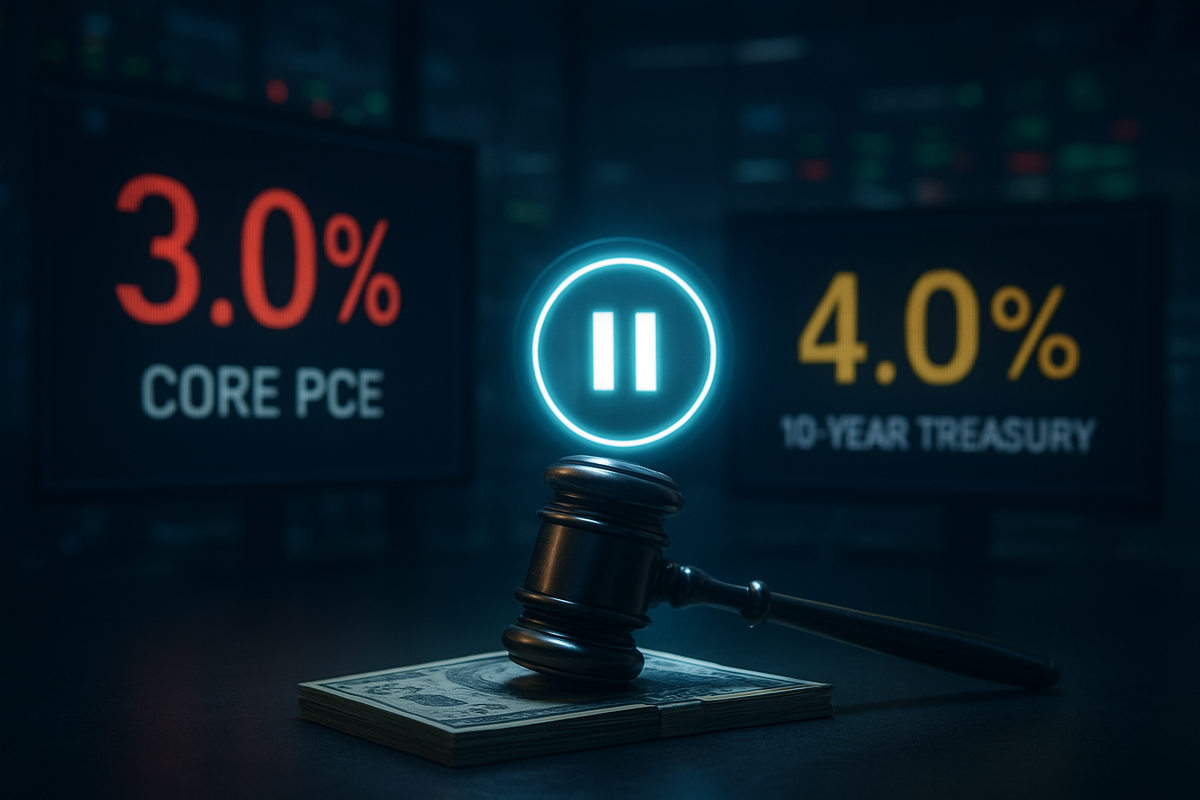
The Federal Reserve has officially hit the pause button on market optimism, electing to hold interest rates steady at a target range of 3.50%–3.75% during its March 2026 meeting. This decision comes as fresh economic data reveals a "sticky" inflation problem that refuses to dissipate, with the Core Personal Consumption Expenditures (PCE) price index—the Fed's preferred inflation gauge—climbing to a stubborn 3.0%. The move has sent shockwaves through Wall Street, effectively dismantling earlier projections of a rapid easing cycle and forcing investors to come to terms with a "higher-for-longer" reality that few had penciled into their 2026 playbooks.
The immediate implications of this hawkish stance are already being felt across the financial landscape. Market expectations, which began the year pricing in as many as four rate cuts, have been aggressively recalibrated to just one or two modest reductions, likely not appearing until the final months of 2026. This shift has propelled the 10-year Treasury yield toward the psychological 4% threshold, hitting a peak of 4.40% in late March. For high-growth equities, this surge in yields acts as a powerful gravity, compressing valuations and sparking a sell-off in the technology sector as the "risk-free" rate of return becomes increasingly attractive to institutional capital.
The March Mandate: Why the Fed Refused to Budge
The Federal Open Market Committee (FOMC) concluded its two-day policy meeting on March 18, 2026, with a unanimous vote to maintain the status quo. Federal Reserve Chair Jerome Powell, in a characteristically stern press conference, emphasized that while the economy remains resilient, the "last mile" of the inflation fight is proving to be the most difficult. The timeline leading to this moment began in late 2025, when a brief easing cycle sparked hopes of a "soft landing." However, a series of geopolitical shocks—most notably escalating tensions in the Middle East involving Iran and Israel—pushed Brent Crude prices toward $110 per barrel, reigniting inflationary pressures that had previously seemed contained.
The "sticky" nature of this inflation is not merely a result of energy costs; structural labor shortages and rising service-sector wages have created a floor under Core PCE that the Fed finds unacceptable. Internal projections, often referred to as the "dot plot," now show a significant hawkish tilt, with seven officials forecasting zero rate cuts for the entirety of 2026. This marks a stark contrast to the sentiment in January, when the consensus was that the Fed would be well into an easing cycle by mid-year. Key stakeholders, including Treasury Secretary Janet Yellen and various regional Fed presidents, have signaled that the risk of cutting too early and reigniting a 1970s-style inflationary spiral outweighs the risk of a moderate economic slowdown.
Initial market reactions were swift and unforgiving. As the news broke, the S&P 500 and the Nasdaq Composite saw immediate drawdowns, with tech-heavy indices bearing the brunt of the volatility. Fixed-income markets saw a massive repricing event, as traders who had bet on a spring pivot were forced to liquidate positions. The yield curve, which had begun to normalize, showed signs of deepening inversion in certain segments, reflecting a growing concern that the Fed’s commitment to 2% inflation might eventually necessitate a "hard landing" if growth begins to falter under the weight of sustained high rates.
Valuation Gravity: Winners and Losers in a High-Yield World
The most visible casualties of the Fed’s decision are the high-growth technology giants that have dominated the market narrative for years. NVIDIA (NASDAQ: NVDA), which had recently flirted with a historic $4 trillion market capitalization, saw its valuation come under intense pressure as the 10-year yield neared 4%. While demand for its next-generation Rubin AI chips remains robust, the higher discount rates used to value its future cash flows have led to a significant "valuation haircut." Similarly, Microsoft (NASDAQ: MSFT) and Apple (NASDAQ: AAPL) both slipped below the $3 trillion threshold in late March, as the cost of financing their massive AI data center expansions rose in tandem with interest rates.
On the other side of the ledger, the banking sector presents a more complex picture. JPMorgan Chase & Co. (NYSE: JPM) and Bank of America Corp. (NYSE: BAC) initially saw a boost in their Net Interest Income (NII) as the gap between what they charge on loans and what they pay on deposits widened. However, this "win" is tempered by the looming threat of reduced loan demand and a potential increase in credit defaults if the "higher-for-longer" environment persists. For now, large-cap banks are seen as a "quality" play, offering a defensive posture that speculative growth stocks lack.
Beyond the "Magnificent Seven," the impact is being felt acutely in the small-cap space. Companies within the Russell 2000, which are typically more dependent on floating-rate debt, are facing a squeeze on profit margins. Conversely, energy giants like Exxon Mobil (NYSE: XOM) are emerging as winners, not only because of the higher oil prices driving the "sticky" inflation but also because of their strong balance sheets and ability to return capital to shareholders via dividends—a feature that becomes more attractive when the broader market is characterized by uncertainty and volatility.
A Structural Shift: Rethinking the 2% Inflation Target
The current situation represents a broader shift in global economic trends that goes beyond a single Fed meeting. For nearly two decades, investors operated in an environment of "secular stagnation" characterized by low growth, low inflation, and near-zero interest rates. The events of March 2026 suggest that this era is firmly in the rearview mirror. The persistence of 3.0% Core PCE indicates that structural forces—such as de-globalization, the green energy transition, and a shrinking global workforce—are keeping price pressures higher than the pre-pandemic norm.
This event draws historical comparisons to the late 1970s, where the Fed’s failure to maintain a restrictive stance led to multiple "waves" of inflation. Today's FOMC appears determined to avoid that legacy, even at the cost of short-term market pain. The ripple effects are global; as the Fed holds rates high, the U.S. dollar has strengthened against the Euro and the Yen, exporting inflation to other regions and forcing central banks like the European Central Bank (ECB) to reconsider their own easing plans. This synchronized "hawkishness" is creating a challenging environment for multi-national corporations that must now navigate unfavorable currency translations alongside higher borrowing costs.
Regulatory and policy implications are also coming into focus. With interest rates remaining high, the cost of servicing the U.S. national debt is ballooning, potentially leading to a political showdown over fiscal spending in the coming election cycle. From an industry perspective, we are seeing a "shakeout" where only the most well-capitalized firms can afford to continue investing in capital-intensive technologies like generative AI. The era of "growth at any cost," fueled by zero-interest-rate policy (ZIRP), has been replaced by an era of "profitable growth" and fiscal discipline.
The Road to December: What Comes Next for the Markets?
Looking ahead to the remainder of 2026, the primary question for investors is whether the Fed can achieve its 2% target without triggering a recession. In the short term, volatility is likely to remain elevated as the market "digests" the new interest rate floor. We may see a strategic pivot from institutional investors away from high-beta growth stocks and toward "value" and "quality" factors. Companies that can demonstrate consistent free cash flow and low debt-to-equity ratios will likely outperform as the cost of capital remains a primary headwind.
In the long term, if inflation remains stuck at 3%, the Fed may be forced to make a difficult choice: either hike rates further to crush demand—risking a severe recession—or eventually accept a higher inflation target of 2.5% to 3.0% as the "new normal." While Chair Powell has repeatedly dismissed the latter option, the market is beginning to price in the possibility that the structural drivers of inflation are simply too powerful for monetary policy alone to overcome. Strategic adaptations will be required for businesses, particularly those in real estate and construction, which must now operate under the assumption that 4% to 5% mortgage rates are a permanent fixture.
Potential scenarios for the late-2026 cuts hinge almost entirely on the labor market. If unemployment begins to tick up significantly from its current historic lows, the Fed may find the political and economic cover to cut rates even if inflation remains slightly above target. However, if the labor market stays tight and consumer spending remains resilient, the "modest cuts" currently expected for December 2026 could easily be pushed into 2027. Investors should watch for a "no-landing" scenario, where the economy continues to grow at a healthy clip despite high rates, which would ironically keep the Fed from cutting at all.
Conclusion: The New Economic Baseline
The Federal Reserve’s decision to hold rates steady in March 2026 marks a definitive turning point in the post-pandemic recovery. By prioritizing the fight against 3.0% "sticky" inflation over the market's desire for liquidity, the Fed has established a new baseline for the cost of capital. The dream of a return to the low-rate environment of the 2010s has been deferred, if not permanently abandoned. For investors, the takeaway is clear: the era of easy money is over, and the era of "real returns" has begun.
Moving forward, the market will likely be characterized by a "K-shaped" recovery in valuations, where companies with strong earnings power and fortress balance sheets thrive, while those reliant on cheap debt struggle to stay afloat. The 10-year Treasury yield at 4% is no longer a temporary spike; it is an anchor that will keep equity valuations in check for the foreseeable future. Significance lies in the fact that the Fed has regained its credibility as an inflation fighter, but at the cost of a significant repricing of risk across all asset classes.
In the coming months, investors should keep a close eye on monthly PCE releases and labor market data. Any signs of "cooling" in the service sector could provide the first glimmer of hope for a late-year cut, but until the 3.0% inflation ceiling is broken, the Fed is likely to remain unmoved. The "higher-for-longer" mantra is no longer a warning—it is the reality of the 2026 financial landscape.
This content is intended for informational purposes only and is not financial advice.