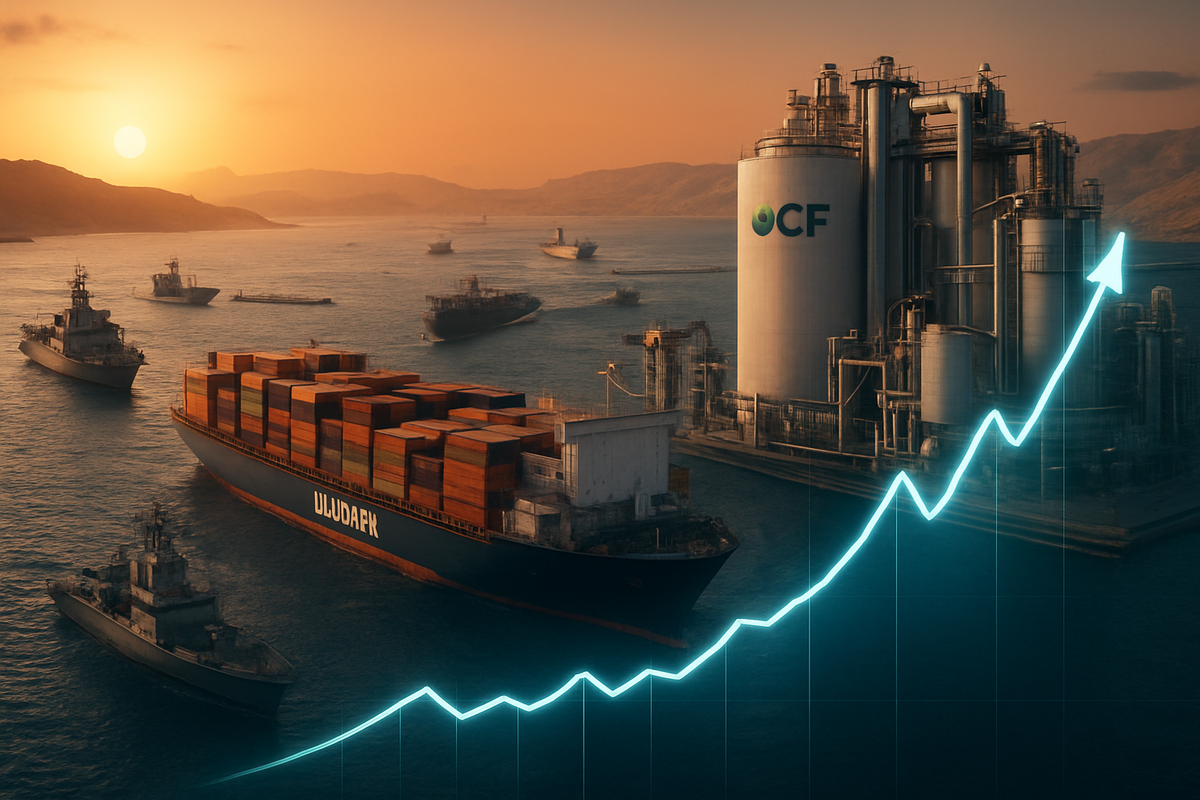
The global agricultural sector has been plunged into a state of high-alert following a dramatic escalation of geopolitical tensions in the Middle East, leading to the total closure of the Strait of Hormuz in late February 2026. This critical maritime chokepoint, through which roughly 25% of the world’s nitrogen fertilizer trade and nearly 50% of seaborne urea flow, has been effectively severed, creating an immediate and unprecedented supply shock. In the weeks since the blockade began, urea prices have gone parabolic, surging more than 50% to exceed $720 per metric ton, as buyers from Brazil to India scramble to secure dwindling inventories ahead of the spring planting season.
For North American producers, the crisis has catalyzed a massive financial windfall. Shares of CF Industries (NYSE: CF) have rallied an astonishing 60% from their 2025 lows, hitting record highs as investors bet on the company’s "North American Moat." Because CF Industries (NYSE: CF) produces nitrogen using domestically sourced natural gas—which has remained relatively stable compared to the astronomical spikes in global LNG prices—the company is capturing record margins. While international rivals are forced to curtail production due to lack of feedstock or maritime access, CF is operating at near-full capacity, effectively becoming the world’s "lender of last resort" for nitrogen.
The Blockade: A Timeline of the 2026 Nitrogen Shock
The current crisis, colloquially referred to by geopolitical analysts as "Operation Epic Fury," began in mid-February 2026 following a series of maritime skirmishes that led to a total naval blockade of the Strait of Hormuz. The impact on the fertilizer market was near-instantaneous. Unlike crude oil, which can occasionally be diverted via long-haul pipelines or redirected around the Cape of Good Hope, the nitrogen infrastructure in the Persian Gulf is specifically designed for direct vessel loading at massive coastal production hubs. With the Strait closed, production from the world’s lowest-cost exporters—including Qatar’s QAFCO, the UAE’s Fertiglobe, and Saudi Arabia’s SABIC—is effectively trapped in the Gulf.
The timeline of the shock has been remarkably compressed compared to previous market disruptions. By March 1st, global urea benchmarks had already jumped from $480 to $600 per ton. By mid-March, as the reality of a prolonged blockade set in, the New Orleans (NOLA) urea spot price surged 32% in a single week. Key exporting nations like Iran, which accounts for nearly 45% of Middle Eastern urea exports, have been completely removed from the global trade map. The resulting vacuum has left major agricultural economies like India, which sources nearly 80% of its ammonia from the Gulf, facing a catastrophic shortage that threatens national food security.
Winners and Losers in a Fragmented Market
The 2026 supply shock has created a stark divergence between producers with secure, low-cost feedstock and those exposed to global energy volatility. CF Industries (NYSE: CF) stands as the primary beneficiary of this landscape. With its production facilities located entirely in North America and the UK, the company is insulated from the physical blockade and the ensuing spike in global LNG prices. CF’s ability to utilize Henry Hub natural gas allows it to maintain production costs near $200 per ton, while its selling prices have skyrocketed toward $700, resulting in the widest profit margins in the company’s history.
In contrast, Yara International (OTC: YARIY) has faced significant operational headwinds. As a major European producer, Yara is hyper-exposed to European natural gas prices, which have climbed over 58% since the blockade began. This has forced the company to implement 25% production curtailments across its European fleet, as the cost of gas has made production economically unviable at several sites. Similarly, The Mosaic Company (NYSE: MOS) has seen extreme volatility; while phosphate prices are rising, Mosaic is struggling with the soaring cost of sulfur—a critical input for phosphate production—more than 50% of which typically passes through the Strait of Hormuz. Nutrien (NYSE: NTR) has also seen its shares rise roughly 20%, benefiting from its massive low-cost Canadian potash and U.S. nitrogen assets, though its gains have been more measured than the "pure-play" nitrogen surge seen by CF.
Wider Significance and the "Energy-Fertilizer-Food" Nexus
The 2026 nitrogen crisis is being compared to the 2022 shock following the invasion of Ukraine, but the structural implications are even more severe. The current event underscores the extreme vulnerability of the global food supply chain to a single maritime chokepoint. Regulatory responses have been swift; in the United States, the Department of Agriculture (USDA) has accelerated the "Homegrown Fertilizer Act," a legislative push to provide grants and low-interest loans to expand domestic production and storage. The goal is clear: decouple American agriculture from volatile Middle Eastern trade corridors.
However, the rapid price increases have also drawn the ire of regulators. In March 2026, the Department of Justice (DOJ) opened an inquiry into major producers including CF Industries (NYSE: CF) and Nutrien (NYSE: NTR) to investigate potential price-fixing in the wake of the 30% weekly price spikes. Meanwhile, the European Union has moved to temporarily suspend the Carbon Border Adjustment Mechanism (CBAM) for fertilizers to lower costs for struggling farmers, a move that highlights how food security concerns are currently overriding long-term climate policy goals.
What Lies Ahead: Strategic Pivots and Scenarios
In the short term, the market remains fixated on the duration of the Hormuz blockade. If the Strait remains closed through the end of the 2026 spring planting season, global crop yields could see a double-digit decline, leading to a secondary wave of food inflation in late 2026 and 2027. This has forced companies like CF Industries (NYSE: CF) to consider strategic pivots, such as accelerating their "Blue Ammonia" projects. CF’s Blue Point Complex in Louisiana is now being viewed not just as a green energy play, but as a critical component of domestic industrial security.
Long-term, the industry is likely to see a massive shift toward "regionalization." The era of relying on ultra-low-cost production from the Persian Gulf may be coming to an end as buyers prioritize reliability over price. We expect to see more joint ventures between major agricultural nations and North American producers to secure long-term supply contracts that bypass global chokepoints. For investors, the "gas spread"—the difference between U.S. natural gas prices and global nitrogen prices—will remain the most important metric to watch in the coming quarters.
Conclusion: A Lasting Impact on Global Markets
The 2026 nitrogen supply shock has fundamentally reordered the fertilizer sector, proving that in a world of geopolitical instability, logistical safety is as valuable as low-cost feedstock. CF Industries (NYSE: CF) has emerged as the definitive winner of this era, leveraging its North American position to achieve record-breaking financial performance while its global competitors struggle to keep plants running. The 60% rally in its stock price is a testament to the market's realization that the company sits on the "right side" of the current geopolitical divide.
Moving forward, investors should watch for any signs of a de-escalation in the Middle East, which could lead to a rapid "mean reversion" in urea prices. However, the regulatory landscape and the push for domestic production suggest that the premium placed on North American assets like those of CF and Nutrien (NYSE: NTR) is here to stay. As the 2026 planting season begins under a cloud of uncertainty, the ability of these companies to supply the world’s breadbaskets will remain the most critical story in the global commodity markets.
This content is intended for informational purposes only and is not financial advice.