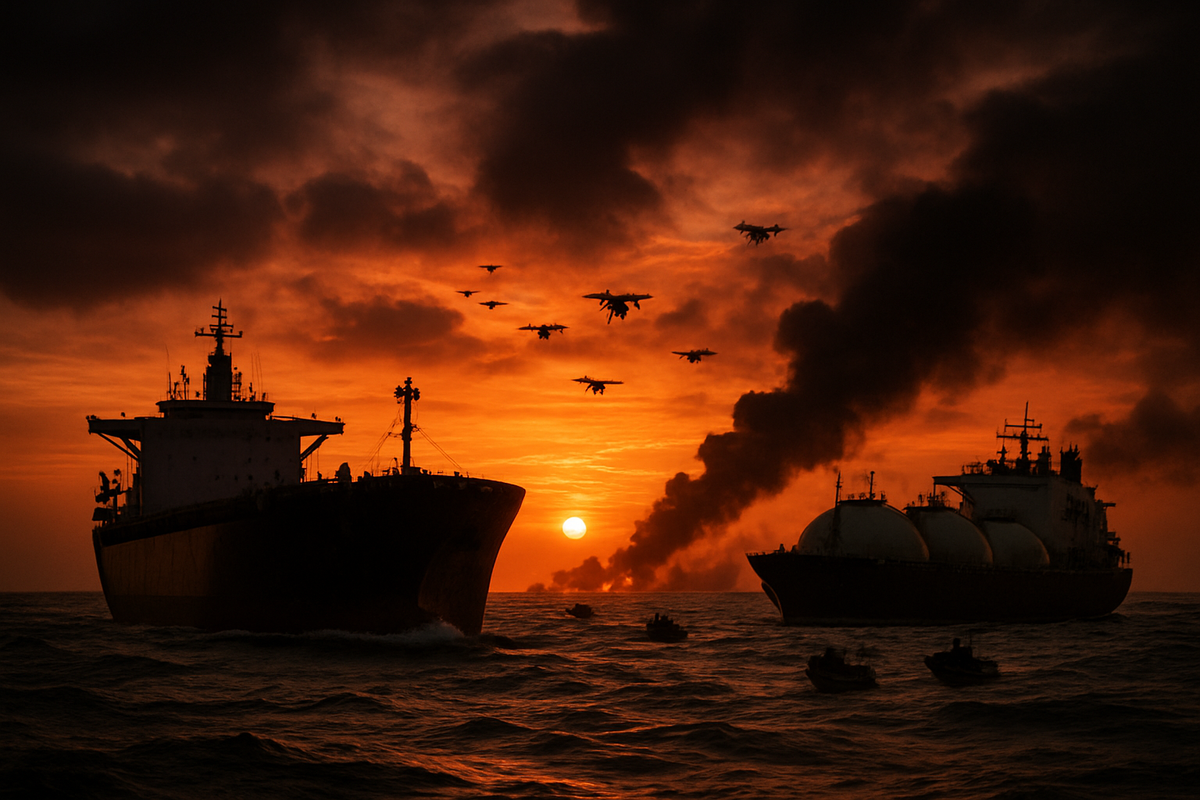
LONDON — Global energy markets are reeling today, March 30, 2026, as the "twin chokepoint" nightmare scenario has become a reality. The entry of Houthi rebels into a direct, active role in the broader Middle East conflict has effectively shuttered the world’s most critical maritime arteries. Following the de facto closure of the Strait of Hormuz by Iranian naval forces earlier this month, the Houthi leadership in Yemen signaled a dramatic escalation on March 28 by launching drone and missile strikes toward southern Israel and declaring the Bab el-Mandeb Strait a "restricted combat zone." This coordinated pressure on both the entrance to the Persian Gulf and the gateway to the Red Sea has sent shockwaves through the financial sector, as the risk of a systemic global supply chain collapse moves from theory to fact.
The immediate implications are staggering: Brent crude oil futures have surged to a two-year high of $126 per barrel, while the cost of insuring a single tanker transit—if a policy can even be secured—has skyrocketed to as much as 10% of the vessel's total value. For the first time in decades, the global economy is facing a simultaneous blockade of routes that collectively handle over 30% of the world's seaborne oil and nearly 20% of its Liquefied Natural Gas (LNG). With major carriers abandoning these waters in favor of the long journey around Africa's Cape of Good Hope, the "regional vulnerability" that analysts have warned about for years has finally cracked, leaving the market in a state of high-alert volatility.
A Perfect Storm: The March Escalation and the Fall of Shipping Traffic
The current crisis traces its immediate roots to the late February escalation of the "2026 Iran War," but it reached a fever pitch this week. Following a series of tactical strikes on regional assets, the Iranian government effectively rendered the Strait of Hormuz impassable for Western-flagged vessels. By March 15, shipping traffic through the Strait had collapsed by an estimated 95%, with daily transits falling from an average of 130 ships to fewer than ten. The Houthi rebels, long-standing allies of Tehran, chose this moment to expand their theater of operations. On March 28, the rebels confirmed their transition from localized maritime harassment to active belligerency, launching sophisticated long-range munitions at Israeli military infrastructure and vowing to sink any vessel supporting the "hostile coalition" in the Bab el-Mandeb.
The timeline of the last 14 days reveals a rapid descent into chaos. On March 10, three tankers were struck by sea mines near the Omani coast, prompting A.P. Moller - Maersk (CPH: MAERSK-B) to issue a blanket suspension of all Gulf transits. By March 20, QatarEnergy took the unprecedented step of declaring force majeure on its LNG shipments, halting deliveries to major hubs in Italy and South Korea. This move was prompted by an Iranian drone swarm that damaged the Ras Laffan gas facility, the crown jewel of Qatari exports. As of today, the maritime corridor is littered with "cancellation notices" from London-based insurers, who have largely withdrawn war-risk coverage for the Arabian Gulf, making commercial transit a logistical and financial impossibility for all but the most daring state-backed operators.
Market Winners and Losers: High Stakes in the Energy and Shipping Sectors
The fallout from the twin chokepoint crisis has created a sharp divide in the equity markets. Among the hardest hit are the European and Asian energy giants that rely heavily on Middle Eastern supply. Shell PLC (NYSE: SHEL) and BP (NYSE: BP) have seen their share prices experience wild swings; while they benefit from the higher spot price of oil, the logistical nightmare of rerouting their massive LNG fleets has incurred billions in additional operational costs. ExxonMobil (NYSE: XOM), which maintains a significant production footprint in Qatar and the UAE, has begun evacuating non-essential personnel and scaling back regional operations as its ability to move product out of the Gulf has effectively vanished.
Conversely, tanker companies are seeing record-breaking, albeit high-risk, premiums. Frontline PLC (NYSE: FRO) has reported VLCC (Very Large Crude Carrier) spot rates reaching nearly $460,000 per day for the alternative routes around the Cape of Good Hope. While the operational risk is extreme, the scarcity of available tonnage for the 14-day detour has created a windfall for owners of modern, fuel-efficient tankers. Similarly, Hapag-Lloyd (XETRA: HLAG) and other container giants have implemented "Emergency Conflict Surcharges" that have pushed the cost of shipping a 40-foot container from Shanghai to Rotterdam above $15,000, a level not seen since the supply chain crises of the early 2020s.
The Significance of the "Regional Vulnerability"
This event represents a fundamental shift in the geopolitical risk profile of the energy industry. For decades, the market operated under the assumption that the Strait of Hormuz could not be closed for more than a few days without a massive, market-stabilizing military intervention. However, the 2026 conflict has demonstrated that a combination of drone swarms, precision missiles, and sea mining can create a "soft blockade" that is just as effective as a physical one. This fits into a broader trend of asymmetric warfare where non-state actors like the Houthis can leverage relatively inexpensive technology to hold the world's most expensive trade routes hostage.
The ripple effects are already extending beyond energy. The semiconductor and automotive industries, which rely on the "just-in-time" delivery of components via the Red Sea, are bracing for a second wave of supply chain disruptions. This historical precedent mirrors the "Tanker War" of the 1980s, but with a critical difference: the scale of the world’s dependence on Middle Eastern LNG has grown exponentially. In the 80s, the focus was almost entirely on crude oil; in 2026, the potential for a prolonged LNG shortage threatens the electrical grids of Western Europe and the industrial heartlands of East Asia. Regulatory bodies are now being forced to reconsider the viability of the East-West pipeline bypasses, which are currently running at maximum capacity but remain vulnerable to Houthi missile range.
What Comes Next: A Strategic Pivot to the Cape
In the short term, the market must adjust to the Cape of Good Hope becoming the "new normal" for East-West trade. This strategic pivot adds roughly 3,500 nautical miles to each journey, a move that will keep global inflation elevated as fuel costs and transit times bake into the price of consumer goods. Strategic oil reserves in the U.S. and Europe are likely to be tapped in the coming weeks to prevent a total price melt-up, but these are temporary fixes for a structural geopolitical problem. The ultimate outcome hinges on whether a diplomatic solution can be reached to decouple the maritime security of the Straits from the broader regional war.
Looking further out, the "Twin Chokepoint" crisis will likely accelerate the global transition toward energy independence and the "near-shoring" of manufacturing. If the Middle East can no longer guarantee the safe passage of its primary exports, the premium for North American and Atlantic-basin energy will continue to grow. Investors should prepare for a period of sustained volatility and look for opportunities in domestic energy production and defense technology firms that specialize in counter-drone and maritime security systems.
Investor Wrap-Up: Navigating a New Era of Volatility
As we look toward the second half of 2026, the key takeaway is that the era of "safe passage" in the Middle East has ended. The entry of the Houthi rebels into the fray has proven that the Strait of Hormuz and the Bab el-Mandeb are no longer separate risks but a single, interconnected vulnerability. The market's ability to absorb this shock will depend entirely on how quickly the global shipping fleet can adapt to the longer, more expensive southern routes and whether regional powers can prevent the conflict from expanding into the infrastructure of the oil fields themselves.
For investors, the coming months will require a defensive posture. Watch for the monthly production reports from OPEC+ and the status of the East-West pipeline in Saudi Arabia, which is currently the only remaining, albeit limited, valve for Persian Gulf crude. The lasting impact of this March 2026 crisis will be a permanent "geopolitical premium" added to energy prices, as the world finally acknowledges that the chokepoints of the past are the flashpoints of the future.
This content is intended for informational purposes only and is not financial advice.