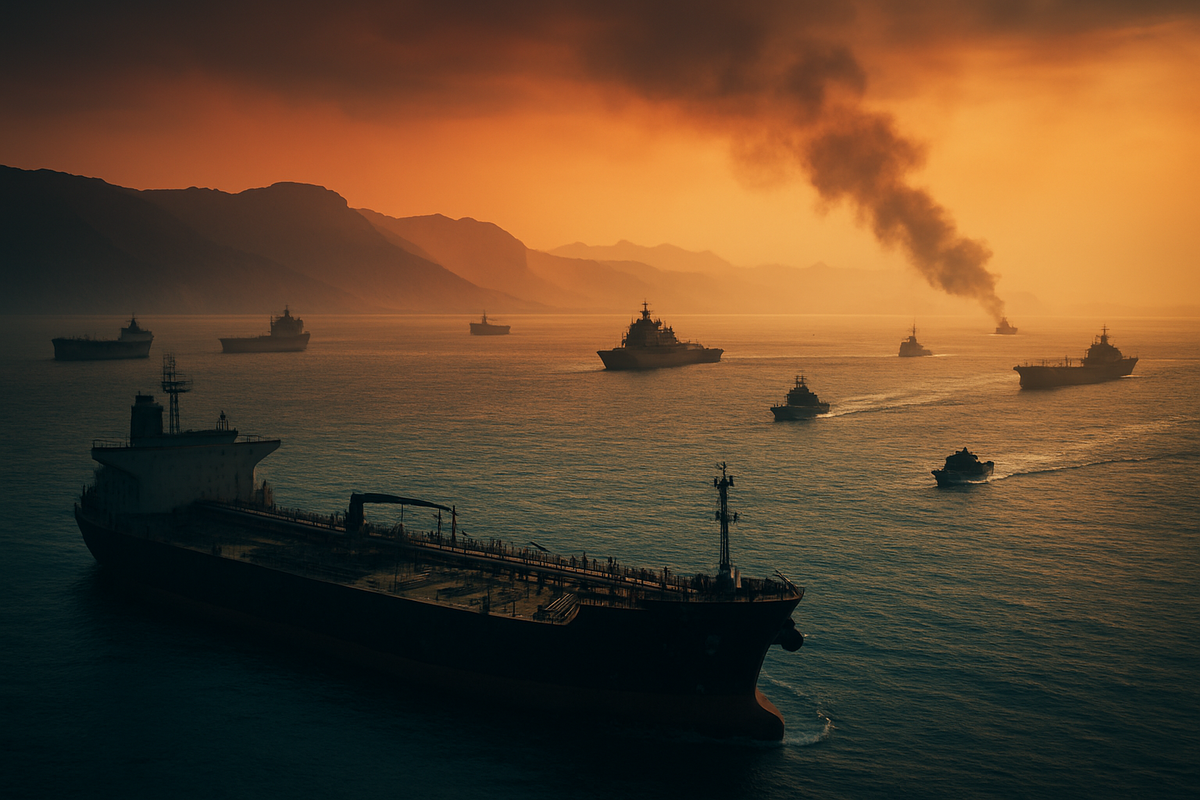
The global energy landscape is currently facing its most severe crisis in decades following the escalation of military hostilities in the Persian Gulf. As of March 5, 2026, the Strait of Hormuz—the world’s most critical maritime chokepoint—has become a de facto closed corridor for commercial shipping. This geopolitical flashpoint, which facilitates the transit of approximately 20.5 million barrels of oil per day, or roughly 20% of global consumption, is now the epicenter of a direct military confrontation between Iran and a coalition led by the United States and Israel.
The immediate implications for the global economy are profound. Brent crude prices, which were trading near $72 per barrel in late February, have surged to over $84 per barrel in just five days of trading. Beyond the immediate price spike, the withdrawal of insurance coverage for vessels in the region and the implementation of massive "war-risk" surcharges by major shipping lines have effectively paralyzed the flow of crude and Liquified Natural Gas (LNG) from the Gulf, sparking fears of a systemic inflationary shock that could derail the global recovery.
A Decisive Escalation: From Shadow War to Direct Conflict
The current crisis traces its roots to the collapse of the Geneva nuclear negotiations in early 2025, which failed to reach a consensus on Iranian enrichment limits. Tensions reached a breaking point in June 2025 during the "Twelve-Day War," after Israel launched "Operation Rising Lion" against Iranian nuclear facilities. While a fragile ceasefire held through the winter, the situation deteriorated rapidly on February 28, 2026, when joint U.S. and Israeli forces launched "Operation Epic Fury," a massive targeted strike against Iranian missile infrastructure and command centers in response to a series of high-profile drone attacks on regional shipping.
The fallout was instantaneous. Within hours of the strikes, the Iranian Revolutionary Guard Corps (IRGC) announced that the Strait of Hormuz was "no longer a safe passage for those who support aggression." While the waterway has not been physically blocked by a naval "chain," the threat of anti-ship missiles and mine-laying operations has driven commercial traffic to a standstill. Major Protection and Indemnity (P&I) clubs, the mutual insurers that cover the vast majority of the world's shipping, have officially suspended coverage for any transit through the Strait, making it economically impossible for most tankers to operate.
Key stakeholders, including the International Energy Agency (IEA) and OPEC+ leadership, have called for emergency meetings to address the sudden loss of supply. While Saudi Arabia possesses an East-West Pipeline capable of bypassing the Strait, its capacity is limited to roughly 7 million barrels per day—far short of the 20 million barrels currently "trapped" within the Gulf. Furthermore, 90% of the world’s spare oil production capacity is located within the Gulf nations, meaning the market’s primary safety net is currently inaccessible to the global fleet.
Market Divergence: Winners and Losers in the Conflict Zone
The sudden supply vacuum has created a sharp divergence in the performance of public companies. Domestic U.S. oil producers have been the primary beneficiaries as markets scramble for non-Middle Eastern supply. ExxonMobil (NYSE: XOM) and Chevron (CVX: NYSE) both reached 52-week highs this week, buoyed by their significant exposure to the Permian Basin, which remains insulated from the geographical risks of the Middle East. Similarly, independent shale giants like Occidental Petroleum (NYSE: OXY) and Diamondback Energy (NASDAQ: FANG) have seen double-digit percentage gains as investors bet on prolonged high prices and a shift toward Western-sourced crude.
In the shipping sector, the impact has been more volatile. While A.P. Møller - Mærsk A/S (CPH: MAERSK-B) and Hapag-Lloyd AG (ETR: HLAG) initially saw their stock prices rise on expectations of higher freight rates, the reality of the blockade has introduced significant "network pain." Hapag-Lloyd announced a $1,500 per container war-risk surcharge on March 3, 2026, to offset the astronomical costs of rerouting vessels around the Cape of Good Hope. However, the loss of direct access to major ports like Jebel Ali and the suspension of 20% of global LNG trade—much of it from Qatar—is expected to weigh heavily on their long-term operating margins.
On the losing side, global airlines and logistics providers are reeling from the spike in jet fuel costs. Carriers such as Delta Air Lines (NYSE: DAL) and United Airlines Holdings (NASDAQ: UAL) have already seen their shares dip by more than 8% this week as fuel-hedging strategies are tested by the sudden volatility. Conversely, oilfield service providers like Baker Hughes (NASDAQ: BKR) and SLB (NYSE: SLB) are experiencing an uptick in demand as producers in South America and West Africa accelerate drilling programs to fill the gap left by the Iranian blockade.
Wider Significance and Historical Context
This event marks a fundamental shift in the "energy security" paradigm that has governed the markets since the 1980s. Historically, the "Tanker War" of the late 1980s saw significant disruption, but the presence of the U.S. Navy's Fifth Fleet usually ensured the continued flow of commerce. The 2026 crisis is different in scale and technological complexity, with the widespread use of autonomous "suicide" drones and precision-guided missiles making naval escorts far more difficult and costly to maintain.
The broader industry trend toward "de-risking" energy supply chains is expected to accelerate. Analysts at Goldman Sachs suggest that this event may be the final catalyst for a permanent shift in global capital toward the Atlantic Basin (the Americas and West Africa) and away from the volatile Middle East. This movement echoes the 1973 oil embargo, which fundamentally changed Western energy policy for a generation, but this time it coincides with the global push toward renewables, potentially accelerating the transition to electrification as nations seek to escape the "Hormuz Trap."
Regulatory and policy implications are also looming. The U.S. Department of Energy is reportedly considering a massive release from the Strategic Petroleum Reserve (SPR), though experts warn that the SPR’s current levels are already low following previous interventions. In Europe, the crisis has reignited debates over the longevity of internal combustion engines, with policymakers in Berlin and Paris under pressure to speed up the roll-out of EV charging infrastructure to mitigate the impact of $5-per-gallon gasoline.
The Road Ahead: Scenarios for 2026
The short-term outlook depends entirely on the duration of the blockade. If the U.S.-led coalition can successfully suppress Iranian missile sites and restore maritime security within the next four weeks, Brent prices may stabilize in the $90 range. However, if the conflict enters a prolonged stalemate, most analysts predict a "super-spike" scenario where oil could reach $150 or even $180 per barrel by mid-summer, almost certainly triggering a global recession.
Market participants should prepare for a period of extreme volatility and a potential "Force Majeure" epidemic. Many long-term supply contracts for both oil and LNG are likely to be declared void due to the impossibility of transit, leading to a legal quagmire in international trade courts. Strategic pivots will be required from energy-intensive industries; we may see a resurgence in domestic coal or nuclear power generation in regions like China and India, which are particularly vulnerable to a cutoff of Gulf energy imports.
Conclusion and Investor Outlook
The crisis in the Strait of Hormuz is not just a regional conflict; it is a systemic shock to the plumbing of the global economy. The event has highlighted the extreme vulnerability of the world’s dependence on a single 21-mile-wide waterway. As we move into the second quarter of 2026, the primary takeaways are the renewed dominance of U.S. shale as a "safe haven" and the stark reality that energy security can no longer be taken for granted.
Moving forward, the market will be hyper-sensitive to any news regarding naval escort success or diplomatic backchannels. Investors should keep a close eye on the weekly inventory reports and the capital expenditure announcements of non-OPEC producers. While the current prices offer a windfall for certain energy stocks, the broader threat of a systemic economic slowdown remains the greatest risk. For now, the world waits to see if the Strait will remain a closed door or if a path to de-escalation can be found before the global economy begins to buckle under the pressure of $85+ oil.
This content is intended for informational purposes only and is not financial advice.