On March 5, 2026, retail giant Costco Wholesale Corporation (NASDAQ: COST) released its fiscal second-quarter earnings, once again silencing skeptics who questioned whether the warehouse club could maintain its momentum. The company reported a significant beat on both the top and bottom lines, driven by a surge in digital sales and unwavering membership loyalty. Despite the stellar performance, the report has reignited a fierce debate on Wall Street regarding Costco's "nosebleed" valuation, as the stock continues to trade at a staggering 50x price-to-earnings (P/E) multiple—a level typically reserved for high-growth Silicon Valley tech firms rather than big-box retailers.
The immediate implications of the Q2 report are two-fold: it reinforces Costco's status as the "gold standard" of consumer staples, but it also raises the stakes for the company to deliver flawless execution. With the stock up more than 16% year-to-date in early 2026, investors are increasingly paying a "quality tax" to hide out in Costco’s defensive fortress. The earnings beat suggests that the company’s 2024 membership fee hike has been fully digested by consumers, providing a massive cushion of recurring high-margin revenue that allows the retailer to keep prices low even as global supply chain pressures linger.
A Masterclass in Membership-Driven Growth
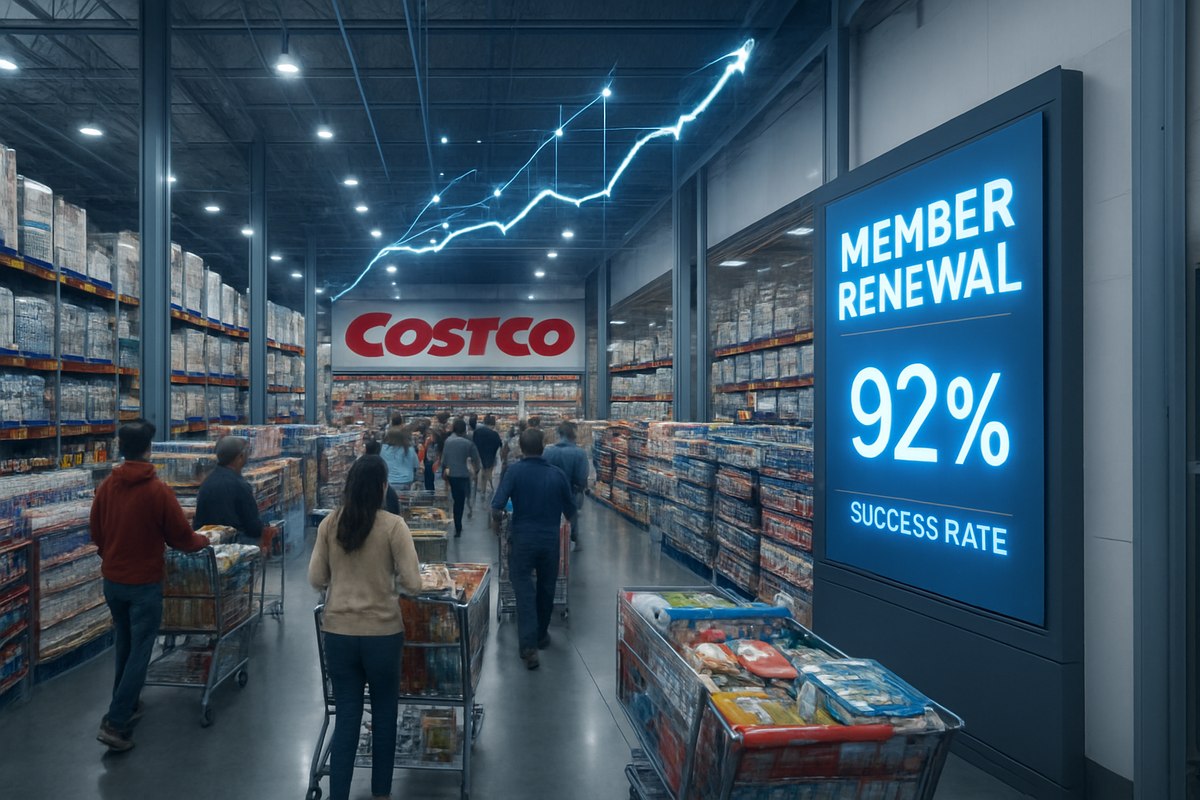
Costco’s fiscal Q2 2026 results were characterized by strength across every major vertical. Total revenue climbed 9.2% to $69.60 billion, comfortably ahead of analyst projections. The true engine of this growth remains the membership model; fee income rose 13.6% to $1.355 billion, a direct result of the membership price increase implemented in late 2024. More impressively, the company managed to grow its paid member base to 82.1 million, proving that the value proposition of the warehouse club remains irresistible even in an era of tightening household budgets. Renewal rates held steady at a near-record 92.1% in the U.S. and Canada, underscoring a level of customer stickiness that few brands in history have ever achieved.
The timeline leading up to this quarter has been one of tactical expansion and digital acceleration. Over the past 12 months, Costco has aggressively pushed into international markets, which paid off handsomely this quarter with international comparable sales surging 13.0%. Furthermore, the retailer’s "digitally-enabled" sales—long considered a weak point for the company—jumped 22.6%. This digital transformation is no longer a side project; it has become a central pillar of the Costco bull case, as the company successfully integrates big-ticket e-commerce items and enhanced delivery options into its ecosystem.
Market reaction was swift, with the stock ticking higher in after-hours trading as investors processed a diluted earnings per share (EPS) of $4.58. This figure comfortably beat the $4.55 consensus and represented a 14% increase over the $4.02 reported in the same quarter of the previous year. For stakeholders, ranging from institutional pension funds to retail "Costco-holics," the message was clear: the "stack-it-high and sell-it-cheap" philosophy is evolving into a sophisticated, data-driven subscription machine that shows no signs of slowing down.
Retail Rivals and the Valuation Divide
While Costco sits atop the mountain, the landscape for its competitors is a study in contrasts. Walmart Inc. (NYSE: WMT) remains the primary challenger, having recently crossed the historic $1 trillion market capitalization threshold. Walmart’s massive scale and focus on its own "Plus" membership have allowed it to keep pace with Costco's stock performance in 2026. However, Walmart trades at a more modest 40x P/E ratio, making it the preferred choice for value-conscious institutional investors who are wary of Costco's 50x multiple. Walmart wins when it can capture the lower-income demographic that Costco often misses, but it continues to trail in per-store productivity.
Target Corporation (NYSE: TGT) has emerged as the "rebound winner" of early 2026. After several years of inventory mismanagement and rising theft concerns, Target has seen its stock rally 40% over the last three months. Trading at a bargain-basement 15x P/E, Target is attracting investors who believe the broader retail sector is oversold. While it does not offer the same membership moat as Costco, its focus on "affordable luxury" and high-margin apparel puts it in a unique position to win back the suburban shopper. Meanwhile, BJ's Wholesale Club Holdings, Inc. (NYSE: BJ) remains the "deep value" play in the warehouse space, trading at 23x earnings. Despite its lower valuation, BJ’s 1.6% comparable sales growth this quarter highlighted the widening gap between the industry leader and its smaller imitators.
The disparity in valuations suggests that the market is no longer treating these companies as part of the same asset class. Costco is being priced as a "forever hold" compounder, while Target and BJ's are viewed through the lens of traditional retail cycles. For Costco, the risk is that any slight miss in membership growth could lead to a massive de-rating of the stock. For Target and BJ’s, the opportunity lies in closing the "execution gap" and proving that they too can generate the kind of predictable, subscription-like cash flows that have made Costco a market darling.
The Significance of the 'Staple-Tech' Hybrid
Costco's current trajectory fits into a broader industry trend where traditional consumer staple companies are being revalued as technology-enabled service providers. Historically, retailers traded at 15x to 25x earnings. However, the market’s willingness to pay 50x for Costco reflects a fundamental shift in how investors perceive risk. In a volatile 2026 economy, Costco’s membership fees act as a synthetic bond, providing guaranteed income regardless of whether a customer buys a rotisserie chicken or a $5,000 diamond ring. This "recession-proof" moat has turned the stock into a defensive proxy, essentially a "flight-to-safety" asset that behaves more like a utility than a store.
The ripple effects of Costco’s success are being felt across the supply chain. Partners and vendors are increasingly desperate for shelf space in Costco’s limited-SKU warehouses, giving the retailer unprecedented bargaining power to keep inflation at bay for its members. This pressure on suppliers ensures that Costco remains the low-price leader, further reinforcing its competitive advantage. From a regulatory standpoint, Costco’s focus on high employee wages and organic growth has largely kept it out of the crosshairs of antitrust or labor activists, a sharp contrast to some of its larger peers who face constant scrutiny.
Comparing 2026 to historical precedents, many analysts point to the "Nifty Fifty" era of the 1970s, where a handful of blue-chip stocks traded at astronomical multiples because they were perceived as "one-decision" stocks (you buy and never sell). While Costco’s fundamentals are significantly stronger than those 1970s outliers, the 50x P/E ratio remains a historical anomaly. The broader significance lies in whether Costco can grow into this valuation through its digital pivot and international expansion, or if it will eventually fall victim to the law of large numbers.
Looking Ahead: The Path to $500 Billion and Beyond
In the short term, the primary catalyst for Costco will be the potential for another special dividend. With a cash pile of approximately $17.4 billion, management has the firepower to reward shareholders, a move that would likely floor the stock's price and support the current valuation. Strategically, the company is expected to lean harder into its "Costco Next" program, which allows members to buy directly from vendors at discounted rates, further expanding the digital ecosystem without the need for massive new warehouse investments.
However, challenges are emerging on the horizon. As Costco reaches saturation in the U.S. market, the pressure to succeed in volatile international markets like China and Southeast Asia will intensify. These markets offer immense growth potential but come with higher geopolitical and operational risks. Furthermore, if the Federal Reserve begins to aggressively cut rates later in 2026, the "flight-to-safety" trade that has propped up Costco’s 50x P/E may unwind as investors rotate back into higher-risk, high-growth tech stocks.
The long-term scenario for Costco involves its transition into a truly global omnichannel powerhouse. If the company can maintain its 20%+ e-commerce growth rate while keeping renewal rates above 90%, it may well justify its premium valuation. Investors should watch for any signs of "subscription fatigue" or a slowdown in executive membership upgrades, as these are the leading indicators of the company’s future health.
The Verdict for Investors
Costco’s fiscal Q2 2026 performance was nothing short of a victory lap. By beating earnings expectations and demonstrating robust growth in its digital and international segments, the company has proven that its business model is as resilient as ever. The core takeaway is that Costco is no longer just a retailer; it is a global membership club that happens to sell groceries and electronics. Its ability to generate over $1.3 billion in pure profit from fees alone provides a level of financial stability that few companies on the planet can match.
As the market moves forward, the "quality vs. price" debate will continue to dominate the narrative around (COST). While the 50x P/E ratio is undeniably expensive by historical standards, it reflects the market’s belief that Costco is the ultimate safe haven in an uncertain world. Investors should keep a close eye on membership trends and the pace of international warehouse openings in the coming months. For those already holding the stock, the Q2 results offer every reason to stay the course, but for those on the sidelines, the search for a cheaper entry point remains a game of patience.
This content is intended for informational purposes only and is not financial advice