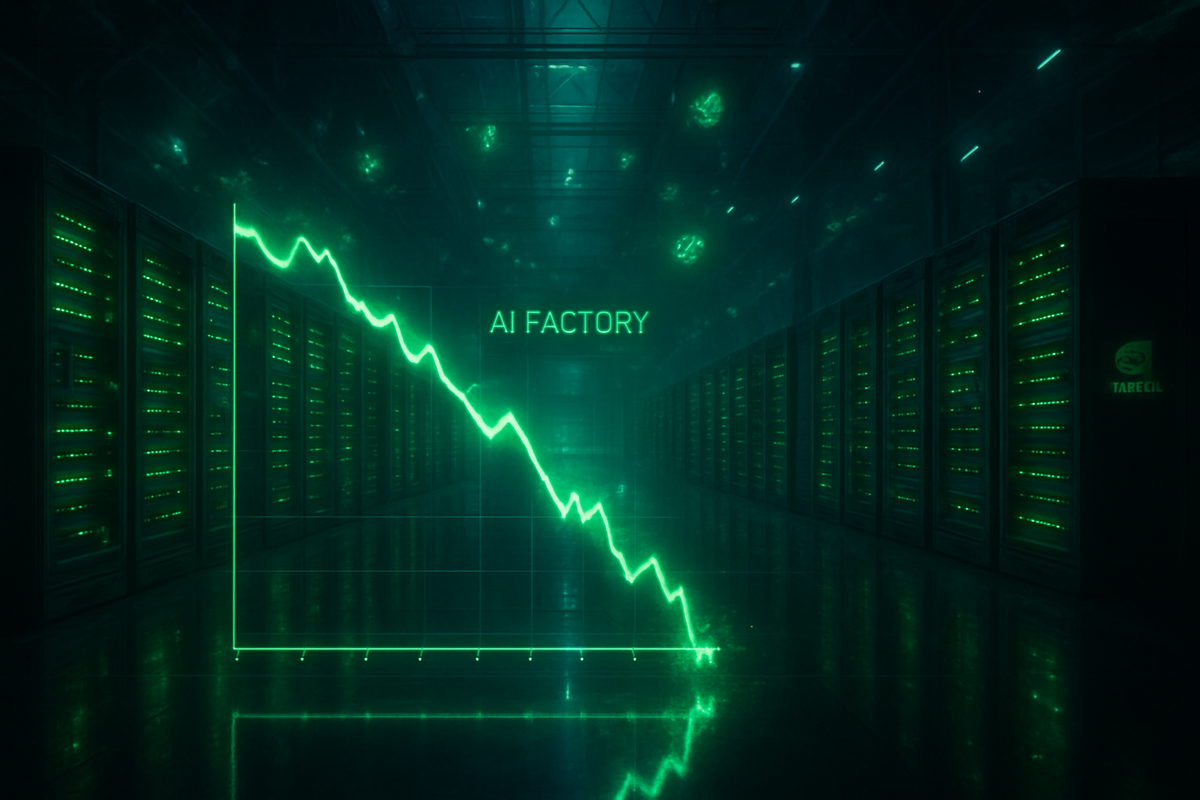
Despite delivering a staggering "blowout" fourth-quarter earnings report that exceeded even the most bullish Wall Street forecasts, NVIDIA (NASDAQ: NVDA) has found itself navigating a period of intense volatility. In the days following its February 25, 2026, financial disclosure, the semiconductor giant witnessed a sharp 14.2% decline from its post-earnings peak to a trough reached on March 2. This unexpected "sell the news" reaction has left investors questioning whether the artificial intelligence (AI) gold rush is entering a more skeptical phase, even as the company's fundamentals remain historically strong.
The immediate implications of this volatility are being felt across the broader technology sector, as the "NVIDIA effect"—which has traditionally lifted the entire market—showed signs of decoupling. While CEO Jensen Huang used his post-earnings platform to promote a futuristic vision of "AI factories" as the backbone of a new industrial revolution, the market's focus shifted abruptly toward geopolitical risks and the mounting pressure on major cloud providers to prove the profitability of their massive infrastructure investments.
The Post-Earnings Paradox: Records Met with Retreat
On February 25, 2026, NVIDIA reported record-breaking fourth-quarter revenue of $68.1 billion, a 73% increase year-over-year, driven primarily by its powerhouse Data Center segment which alone generated $62.3 billion. Earnings per share (EPS) landed at $1.62, comfortably beating the consensus estimate of $1.52. More impressively, the company issued forward guidance for the first quarter of fiscal 2027 at $78 billion, a figure that sat nearly $6 billion above analyst expectations. Initially, the market cheered, pushing shares to an all-time intraday high of approximately $212.19 in the hours following the announcement.
However, the euphoria was short-lived. By the following morning, a wave of profit-taking initiated a cascade that saw the stock price tumble. Over the next four trading sessions, NVIDIA shares shed over $30 in value, hitting a trough of $182.05 by March 2. This 14.2% correction was accelerated by a confluence of technical and external factors, including the stock breaking below its 50-day moving average, which triggered algorithmic selling. Stakeholders, ranging from institutional hedge funds to retail investors, were forced to reconcile the company’s flawless execution with a deteriorating macroeconomic backdrop.
The timeline of the decline coincided with escalating military strikes in the Middle East, which sent oil prices higher and reignited dormant fears of global inflation. This geopolitical friction provided the catalyst for a broader market rotation out of high-multiple growth stocks. While Huang’s rhetoric during the Morgan Stanley Technology Conference on March 4 remained defiant—emphasizing that the world is in the midst of a "fantastic" supply scarcity—the market's initial reaction was one of caution rather than conviction.
Winners, Losers, and the 'AI Scare Trade'
The recent volatility in NVIDIA has created a ripple effect among its primary customers and competitors. The "hyperscalers"—Microsoft (NASDAQ: MSFT), Amazon (NASDAQ: AMZN), and Meta Platforms (NASDAQ: META)—are currently viewed through a lens of intense scrutiny. While these companies remain "winners" in terms of their early access to NVIDIA’s latest Blackwell and Vera Rubin architectures, they are also under pressure to show that their $650 billion in planned capital expenditure for 2026 will yield tangible returns. A sustained dip in NVIDIA’s stock often reflects a fear that these giants might eventually hit a "capex air pocket" and slow their chip purchasing.
In the software sector, companies like ServiceNow (NYSE: NOW) and Salesforce (NYSE: CRM) have become the center of what analysts call the "AI Scare Trade." Concerns that AI "agents" might replace the traditional per-seat licensing models led to a synchronized sell-off in enterprise software alongside NVIDIA’s dip. If AI can do the work of ten people, investors worry that software revenues tied to headcount will shrink. Conversely, Advanced Micro Devices (NASDAQ: AMD) and Taiwan Semiconductor Manufacturing Company (NYSE: TSM) are attempting to position themselves as beneficiaries of any potential shift toward more cost-effective or diverse hardware ecosystems, though they remain heavily tied to the overall sentiment of the AI sector.
The New Industrial Revolution and the ROI Question
NVIDIA’s current struggle fits into a broader industry trend where the narrative is shifting from "AI potential" to "AI productivity." Jensen Huang’s recent focus on "AI factories" is a strategic move to frame data centers as revenue-generating assets rather than mere cost centers. By comparing the current era to the first Industrial Revolution, Huang is arguing that "tokens" are the new electricity. However, the market is currently grappling with a "historical precedent" problem: the build-out phase of major technological shifts (like the fiber-optic boom of the late 1990s) often precedes a period of painful consolidation before the true utility is realized.
Regulatory and policy implications are also weighing on the sector. As NVIDIA’s chips become essential national infrastructure, potential export controls and antitrust scrutiny remain persistent shadow risks. The recent 14% drop highlights how sensitive the "AI trade" has become to external shocks. When geopolitical tensions rise, the highly concentrated nature of the AI supply chain—centered largely on a few firms and specialized manufacturing hubs—creates a volatility profile that can deviate wildly from a company's actual earnings growth.
Looking Ahead: The GTC Catalyst and Beyond
The short-term trajectory for NVIDIA will likely be dictated by the upcoming GTC 2026 conference, scheduled for March 16-19. Historically, this "Woodstock of AI" serves as a major catalyst for the stock, with the market expecting deep dives into the next-generation Vera Rubin architecture and new software services. If NVIDIA can demonstrate that its customers are successfully monetizing AI at scale, it could trigger a rapid recovery toward the $300 price targets recently set by firms like Bank of America and Citi.
In the long term, the company faces the challenge of maintaining its dominance as the industry pivots toward "tokens per watt" as the primary metric for success. As power constraints become the ultimate bottleneck for data center expansion, NVIDIA's ability to innovate in energy efficiency will be just as important as raw computing power. Strategic adaptations may involve deeper integrations into the power grid and liquid cooling technologies, areas where NVIDIA is already seeking to expand its footprint.
Market Wrap-Up: A Test of Conviction
The 14% peak-to-trough decline in NVIDIA stock despite a stellar Q4 report serves as a stark reminder that even the most successful companies are not immune to market sentiment and macroeconomic headwinds. The core takeaway for investors is that the "easy money" phase of the AI rally has likely transitioned into a more disciplined "show-me" phase. While the demand for AI infrastructure remains robust, the market is no longer willing to ignore the risks of geopolitical instability and the eventual normalization of growth rates.
Moving forward, the market will be closely watching the Capital Expenditures (CapEx) reports of the "Magnificent Seven" and any signs of cooling in the enterprise software space. For NVIDIA, the focus remains on the transition to "AI factories" and whether this vision can convince skeptics that the massive spending on GPUs will result in a sustainable new economy. Investors should maintain a close eye on the GTC conference and mid-month economic data, as these will likely determine if the March dip was a buying opportunity or the beginning of a larger structural shift in tech valuations.
This content is intended for informational purposes only and is not financial advice.